How effective is your business website? Are you keeping customers on your site and generating lots of sales and leads or have you gone overboard on the design or crammed far too much in?
In today’s digital age, a business website is often the first point of contact between a company and its potential customers. Whether you run a small startup or a well-established corporation, having an effective business website is crucial for success.
Your website is like a virtual storefront, and just like a physical store, it needs to be inviting, informative, and easy to navigate. To help you achieve this, here are 10 rules you must follow for a more effective business website.
If your website is struggling and you’re looking for ways to improve results take a look at the infographic below from Digivate which gives you 10 key principals of effective website design.
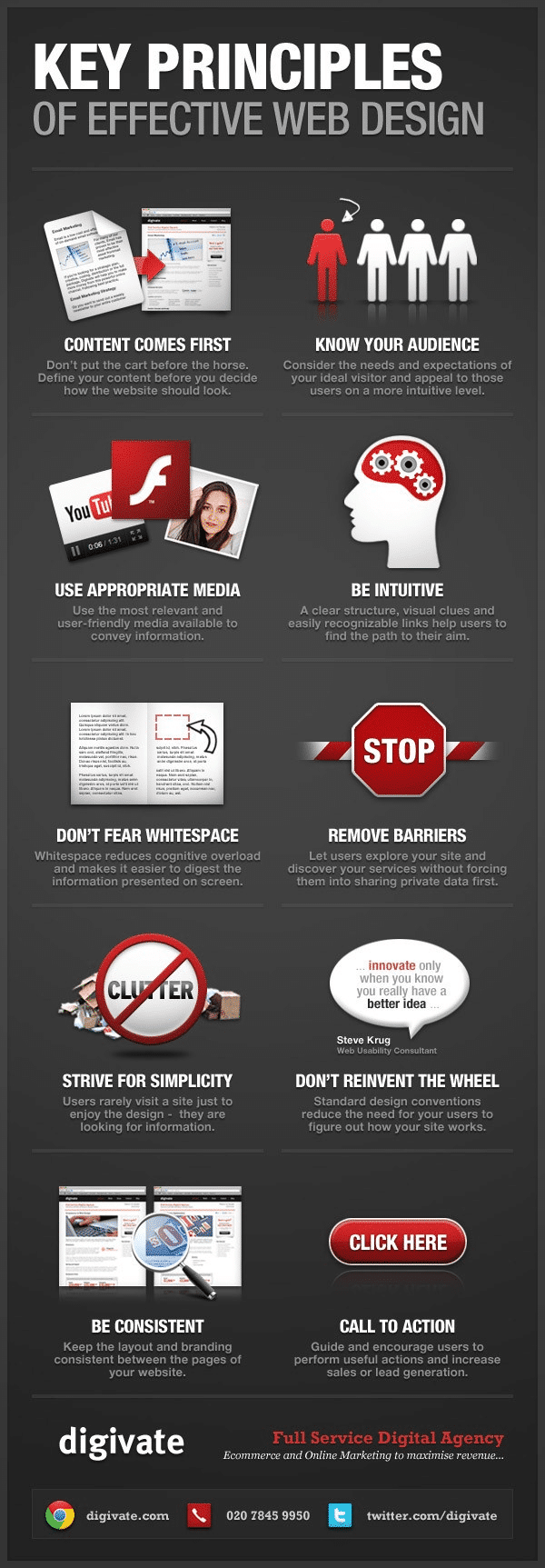
Rule 1: Define Your Goals
Before you start building or revamping your website, it’s essential to define your goals. What do you want your website to achieve? Are you looking to increase online sales, generate leads, provide information to your customers, or showcase your portfolio? Clearly defining your objectives will guide all other decisions related to your website, from design to content and functionality.
Rule 2: Keep It User-Friendly
User-friendliness is paramount in web design. Your website should be intuitive and easy to navigate. Visitors should be able to find the information they need without having to dig through cluttered menus or confusing layouts. Ensure that your website is mobile-responsive, as an increasing number of users access the web from their smartphones and tablets.
Rule 3: Prioritize Speed and Performance
In the fast-paced online world, users have little patience for slow-loading websites. Studies have shown that slow websites lead to higher bounce rates and lower conversion rates. To keep visitors engaged, optimize your website’s speed and performance. Compress images, use content delivery networks (CDNs), and minimize HTTP requests to ensure swift loading times.
Rule 4: Invest in Professional Design
First impressions matter, and your website’s design plays a significant role in shaping those impressions. Invest in professional web design to create a visually appealing and cohesive website. Your design should reflect your brand identity, be aesthetically pleasing, and convey professionalism.
Rule 5: Mobile Optimization is Non-Negotiable
With the proliferation of mobile devices, mobile optimization is no longer optional; it’s a must. Ensure that your website looks and functions seamlessly on all screen sizes. A responsive design adapts to various devices, providing a consistent and enjoyable user experience.
Rule 6: High-Quality Content is King
Content is the backbone of your website. High-quality, relevant, and engaging content not only attracts visitors but also keeps them coming back. Create informative blog posts, product descriptions, and compelling landing pages. Use visuals like images and videos to enhance your content and make it more shareable.
Rule 7: Optimize for Search Engines (SEO)
To be effective, your website must be discoverable by search engines. Implementing SEO best practices can significantly improve your website’s visibility in search engine results pages (SERPs). Conduct keyword research, optimize meta tags, create valuable content, and build high-quality backlinks to improve your SEO ranking.
Rule 8: Embrace Social Media Integration
Social media is an integral part of modern marketing. Integrate social media buttons and widgets into your website to encourage sharing and engagement. This not only helps you connect with your audience but also boosts your online presence.
Rule 9: Prioritize Security
Security is a concern for both you and your visitors. Protect sensitive data, such as customer information and payment details, by implementing robust security measures. Use SSL certificates to secure data transmission and regularly update your website’s software to patch vulnerabilities.
Rule 10: Regularly Update and Maintain
A website is not a one-and-done project. To remain effective, it needs regular updates and maintenance. Keep your content fresh and up-to-date, fix broken links, and ensure that all features and plugins are working correctly. Regularly monitoring and optimizing your website will help it stay competitive and relevant.
Conclusion
A well-designed and effective business website is a powerful tool in today’s digital landscape. It can attract new customers, build trust with your audience, and drive growth for your business. By following these 10 rules, you can create a website that not only looks great but also delivers results. Remember that your website is a reflection of your brand, so invest the time and resources needed to make it the best it can be.

Author:
Mark Ford

Mastering the Art of the Landing Page: Design, Copy, and Conversion in Harmony
Are you trying to design a landing page that not only looks great but actually converts visitors into customers? Want to learn how to balance design, copy, and strategy to create landing pages that work in perfect harmony? […]