
What is the aim of your current SEO strategy? Are you just focusing on keyword rankings or do you look at traffic and conversions too?
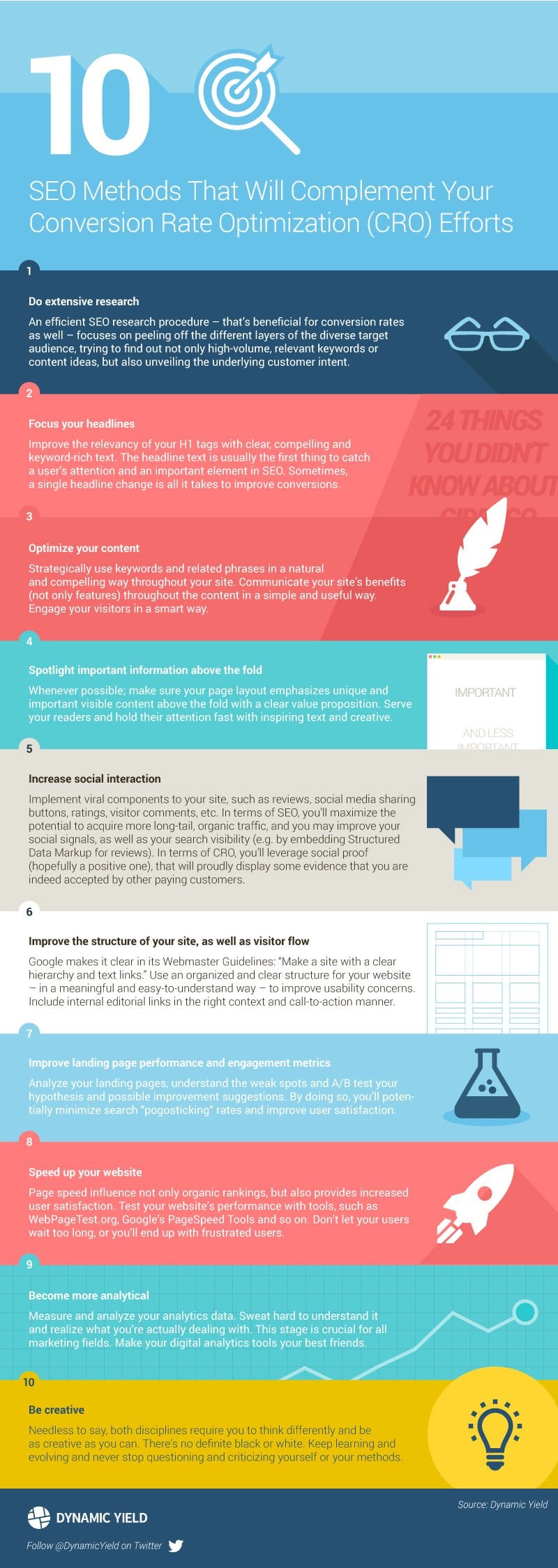
For some guidance optimising for SEO and conversions at the same time take a look at this infographic from Dynamic Yield.
Here’s what they cover:
- Do Extensive Research
- Focus on Headlines
- Optimise Your Content
- Highlight Key Information Above the Fold
- Encourage Social Interaction
- Enhance Site Structure and Navigation
- Improve Landing Pages
- Speed Up Your Website
- Leverage Analytics
- Be Creative
Check out the infographic for more.
Search Engine Optimization (SEO) and Conversion Rate Optimization (CRO) are often seen as separate strategies. However, the two go hand in hand. Good SEO practices not only boost your rankings but also enhance user experience, making it easier to convert visitors into customers.
In this guide, we’ll explore 10 SEO techniques that will also help improve your website conversions.
Do Extensive Research
SEO research goes beyond just finding high-volume keywords. It involves understanding user intent, identifying gaps in the market, and ensuring your content aligns with what your audience is searching for. A well-researched SEO strategy will attract the right visitors and make it easier to convert them. The more you know about your audience, the better you can serve their needs.
- Use keyword research tools like Google Keyword Planner and Ahrefs to identify high-converting search terms.
- Analyze search intent by examining the top-ranking pages for your target keywords.
- Monitor competitor strategies to identify content gaps and areas for differentiation.
- Conduct audience research using surveys and analytics to understand pain points and expectations.
Focus on Headlines
Your headlines are the first thing visitors see, and they play a crucial role in capturing attention. A compelling, keyword-rich headline can increase both click-through rates and user engagement. Well-crafted headlines not only help with SEO but also guide users toward taking action. Keep them clear, concise, and benefit-driven to maximize their impact.
- Use numbers, power words, and questions to make headlines more engaging.
- Ensure your main headline (H1 tag) includes a primary keyword for SEO benefits.
- Test different headline variations using A/B testing to determine what resonates best.
- Keep headlines within 60 characters to prevent them from getting cut off in search results.
Optimize Your Content
Content optimization is about more than just keyword placement. It involves structuring your content to be informative, engaging, and easy to read. Optimized content builds trust with your audience while also making it easier for search engines to rank your site. A well-structured page increases the likelihood of conversions by keeping visitors engaged longer.
- Use short paragraphs, bullet points, and subheadings to improve readability.
- Optimize images and media files to ensure fast loading times.
- Implement internal linking to guide users to relevant pages and reduce bounce rates.
- Write with a conversational tone to keep visitors engaged and encourage action.
Highlight Key Information Above the Fold
The area of your website visible without scrolling—also known as “above the fold”—is crucial for engagement. Users make snap decisions about whether to stay or leave based on what they see immediately. By placing important content, such as calls to action and value propositions, above the fold, you increase the chances of conversion.
- Include a clear and compelling call-to-action (CTA) in a prominent position.
- Use concise copy to immediately convey your unique selling points.
- Ensure mobile responsiveness so key information is easily visible on all devices.
- Use contrasting colours and whitespace to make important elements stand out.
Encourage Social Interaction
Social signals can indirectly boost SEO and directly enhance website conversions. Reviews, social shares, and user-generated content increase trust and credibility, encouraging visitors to take action. By leveraging social proof, you can create a stronger brand presence and increase engagement on your site.
- Add share buttons to blog posts and product pages to encourage social sharing.
- Display customer testimonials and reviews to build credibility and trust.
- Embed structured data markup to make reviews and ratings appear in search results.
- Use user-generated content, such as customer photos and comments, to increase authenticity.
Enhance Site Structure and Navigation
A well-structured website makes it easier for both users and search engines to navigate. Poor site structure can lead to high bounce rates and lost conversions. By organizing your site in a logical and user-friendly manner, you improve both SEO and the overall user experience.
- Use a clear and logical navigation menu with easily accessible links.
- Implement breadcrumbs to help users and search engines understand site hierarchy.
- Ensure URLs are clean, descriptive, and include relevant keywords.
- Avoid excessive pop-ups and intrusive ads that can disrupt user experience.
Improve Landing Pages
Landing pages play a significant role in both SEO and conversion rates. A poorly optimized landing page will struggle to rank in search engines and fail to convert visitors. By analyzing performance metrics and testing different elements, you can fine-tune your landing pages for better results.
- Perform A/B testing on headlines, CTAs, and layout variations.
- Use high-quality images and videos to enhance user engagement.
- Optimize for fast loading speeds by compressing images and using a content delivery network (CDN).
- Ensure the messaging aligns with the search intent and ad copy to maintain consistency.
Speed Up Your Website
Page speed is a major ranking factor for SEO and a critical component of user experience. Slow-loading pages lead to high bounce rates and lost conversions. Ensuring that your website loads quickly will improve both search rankings and customer satisfaction.
- Use Google PageSpeed Insights to identify performance bottlenecks.
- Optimize images using compression tools like TinyPNG or WebP formats.
- Enable browser caching and minimize HTTP requests to reduce load times.
- Invest in high-quality hosting and use a CDN for faster content delivery.
Leverage Analytics for Continuous Improvement
SEO and CRO both require ongoing optimization based on data analysis. Tracking key performance metrics helps identify what’s working and what needs improvement. By making data-driven decisions, you can refine your strategy and maximize your website’s potential.
- Use Google Analytics and heatmaps to understand user behaviour.
- Track conversion rates and identify drop-off points in your sales funnel.
- Set up goals and event tracking to measure the effectiveness of CTAs.
- Regularly review and adjust strategies based on data insights.
Be Creative with Your Approach
SEO and CRO are not rigid formulas—they require creativity and experimentation. Thinking outside the box can help you discover new opportunities for growth. The most successful websites are those that continually test, iterate, and innovate.
- Experiment with different content formats, such as videos, infographics, and interactive tools.
- Use storytelling to create emotional connections with your audience.
- Personalize user experiences with dynamic content based on visitor behaviour.
- Stay updated with industry trends and be willing to adapt strategies as needed.
Final Thoughts
SEO and CRO are two sides of the same coin. While SEO brings in traffic, CRO ensures that traffic converts into customers. By implementing these 10 techniques, you can create a website that ranks well and delivers an exceptional user experience.
The key is to stay proactive, track performance, and continuously refine your approach. A well-optimized website is not just about visibility—it’s about turning visitors into loyal customers.

Author:
Mark Ford