In the digital age, your website is often the first interaction potential customers have with your business. It serves as your online storefront, providing essential information and shaping visitors’ perceptions.
A well-designed, user-friendly website can be a powerful tool for attracting and retaining customers. However, there are common mistakes that can have the opposite effect, driving visitors away and hurting your online presence.
In this blog post, we will explore 11 common mistakes that could be killing your website’s performance and offer solutions to rectify them.
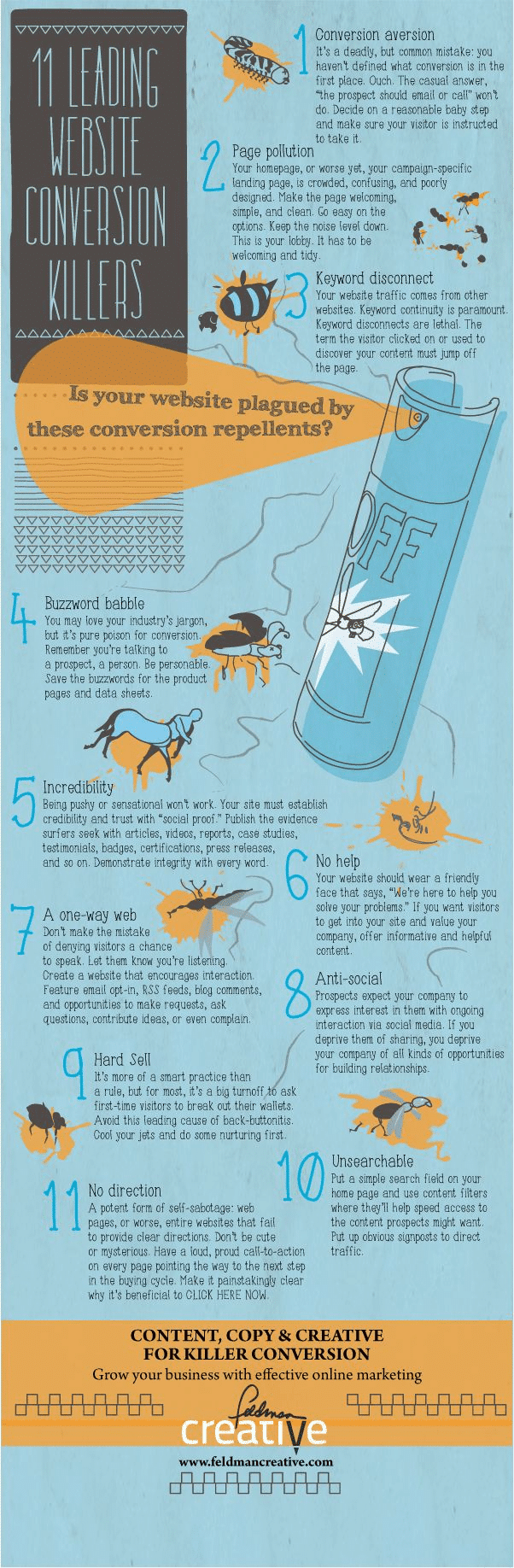
The infographic below from Feldman Creative gives you 11 of the most common website conversion killers.
- Neglecting Mobile Optimization
With the increasing use of smartphones and tablets, mobile optimization is no longer optional—it’s essential. Neglecting to make your website mobile-friendly can result in a poor user experience for a significant portion of your audience. Google also prioritizes mobile-friendly websites in its search rankings. To avoid this mistake, use responsive web design to ensure that your site adapts seamlessly to different screen sizes.
- Slow Loading Times
In today’s fast-paced world, people expect websites to load quickly. If your site takes too long to load, visitors are likely to abandon it and look for alternatives. Several factors can contribute to slow loading times, such as large images, excessive use of plugins, and a lack of browser caching. To speed up your website, optimize images, reduce unnecessary plugins, and implement browser caching.
- Poor Navigation
Navigation is a critical aspect of user experience. If visitors can’t easily find what they’re looking for on your website, they’re likely to leave in frustration. To avoid this mistake, create a clear and intuitive navigation menu. Use descriptive labels for menu items, and organize your content logically. Implementing a search bar can also help users find specific information quickly.
- Lack of Contact Information
One of the primary purposes of a business website is to facilitate contact with potential customers. If your contact information is difficult to find or missing altogether, you’re missing out on valuable opportunities. Ensure that your contact information, including a phone number and email address, is prominently displayed on your website, preferably in the header or footer of every page.
- Inadequate Content
Content is king on the internet, and having valuable, engaging content is crucial for attracting and retaining visitors. Common content mistakes include thin or duplicate content, outdated information, and poor grammar and spelling. Regularly update your content, provide in-depth information, and proofread it for errors. Consider starting a blog to showcase your expertise and provide fresh, relevant content.
- Ignoring SEO
Search engine optimization (SEO) is essential for increasing your website’s visibility in search engine results. Ignoring SEO best practices is a common mistake that can lead to poor search rankings. Optimize your website for relevant keywords, create high-quality backlinks, and improve your website’s loading speed to enhance its SEO performance.
- Neglecting Security
Website security is a critical concern, especially if your website handles sensitive information or e-commerce transactions. Neglecting security measures can result in data breaches, which can be costly in terms of both finances and reputation. Invest in SSL certificates to encrypt data transmission, regularly update your website’s software and plugins, and implement strong password policies to enhance security.
- Overloading with Ads and Pop-ups
While monetizing your website with ads is a common practice, overloading it with ads and pop-ups can be detrimental. Excessive advertising can make your website appear unprofessional and annoying to users. Strike a balance between monetization and user experience by limiting the number of ads and pop-ups and ensuring they are relevant to your content.
- Neglecting Mobile Users’ Experience
Mobile users have unique needs and behaviors compared to desktop users. Neglecting these differences can lead to a poor mobile user experience. Avoid mistakes like using Flash-based content (which is not supported on most mobile devices), having small, hard-to-click buttons, or displaying intrusive interstitials on mobile. Test your website thoroughly on various mobile devices to ensure it functions seamlessly.
- Not Monitoring and Analyzing Performance
Failing to monitor and analyze your website’s performance is a mistake that can hinder your ability to make data-driven improvements. Use tools like Google Analytics to track website traffic, user behavior, and conversion rates. Analyze this data regularly to identify areas for improvement and make informed decisions to enhance your website’s effectiveness.
- Neglecting Regular Updates
Websites are not static; they require ongoing maintenance and updates to stay relevant and secure. Neglecting regular updates to your website’s content, design, and functionality can lead to a stale and outdated online presence. Develop a maintenance schedule to keep your website fresh and up-to-date with the latest trends and technologies.
Conclusion
Your website is a critical component of your online presence and can significantly impact your business’s success. Avoiding these common mistakes, such as neglecting mobile optimization, slow loading times, poor navigation, and inadequate content, can help improve your website’s performance and user experience. By investing in SEO, security, and regular updates, you can ensure that your website remains a valuable asset in attracting and retaining customers. Remember that your website should evolve with your business and the changing digital landscape, so continuous improvement is key to its long-term success.

Author:
Mark Ford

Mastering the Art of the Landing Page: Design, Copy, and Conversion in Harmony
Are you trying to design a landing page that not only looks great but actually converts visitors into customers? Want to learn how to balance design, copy, and strategy to create landing pages that work in perfect harmony? […]