
Are you looking for smarter ways to improve your SEO strategy using real-time data? Want to learn how to use Google Trends to uncover keyword opportunities and boost your visibility?
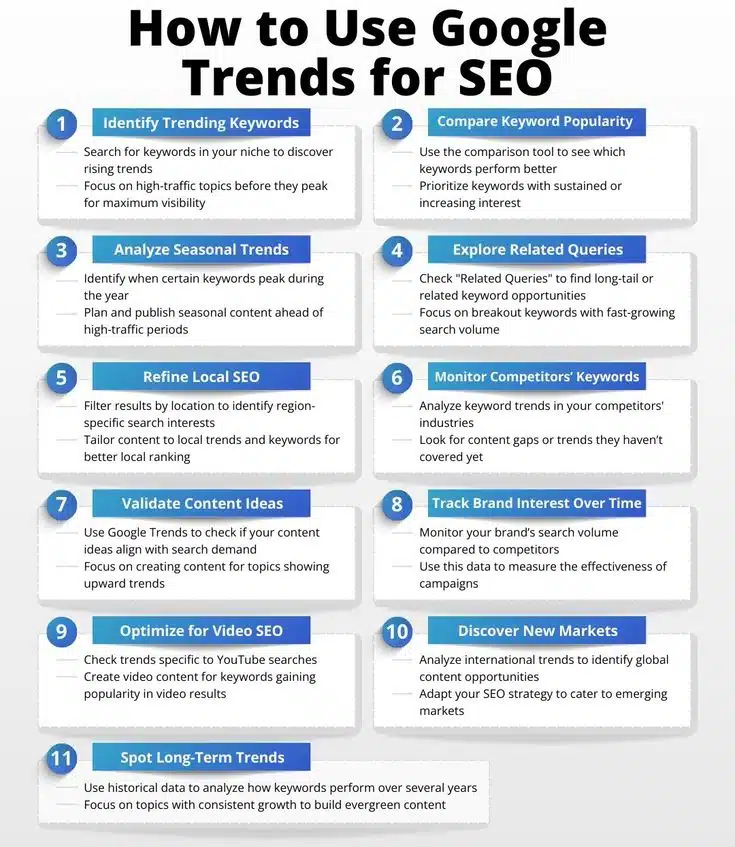
You’ll find some SEO basics in this infographic.
- Identify Trending Keywords
- Compare Keyword Popularity
- Analyse Seasonal Trends
- Explore Related Queries
- Refine Local SEO
- Monitor Competitors’ Keywords
- Validate Content Ideas
- Track Brand Interest Over Time
- Optimise for Video SEO
- Discover New Markets
- Spot Long-Term Trends
Check out the post below for more.
When it comes to sharpening your SEO strategy, data is everything—and Google Trends offers a goldmine of it. This free tool gives you real-time insights into what people are searching for and when.
From spotting keyword trends to tracking brand awareness, it’s a must-have in every marketer’s toolkit. Below, we’ll walk you through 11 smart ways to make the most of Google Trends for better SEO results.
Identify Trending Keywords
Finding the right keywords at the right time can make or break your SEO performance. Google Trends allows you to spot rising topics in your niche before they go mainstream. This means you can jump on relevant search terms while the competition is still low. By staying ahead of the curve, you can drive more organic traffic when it matters most.
- Search by topic or niche to uncover emerging keywords gaining traction.
- Focus on search terms that show a clear upward trend in interest.
- Avoid one-hit wonders by looking for trends with sustained momentum.
- Use filters like country or category to tailor your keyword research.
Compare Keyword Popularity
Not all keywords are created equal—even if they seem similar on the surface. Google Trends lets you compare multiple search terms to see which performs best. This feature is essential for refining your content strategy and prioritising efforts. It ensures you’re targeting the terms that deliver the highest potential return.
- Use the compare function to test different variations of the same keyword.
- Choose keywords with steady or increasing popularity over time.
- Spot seasonal or regional performance differences to fine-tune content.
- Avoid outdated or declining terms with reduced search demand.
Analyse Seasonal Trends
Some keywords naturally peak at specific times of the year—think “Christmas gifts” or “summer fashion.” Google Trends helps you identify these seasonal spikes so you can publish content at just the right moment. Planning ahead based on seasonality ensures your pages are indexed and ready when demand surges.
- Look at historical data to pinpoint peak interest periods.
- Align your publishing schedule with expected keyword surges.
- Create content in advance to give search engines time to rank it.
- Repurpose seasonal content annually to capitalise on recurring trends.
Explore Related Queries
Looking beyond your core keywords can open the door to untapped opportunities. Google Trends offers a “Related Queries” feature to surface long-tail keywords and breakout terms. These are often easier to rank for and can bring in targeted traffic. It’s a fast and effective way to expand your content ideas.
- Scan “Related Queries” for fresh, less competitive keyword angles.
- Identify long-tail variations with specific user intent.
- Prioritise breakout keywords that show rapid search growth.
- Use related queries as inspiration for blog topics or FAQs.
Refine Local SEO
If your business serves a specific region, local SEO is crucial. Google Trends allows you to filter results by location, showing what users are searching for in different areas. By tailoring your content to these regional differences, you’ll rank better in local search results and attract nearby customers.
- Use location filters to see what keywords are popular in your region.
- Tailor landing pages or blog posts to reflect local terminology.
- Compare performance of national vs. regional keyword variants.
- Optimise Google Business Profile content based on local interest.
Monitor Competitors’ Keywords
Want to know what’s working for your competitors? Google Trends gives you insight into their keyword performance. By researching search trends in your competitors’ industries, you can spot content gaps or discover areas where they haven’t gained traction yet. This helps you carve out your own SEO edge.
- Search competitor brand names to track their search visibility.
- Identify topics gaining interest in your competitors’ niche.
- Use trend differences to uncover new content ideas.
- Look for keywords they’ve missed or underutilised.
Validate Content Ideas
You don’t want to spend time and resources creating content no one is searching for. Google Trends lets you test your content ideas before you commit. By checking whether a topic is trending up or down, you can make smarter decisions and ensure your content meets actual demand.
- Enter your headline idea to see if interest is growing or declining.
- Compare multiple angles to choose the one with the most potential.
- Use rising queries to validate content relevance and timing.
- Filter by timeframe to confirm short-term or long-term interest.
Track Brand Interest Over Time
Understanding how people search for your brand is key to measuring awareness and success. Google Trends lets you track your brand name and see how interest changes over time. You can also compare it to competitors to gauge your market position and campaign impact.
- Search your brand name and monitor fluctuations in search volume.
- Compare with industry peers to see how you stack up.
- Use spikes to correlate with product launches or promotions.
- Analyse dips in interest to identify potential PR or visibility issues.
Optimise for Video SEO
Video is becoming a major player in search visibility, especially with platforms like YouTube. Google Trends includes data specific to YouTube searches, helping you find topics gaining traction in video format. You can use this to guide your video creation strategy and attract more viewers.
- Switch to “YouTube Search” to focus on video-specific trends.
- Find out which topics are gaining views and interest on YouTube.
- Align your video content with trending search queries.
- Optimise titles, tags, and descriptions with relevant keywords.
Discover New Markets
Google Trends isn’t limited to one country—it lets you explore global search behaviour. This is incredibly useful if you’re looking to expand your audience or enter new markets. Analysing international trends can reveal where your content might gain traction outside your home country.
- Use country filters to see which regions show interest in your niche.
- Spot emerging markets where competition may be lower.
- Localise content to suit different languages or cultural interests.
- Tailor SEO strategies to fit global content consumption patterns.
Spot Long-Term Trends
Not all trends are short-lived. Google Trends can help you identify keywords with consistent, long-term growth. These are the foundation of evergreen content that continues to bring in traffic for years. Building around these topics ensures your SEO strategy is stable and future-proof.
- Use time filters to view interest over a multi-year period.
- Choose keywords with steady or gradually increasing growth.
- Avoid volatile or one-time trends with unpredictable performance.
- Build cornerstone content based on high-performing long-term terms.
Final Thoughts
Google Trends is one of the most underused but powerful SEO tools available—and it’s completely free. Whether you’re planning content, exploring new niches, or simply keeping tabs on your competition, the insights you gain can transform your SEO strategy.
By applying these 11 smart tactics, you’ll stay ahead of the game and ensure your content is aligned with what your audience actually cares about.
Want help putting these insights into action? Let us know—we’re happy to support your SEO goals.

Author:
Mark Ford