How effective is your business website? Is it generating leads and enquiries? If not, why not? Your homepage is probably the most visited page on your website so make sure it is optimised to its full potential to convert that traffic into leads.
In the digital age, your website is often the first point of contact between your business and potential customers. Your homepage, in particular, plays a crucial role in making a positive impression and guiding visitors toward their desired actions.
Whether you’re running an e-commerce site, a blog, or a corporate website, your homepage should be thoughtfully designed to engage, inform, and convert visitors. In this blog post, we’ll explore the 12 critical elements that your website homepage must have for maximum impact.
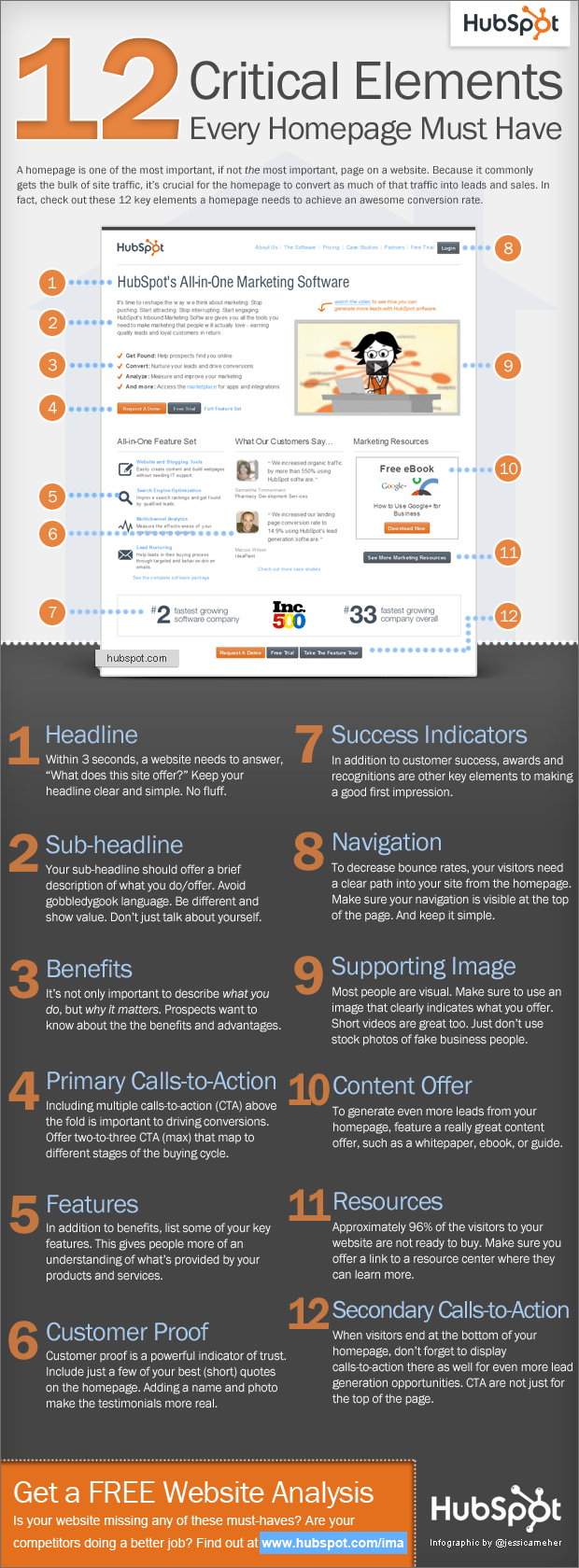
This infographic from HubSpot gives you 12 critical elements your homepage should have.
1. Clear and Compelling Headline
The headline is the first thing visitors see when they land on your homepage, and it should immediately communicate what your website is about. It should be clear, concise, and engaging. Use language that resonates with your target audience and highlights the main benefit or value proposition of your website.
2. Engaging Visuals
Humans are visual creatures, and compelling visuals can capture attention and convey information more effectively than text alone. Use high-quality images, videos, or graphics that relate to your brand and content. Ensure that your visuals are responsive and load quickly to enhance user experience.
3. Navigation Menu
A user-friendly navigation menu is essential for helping visitors find their way around your website. Keep it simple and organized, with clear labels for each section or page. Consider using drop-down menus if you have multiple subcategories to make navigation even more intuitive.
4. Call-to-Action (CTA)
CTAs are prompts that encourage visitors to take a specific action, such as signing up for a newsletter, making a purchase, or contacting your business. Make your CTAs prominent, visually appealing, and action-oriented. Use persuasive language that conveys the value of the action.
5. Value Proposition
Clearly communicate the unique value your website offers to visitors. Explain how your products or services can solve their problems or meet their needs. Use concise and compelling language to differentiate your brand from competitors.
6. Trust Signals
Establish trust with your audience by including trust signals on your homepage. This can include customer reviews, testimonials, industry awards, certifications, and security badges. Trust signals reassure visitors that your website is reliable and credible.
7. Featured Content
Highlight your best and most relevant content on your homepage. This could be your latest blog posts, top-selling products, or key information about your services. Featured content should be regularly updated to keep your homepage fresh and engaging.
8. Contact Information
Make it easy for visitors to get in touch with you by prominently displaying your contact information. This can include a contact form, phone number, email address, and physical address. Providing multiple contact options gives visitors a choice that suits their preference.
9. Social Media Links
Connect with your audience on social media by including links to your social profiles on your homepage. Social media buttons or icons should be clearly visible and lead to your official accounts. Active social media engagement can enhance your brand’s credibility.
10. Mobile Responsiveness
With the increasing use of smartphones and tablets, it’s essential that your homepage is fully responsive. Ensure that your website looks and functions well on all screen sizes. Mobile responsiveness is a ranking factor for search engines and improves the user experience.
11. Loading Speed
Fast-loading pages are crucial for retaining visitors. Slow websites can lead to frustration and high bounce rates. Optimize your homepage by compressing images, minifying code, and using content delivery networks (CDNs) to ensure speedy loading times.
12. Analytics and Tracking
To measure the effectiveness of your homepage and make data-driven improvements, integrate analytics tools like Google Analytics. This allows you to monitor visitor behavior, track conversions, and gather insights into what’s working and what needs adjustment.
Conclusion
Your website’s homepage is the virtual front door to your business or brand. It’s where first impressions are formed, and it plays a pivotal role in converting visitors into customers or loyal followers. By incorporating these 12 critical elements into your homepage design, you can create a compelling and effective online presence that engages, informs, and converts your audience. Remember that web design is an ongoing process, and regular updates and improvements are necessary to stay competitive and meet the evolving needs of your audience.

Author:
Mark Ford