In the SEO world the techniques we use to improve our website ranking can usually be classed as either Black Hat or White Hat. You can probably guess which are good and which are bad in the eyes of Google?
In the ever-evolving landscape of search engine optimization (SEO), staying ahead of the curve is crucial for success. While ethical SEO practices can help your website rank higher in search engine results and attract more organic traffic, some individuals and companies resort to unethical tactics known as “Black Hat SEO” to gain a short-term advantage.
These tactics violate search engine guidelines and can lead to severe penalties, including being deindexed from search engines like Google.
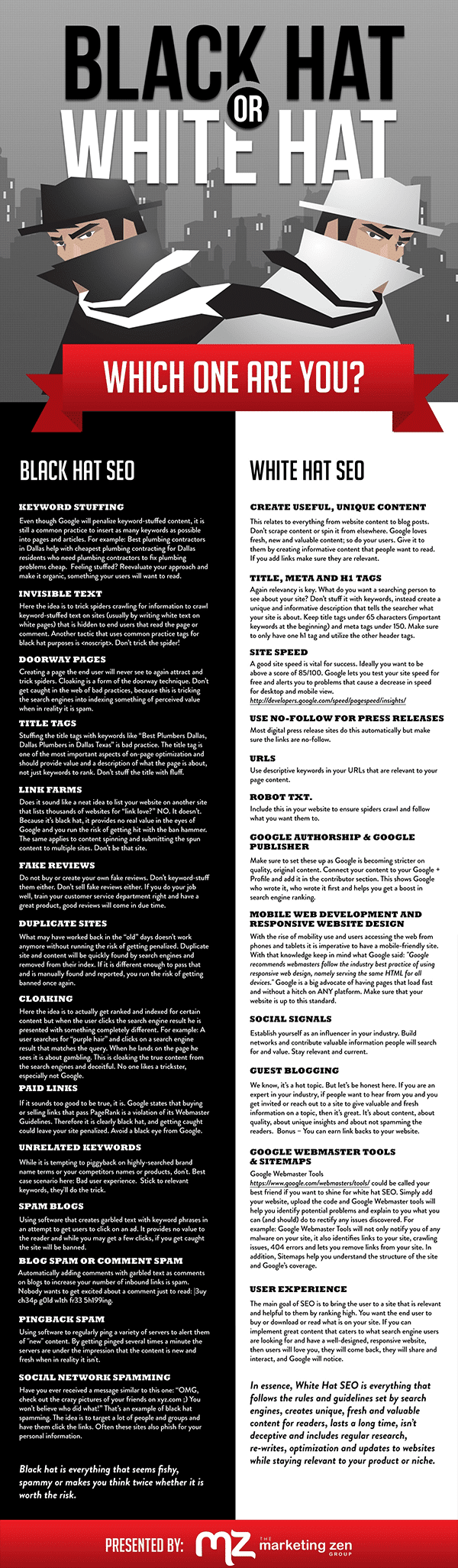
The infographic below from The Marketing Zen Group gives you 14 Black Hat SEO techniques you should stop using and 12 White Hat techniques to use instead.
- Keyword Stuffing
Keyword stuffing involves excessively using target keywords within the content, meta tags, or even hidden in the website’s code. This technique may have worked in the early days of SEO, but modern search engines have sophisticated algorithms that can detect and penalize keyword stuffing.
Instead, focus on creating high-quality, informative content that naturally incorporates relevant keywords. Write for your audience, not just for search engines.
- Cloaking
Cloaking is the practice of displaying different content to search engine crawlers and human visitors. This deceptive technique is achieved by detecting the user agent of the visitor and serving different content based on that information. The content displayed to search engines is often optimized for SEO, while the content shown to users may be irrelevant or spammy.
Search engines take cloaking very seriously and will penalize websites that engage in this practice. Maintain transparency by providing consistent content to both search engines and human users.
- Duplicate Content
Duplicate content refers to the publication of identical or substantially similar content on multiple pages of a website or across different domains. While it may seem like an easy way to increase the volume of content on your site, search engines penalize duplicate content because it can lead to a poor user experience and confusion.
Instead, focus on producing unique, valuable, and relevant content that caters to the needs and interests of your audience. Quality always trumps quantity.
- Link Farms
Link farms are networks of websites that exist solely to link to one another or to a specific target website. This tactic is used to manipulate search engine rankings by artificially inflating the number of backlinks to a site. Search engines are adept at detecting link farms and will penalize sites associated with them.
Building a strong backlink profile should be based on organic, high-quality links from reputable sources. Quality over quantity is the key to success in this aspect of SEO.
- Private Blog Networks (PBNs)
Private Blog Networks, or PBNs, are a group of websites created for the sole purpose of linking to a single target website. These networks are often used to manipulate search engine rankings and are a clear violation of search engine guidelines.
Rather than relying on PBNs, invest in legitimate link-building strategies such as guest posting, outreach, and content marketing to earn high-quality backlinks.
- Hidden Text and Links
Hidden text and links involve using techniques to make keywords or links invisible to human visitors while still visible to search engines. This could include using white text on a white background or placing text behind images. These practices are blatant attempts to manipulate search engine rankings and can result in severe penalties.
Maintain transparency and user-friendliness by ensuring that all text and links on your website are easily visible and accessible to visitors.
- Content Scraping
Content scraping is the act of copying and republishing content from other websites without permission. This unethical practice not only violates copyright laws but can also harm your website’s SEO. Search engines strive to provide unique and valuable content to users, so duplicating content from other sources will likely result in lower rankings.
Create original, high-quality content that sets your website apart from the competition and attracts organic traffic.
- Clickbait and Deceptive Titles
Using misleading or clickbait titles to attract clicks is a Black Hat tactic that can damage your website’s reputation and user trust. While it may generate short-term traffic, users who feel deceived are unlikely to return to your site or engage with your content.
Opt for honest, accurate, and descriptive titles that accurately represent the content of your pages. This will help build trust with your audience and improve user engagement.
- Automated Content Generation
Automated content generation involves using software or algorithms to create content automatically. While this may seem like a time-saving solution, the quality of automatically generated content is often poor and lacks the human touch that readers appreciate.
Invest time and effort in creating valuable, well-researched, and well-written content that resonates with your target audience.
- Doorway Pages
Doorway pages, also known as bridge or gateway pages, are low-quality pages created solely to rank for specific keywords and then redirect visitors to another page. These pages provide little to no value to users and are designed to manipulate search engine rankings.
Instead of creating doorway pages, focus on optimizing your main content and improving the user experience on your website.
- Negative SEO
Negative SEO involves attempting to harm a competitor’s website by using Black Hat tactics against them. This unethical practice may include building spammy links to their site, generating duplicate content, or even hacking their website.
Rather than engaging in negative SEO, focus on improving your own website and providing value to your audience. Compete fairly and ethically within your niche.
- Comment Spam
Comment spam is the act of posting irrelevant or promotional comments with links to your website on other people’s blogs or forums. This tactic not only annoys website owners but also reflects poorly on your brand.
Engage in meaningful discussions and contribute valuable insights when participating in online communities. Building genuine relationships can lead to legitimate opportunities for promoting your website.
- Purchasing Links
Buying links from link vendors or participating in link schemes is a clear violation of search engine guidelines. While it may seem like a quick way to boost your website’s rankings, the risks of penalties and loss of reputation far outweigh the benefits.
Focus on earning backlinks organically by creating valuable content and fostering relationships with other websites in your industry.
- Thin or Low-Quality Content
Thin or low-quality content provides little value to users and is often used to manipulate search engine rankings. These pages typically contain minimal information, are stuffed with keywords, and lack depth or originality.
Prioritize the creation of comprehensive, informative, and engaging content that genuinely addresses the needs and questions of your audience. High-quality content is more likely to attract organic traffic and earn valuable backlinks.
Conclusion
In the world of SEO, ethical practices are not only beneficial for long-term success but also essential for maintaining a positive online reputation. Black Hat SEO techniques may provide short-term gains, but they come at a high cost, including potential penalties, loss of trust, and damage to your brand’s credibility.
To ensure the sustained success of your website, focus on white hat SEO techniques that prioritize user experience, high-quality content, and ethical optimization strategies. By doing so, you’ll build a strong online presence that stands the test of time and earns the trust of both users and search engines.

Author:
Mark Ford