Are you trying to rank higher on Google but failing? Do you know why content marketing should be an essential part of your SEO strategy?
Having your website ranked higher in search engines will no doubt generate more leads, the closer to page 1 for your target keywords you are the better. If your current strategy isn’t working the chances are you haven’t been creating enough of the right content for Google to notice.
To help you understand why this is needed in your strategy QuickSprout have created the infographic below.
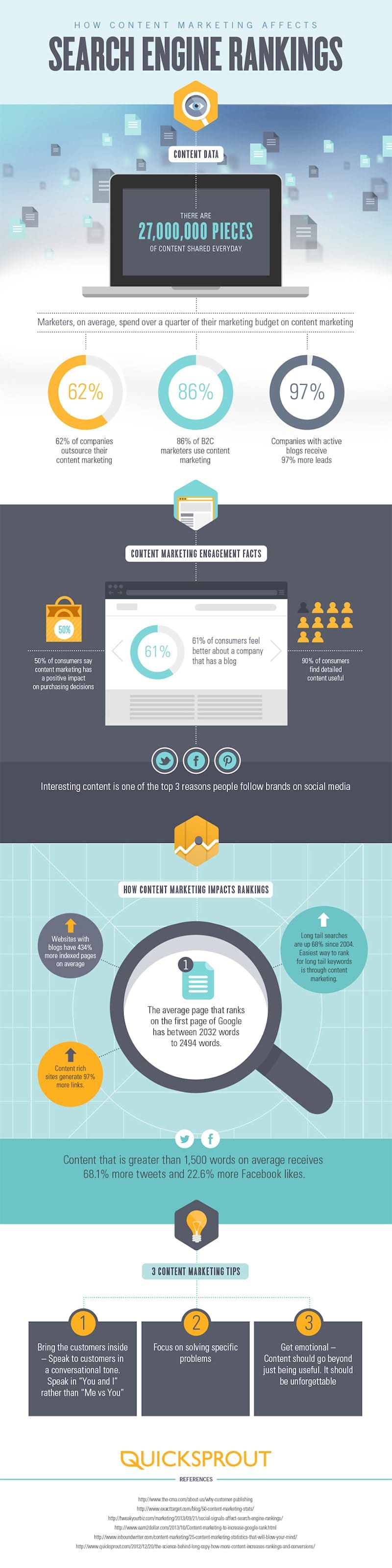
In the ever-evolving landscape of digital marketing, the symbiotic relationship between content marketing and SEO (Search Engine Optimization) has become increasingly crucial for businesses aiming to thrive online. Gone are the days when SEO was solely about optimizing meta tags and building backlinks. Today, content marketing has emerged as a cornerstone of effective SEO strategies. In this blog post, we’ll delve into three compelling reasons why content marketing should be an integral part of your SEO strategy.
1. Quality Content Drives Organic Traffic
When it comes to SEO, the foundation is organic search traffic. High-quality content plays a pivotal role in attracting organic traffic to your website. Search engines like Google are constantly refining their algorithms to prioritize content that offers real value to users. This means that, in the world of SEO, the phrase “content is king” has never been more relevant.
The Role of Keywords
Keywords are the building blocks of SEO, and they form the bridge between content marketing and search engine optimization. Keywords are the words and phrases users type into search engines when looking for information. By strategically incorporating relevant keywords into your content, you can increase your website’s visibility in search results.
Effective keyword research is the starting point for creating content that ranks well in search engines. Tools like Google Keyword Planner and SEMrush can help you identify keywords that are relevant to your industry and have reasonable search volumes. Once you have your list of target keywords, you can create content that centers around them.
Creating High-Quality, Relevant Content
Google’s algorithms have evolved to assess the quality and relevance of content more accurately. It’s no longer enough to stuff articles with keywords and hope for the best. Google now prioritizes content that offers genuine value to users. This means your content must be informative, engaging, and relevant to your target audience.
High-quality content not only satisfies users but also encourages them to stay on your website longer, reducing bounce rates. Google interprets this as a positive user experience and may reward your site with higher rankings.
Content Formats Matter
Diversifying your content formats can further enhance your SEO efforts. Alongside traditional written content, consider incorporating videos, infographics, podcasts, and interactive elements into your content marketing strategy. This not only caters to different types of audiences but also keeps your website fresh and engaging.
2. Content Builds Authority and Backlinks
In the realm of SEO, backlinks remain a powerful ranking factor. Backlinks are links from other websites to yours, and they are seen as a vote of confidence in your content. However, acquiring high-quality backlinks can be challenging. This is where content marketing comes into play.
Producing Link-Worthy Content
Creating exceptional content that others find valuable is the key to attracting backlinks naturally. When you consistently produce informative, well-researched, and authoritative content, other websites and bloggers in your niche are more likely to link to your pages as a reference. This is often referred to as “earning” backlinks, as they are a result of the merit of your content.
To create content that attracts backlinks, consider the following strategies:
- In-depth Guides: Comprehensive guides and tutorials that serve as go-to resources in your industry.
- Original Research: Conduct and publish original research or studies relevant to your field.
- Infographics: Create visually appealing infographics that simplify complex information.
- Guest Blogging: Contribute guest posts to authoritative websites in your niche, including a link back to your content.
Outreach and Relationship Building
In addition to producing link-worthy content, outreach and relationship building are essential for link acquisition. Engage with influencers and other content creators in your industry through social media and email outreach. Building relationships can lead to opportunities for guest posting and collaboration, which often result in valuable backlinks.
Leveraging Social Media
Social media platforms can also be instrumental in building backlinks. When you share your content on platforms like Facebook, Twitter, and LinkedIn, it increases the chances of others discovering and linking to it. Furthermore, social signals (engagement on social media) can indirectly impact your SEO rankings.
3. Content Enhances User Experience
User experience (UX) is another critical factor in SEO. Search engines aim to provide users with the best possible results, and a positive UX is a significant part of that equation. High-quality content contributes to a better user experience in several ways.
Reduced Bounce Rates
When users click on a search result and quickly return to the search results page, it sends a signal to search engines that the content did not meet their expectations. This can lead to a decrease in rankings. Well-crafted, informative content that aligns with user intent is more likely to keep visitors engaged and reduce bounce rates.
Improved Dwell Time
Dwell time refers to the amount of time a user spends on a web page after clicking on a search result. When users spend more time on your page, it signals to search engines that your content is relevant and valuable. Engaging content, such as in-depth articles, videos, and interactive elements, can increase dwell time.
Mobile Optimization
With the growing use of mobile devices for online browsing, mobile optimization has become a crucial aspect of SEO. Content marketing allows you to create responsive and mobile-friendly content that caters to users on smartphones and tablets. Mobile-friendly websites are more likely to rank well in mobile search results.
Voice Search Compatibility
As voice search technology continues to advance, optimizing your content for voice search is becoming increasingly important. Content marketing can help you create conversational, question-based content that aligns with the way people use voice search. This can give you an edge in capturing voice search traffic.
Conclusion
In today’s digital landscape, content marketing and SEO are no longer separate entities. They are two sides of the same coin, working in tandem to help your website rank higher in search engine results, attract organic traffic, and ultimately, drive business success. By creating high-quality, keyword-optimized content that builds authority, attracts backlinks, and enhances user experience, you can position your website for sustained visibility and growth in the highly competitive online space. As you formulate your digital marketing strategy, remember that content marketing isn’t just an option—it’s a necessity for SEO success.

Author:
Mark Ford