
Are you looking for ways to improve your Ecommerce website? Want to know how to generate more online sales?
In today’s digital age, having a strong online presence is crucial for the success of any business, especially for those in the world of e-commerce. With millions of websites competing for customers’ attention, it’s essential to ensure that your e-commerce website stands out and offers a seamless shopping experience.
In this blog post, we’ll discuss five actionable steps to improve your e-commerce website and generate more online sales.
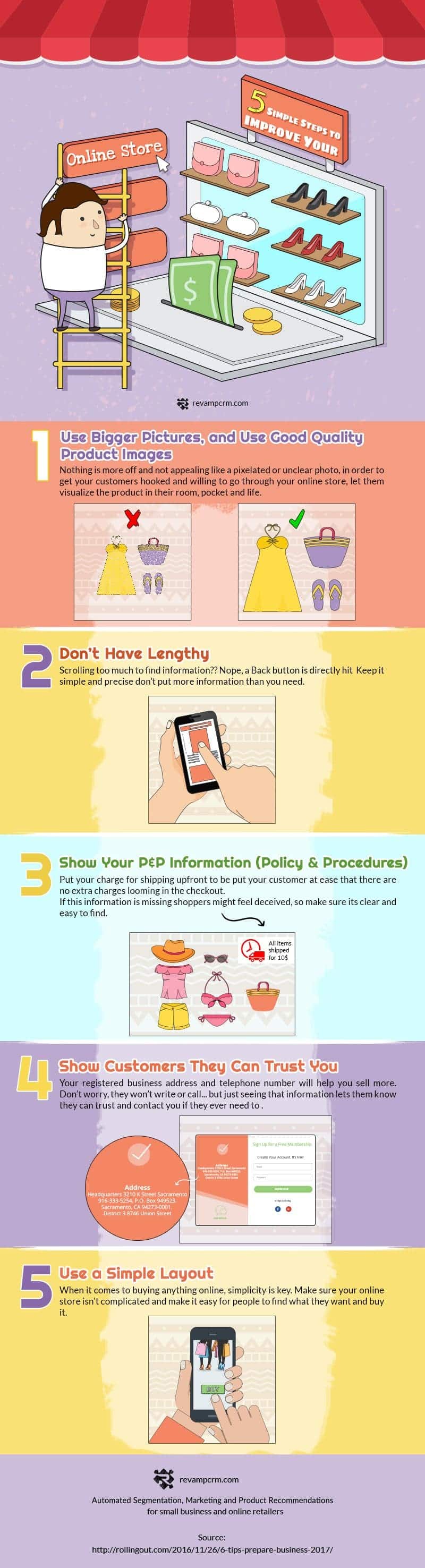
Revamp CRM share their tips for success in this infographic.Here’s a quick summary:
- Use bigger and better pictures
- Keep scrolling to a minimum
- Show your shipping information
- Show contact information
- Keep it simple
Check out the infographic for more detail.
Step 1: Optimize Your Website Speed
The first step in improving your ecommerce website is to ensure that it loads quickly and efficiently. Website speed is a critical factor that can significantly impact your sales and customer satisfaction. According to various studies, a one-second delay in page load time can result in a 7% decrease in conversions.
Here are some strategies to optimize your website’s speed:
a. Use a Reliable Hosting Service
Choosing the right hosting service is essential for a fast-loading website. Consider using a dedicated server or a reputable hosting provider that can handle your website’s traffic and provide excellent uptime.
b. Compress Images and Files
Large image and file sizes can slow down your website’s loading time. Use image compression tools and optimize your files to reduce their size without compromising quality.
c. Implement Browser Caching
Browser caching allows your website to store certain elements, such as images and scripts, on the user’s device. This way, when a visitor returns to your site, these elements don’t need to be reloaded, speeding up the browsing experience.
d. Minimize HTTP Requests
Each element on your webpage, such as images, scripts, and stylesheets, requires an HTTP request to load. Minimize the number of requests by combining and minifying files whenever possible.
e. Enable Content Delivery Network (CDN)
A CDN distributes your website’s content across multiple servers worldwide, reducing the distance data needs to travel to reach your visitors. This can significantly improve loading times, especially for international customers.
Step 2: Enhance User Experience (UX)
A seamless and enjoyable user experience is paramount in ecommerce. If your visitors find it difficult to navigate your website or complete a purchase, they are likely to abandon their shopping carts and look elsewhere. Here are some tips to enhance the UX of your ecommerce website:
a. Mobile Optimization
With the increasing use of smartphones, your website must be responsive and mobile-friendly. Ensure that your design and layout adapt seamlessly to various screen sizes and resolutions.
b. Intuitive Navigation
Make it easy for customers to find what they are looking for by organizing your products into clear categories and providing a user-friendly search function. Use descriptive labels and intuitive menus.
c. Streamline Checkout Process
A lengthy and complicated checkout process can deter potential customers. Simplify it as much as possible, offering guest checkout options and minimizing the number of form fields.
d. High-Quality Product Images and Descriptions
Include high-resolution images and detailed product descriptions that provide all the information your customers need to make an informed purchase decision.
e. Implement User Reviews and Ratings
Allow customers to leave reviews and ratings for your products. These can help build trust and provide social proof, increasing the likelihood of a purchase.
Step 3: Optimize for Search Engines (SEO)
Search engine optimization (SEO) is crucial for driving organic traffic to your ecommerce website. By optimizing your site for search engines, you can increase your visibility in search results and attract more potential customers. Here’s how to do it:
a. Keyword Research
Identify relevant keywords that potential customers might use when searching for products like yours. Use tools like Google Keyword Planner to find popular and relevant keywords for your niche.
b. On-Page SEO
Optimize your product pages by incorporating your chosen keywords into titles, headers, and product descriptions. Ensure that your website’s meta tags, including meta titles and meta descriptions, are well-optimized.
c. High-Quality Content
Regularly publish high-quality, informative, and engaging content related to your products or industry. Blog posts, product guides, and tutorials can help establish your website as an authority in your niche.
d. Link Building
Build a strong backlink profile by acquiring high-quality, relevant backlinks from authoritative websites in your industry. Guest posting, outreach, and content promotion can help you secure valuable backlinks.
e. Mobile Optimization
As mentioned earlier, mobile optimization is not only essential for UX but also for SEO. Google considers mobile-friendliness as a ranking factor, so ensure your website works seamlessly on mobile devices.
Step 4: Implement Conversion Rate Optimization (CRO) Techniques
Increasing traffic to your ecommerce website is essential, but it’s equally important to convert that traffic into paying customers. Conversion rate optimization (CRO) involves making strategic changes to your website to improve the percentage of visitors who take desired actions, such as making a purchase. Here are some CRO techniques to consider:
a. A/B Testing
Conduct A/B tests on different elements of your website, such as headlines, images, call-to-action buttons, and checkout processes. This will help you identify which variations perform better and lead to higher conversion rates.
b. Clear Call-to-Action (CTA)
Ensure that your website has clear and compelling CTAs that guide visitors toward taking specific actions, such as “Add to Cart” or “Buy Now.” Make these buttons prominent and visually appealing.
c. Trust Signals
Display trust signals, such as secure payment badges, customer reviews, and guarantees, to build trust with your visitors and reduce any anxiety they may have about making a purchase.
d. Exit-Intent Pop-ups
Use exit-intent pop-ups to capture the attention of visitors who are about to leave your site. Offer them discounts, incentives, or the option to subscribe to your newsletter.
e. Cart Abandonment Recovery
Implement cart abandonment recovery strategies, such as sending reminder emails with personalized product recommendations and incentives to complete the purchase.
Step 5: Analyze and Iterate
Continuous improvement is key to the long-term success of your ecommerce website. Regularly analyze your website’s performance using tools like Google Analytics and e-commerce-specific analytics platforms. Keep an eye on important metrics such as conversion rate, bounce rate, average order value, and customer acquisition cost. Based on your findings, make data-driven decisions to iterate and optimize your website further.
a. Set Goals and KPIs
Define clear goals and key performance indicators (KPIs) that align with your business objectives. This could include increasing sales revenue, improving conversion rates, or expanding your customer base.
b. Monitor User Behavior
Use analytics tools to track how visitors navigate your website. Identify common points of friction or drop-off in the customer journey and take steps to address them.
c. Customer Feedback
Collect feedback from your customers through surveys, reviews, and social media. Use this feedback to make improvements to your website and enhance the overall shopping experience.
d. Stay Updated with Trends
Keep an eye on emerging trends in ecommerce, web design, and digital marketing. Technology and consumer behavior evolve, so staying up-to-date will help you stay competitive.
e. Test New Features and Technologies
Experiment with new features, technologies, and marketing strategies that have the potential to enhance your website’s performance. Stay open to innovation and adapt to changing customer preferences.
In conclusion, improving your ecommerce website and generating more online sales is an ongoing process that requires dedication and a customer-centric approach. By optimizing your website speed, enhancing user experience, implementing SEO strategies, focusing on conversion rate optimization, and regularly analyzing and iterating, you can create a successful ecommerce platform that attracts, converts, and retains customers. Remember that the ecommerce landscape is dynamic, so staying proactive and adapting to changes is essential for sustained growth and success in the digital marketplace.

Author:
Mark Ford