As business owners we all want to get to the top of Google right? We want to be the first company potential customers call when they are searching online.
But at what cost?
Google has released a series of updates over the past few years that has rendered certain SEO techniques not only useless, but they can get your site removed from Google completely.
The infographic below from SEO.com gives you 6 black hat SEO tactics that could be killing your website.
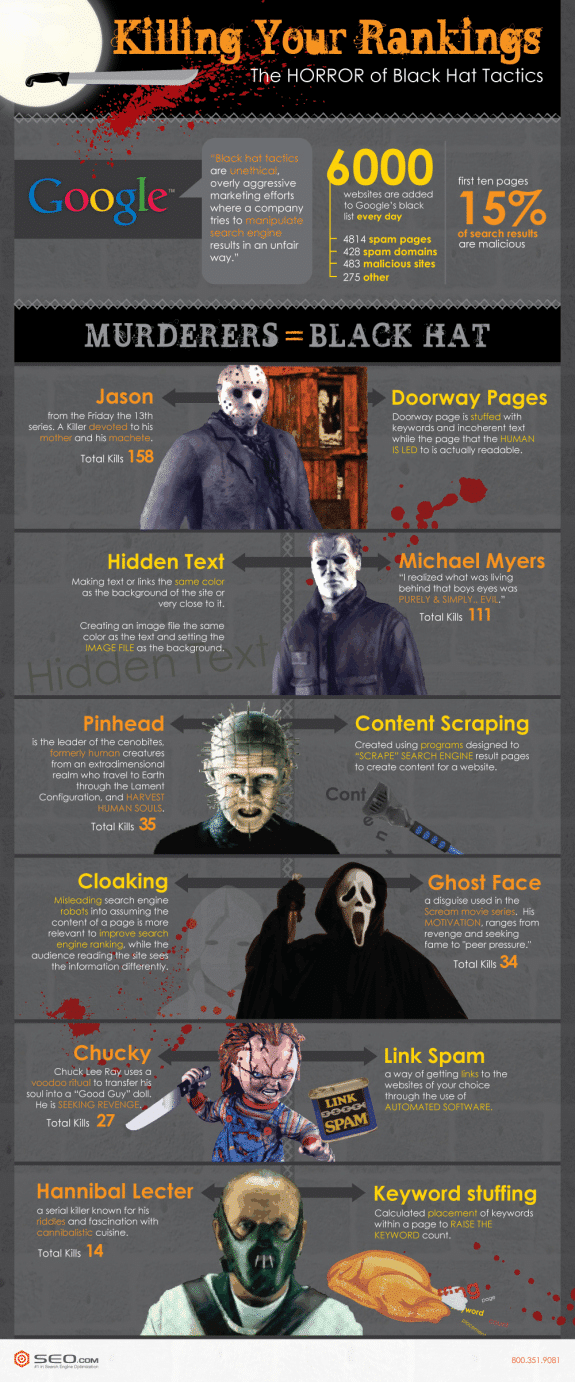
Search Engine Optimization (SEO) is a critical component of any successful online presence. It involves optimizing your website to rank higher on search engine results pages (SERPs), making it more visible to potential visitors. However, not all SEO techniques are created equal.
While some methods adhere to ethical guidelines and best practices, others resort to unethical practices known as “Black Hat SEO.” These techniques may seem tempting in the short term, promising quick results, but they can ultimately have devastating consequences for your website’s long-term success.
In this blog post, we will explore six Black Hat SEO techniques that could be detrimental to your website’s health. We’ll discuss what these techniques are, why they are harmful, and how to avoid falling into the trap of using them. Let’s dive in!
Keyword Stuffing: The Poisonous Overuse of Keywords
Keywords are the foundation of SEO. They help search engines understand the content and context of your web pages. However, keyword stuffing is a Black Hat technique that involves excessively loading your content with keywords in an attempt to manipulate search rankings.
Why it’s harmful:
- Google and other search engines have evolved to recognize keyword stuffing. They penalize websites that engage in this practice, pushing them lower in search results or even deindexing them.
- Keyword-stuffed content is difficult to read and provides a poor user experience, driving potential visitors away.
- It damages your website’s credibility, making it less likely to attract high-quality backlinks or engagement.
How to avoid it:
- Conduct thorough keyword research to identify relevant keywords for your content.
- Use keywords naturally and strategically in your content, focusing on providing value to your readers.
- Prioritize user experience and readability over keyword density.
Cloaking: The Art of Deception
Cloaking is a deceptive Black Hat technique where a website presents different content to search engines and human visitors. In other words, it shows one version of a page to search engine crawlers and a different version to users.
Why it’s harmful:
- Cloaking violates search engine guidelines by misleading both search engines and users.
- It can lead to penalties, including deindexing, making your website invisible in search results.
- Users who land on your website expecting one thing and finding something entirely different are likely to leave, increasing your bounce rate.
How to avoid it:
- Ensure that your website serves the same content to both search engine crawlers and users.
- Follow ethical SEO practices and focus on delivering a consistent and valuable user experience.
Paid Links: Buying Your Way to the Top
Obtaining high-quality backlinks from reputable websites is a legitimate SEO strategy. However, Black Hat practitioners resort to paid links, which involve buying links from other websites to manipulate search rankings.
Why it’s harmful:
- Search engines like Google consider paid links a violation of their guidelines and may penalize your website.
- Paid links often come from low-quality or spammy websites, which can harm your site’s reputation.
- It’s an unsustainable strategy that can lead to long-term damage to your website’s ranking and credibility.
How to avoid it:
- Focus on earning backlinks naturally by creating valuable, shareable content.
- Build relationships with other website owners and industry influencers to encourage organic link building.
- Avoid participating in link schemes or purchasing links.
Duplicate Content: A Copycat’s Downfall
Duplicate content refers to identical or substantially similar content appearing on multiple pages of your website or across different websites. Black Hat SEOs may use duplicate content to try to increase their chances of ranking for specific keywords.
Why it’s harmful:
- Search engines aim to provide diverse and high-quality results to users. Duplicate content can confuse search engines and lead to lower rankings.
- It can result in self-cannibalization, where multiple pages on your site compete against each other, weakening your overall SEO efforts.
- Duplicate content can harm user experience and diminish your website’s trustworthiness.
How to avoid it:
- Create unique and valuable content for each page on your website.
- Use canonical tags to indicate the preferred version of a page if you have similar content on multiple pages.
- Regularly check for and address duplicate content issues.
Link Farming: The Illusion of Popularity
Link farming is a Black Hat technique that involves creating or participating in networks of websites solely for the purpose of building links. These websites often have little or no valuable content and exist primarily to manipulate search engine rankings.
Why it’s harmful:
- Search engines have sophisticated algorithms that can detect link farms. Websites associated with link farms can face severe penalties.
- Link farming can damage your website’s reputation and credibility, as these links are often of low quality.
- It’s a short-sighted strategy that may yield temporary gains but will ultimately harm your SEO efforts in the long run.
How to avoid it:
- Focus on building high-quality backlinks from reputable and relevant websites.
- Prioritize content marketing and natural link acquisition strategies over shortcuts like link farming.
Automated Content Generation: The Robotic Approach
Some Black Hat practitioners use automated content generation tools to create large volumes of low-quality content quickly. This content is often nonsensical or irrelevant and is intended to manipulate search rankings.
Why it’s harmful:
- Automated content is usually of low quality, providing little to no value to users.
- Search engines can easily detect automatically generated content and may penalize your website.
- It damages your website’s credibility and trustworthiness, driving away potential visitors.
How to avoid it:
- Invest in creating high-quality, valuable, and original content for your audience.
- Focus on user intent and providing content that meets their needs.
- Avoid using automated content generation tools for the purpose of SEO manipulation.
Conclusion
In the world of SEO, taking shortcuts through Black Hat techniques may seem appealing, especially when quick results are desired. However, the risks far outweigh the rewards. Engaging in Black Hat SEO can lead to penalties, damaged reputation, and long-term harm to your website’s rankings.
Instead, focus on ethical and sustainable SEO practices. Create high-quality, valuable content, build relationships with others in your industry, and prioritize user experience. Remember that SEO is a long-term game, and success comes from providing genuine value to your audience and abiding by search engine guidelines.
By steering clear of Black Hat SEO techniques, you can build a strong and enduring online presence that not only ranks well in search engines but also gains the trust and loyalty of your target audience.

Author:
Mark Ford