In the ever-evolving world of digital marketing, Search Engine Optimization (SEO) remains a cornerstone of success. When done right, SEO can catapult your website to the top of search engine rankings, bringing in a steady stream of organic traffic and potential customers.
However, SEO is not just about optimizing for search engines; it’s also about providing a better user experience. Unfortunately, many website owners inadvertently make mistakes that not only hinder their SEO efforts but also alienate visitors.
In this blog post, we’ll explore eight awful website mistakes that could be making your SEO suck, and more importantly, how to rectify them.
The infographic below from Ecreative IM gives you 8 things that will be harming your SEO.
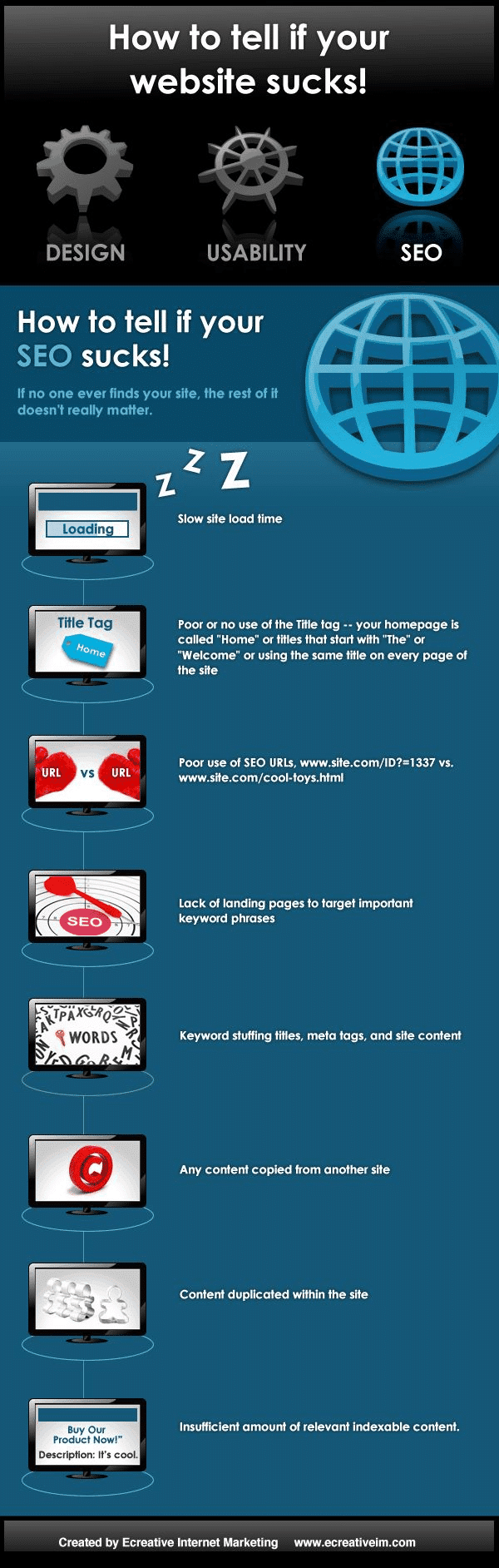
- Neglecting Mobile Optimization
With the majority of internet traffic coming from mobile devices, neglecting mobile optimization is a grave mistake. If your website is not responsive and doesn’t adapt to various screen sizes, it’s not only frustrating for users but also detrimental to your SEO. Google prioritizes mobile-friendly websites in its search rankings, so failing to optimize for mobile can lead to lower search engine visibility.
Solution: Implement a responsive web design that ensures your site functions seamlessly on all devices, from smartphones to tablets and desktops. Google’s Mobile-Friendly Test can help you determine if your site meets the mobile optimization standards.
- Slow Page Loading Speed
In today’s fast-paced world, users expect websites to load quickly. If your site takes too long to load, you risk losing visitors and damaging your SEO efforts. Google considers page speed as a ranking factor, and slow-loading pages can lead to lower search engine rankings.
Solution: To improve page loading speed, optimize images, use browser caching, and minimize HTTP requests. Consider using a Content Delivery Network (CDN) to distribute your website’s content across multiple servers, reducing server load and speeding up loading times.
- Ignoring On-Page SEO Elements
On-page SEO plays a crucial role in determining how search engines perceive your website’s content. Neglecting on-page elements like meta titles, meta descriptions, header tags, and image alt attributes can hinder your SEO efforts. These elements help search engines understand the context and relevance of your content.
Solution: Conduct thorough keyword research and optimize your on-page elements accordingly. Ensure that your meta titles and meta descriptions are both informative and enticing, and use header tags (H1, H2, H3) to structure your content logically. Don’t forget to include descriptive alt attributes for images.
- Overlooking Quality Content
Content is king in the world of SEO. Low-quality, thin, or duplicate content can harm your search engine rankings and drive visitors away. Google rewards websites that provide valuable, informative, and engaging content.
Solution: Invest in creating high-quality, original content that addresses the needs and interests of your target audience. Regularly update your content to keep it fresh and relevant. Use multimedia elements like images, videos, and infographics to enhance the user experience.
- Neglecting Internal Linking
Internal linking is often overlooked but is a powerful SEO strategy. It helps search engines understand the structure of your website and the relationships between different pages. Failing to include internal links can lead to poor indexation and reduced SEO performance.
Solution: Incorporate relevant internal links within your content to guide users to other valuable pages on your website. Ensure that anchor text is descriptive and relevant to the linked page. This not only benefits SEO but also enhances user navigation.
- Neglecting External Link Building
While internal links are crucial, external link building is equally important for SEO. Websites with a healthy backlink profile tend to rank higher in search results. Neglecting to build quality external links can hinder your website’s authority and visibility.
Solution: Develop a backlink strategy that includes outreach to relevant websites, guest posting, and creating shareable content that naturally attracts links. Avoid low-quality link schemes, as they can harm your SEO efforts rather than help.
- Disregarding User Experience (UX)
User experience is not just a buzzword; it’s a critical factor that can make or break your website’s success. If users find your website difficult to navigate, confusing, or cluttered, they’re likely to bounce, which can negatively impact your SEO.
Solution: Invest in a user-centric design that prioritizes ease of navigation, clear calls to action, and a visually appealing layout. Conduct user testing to gather feedback and make improvements based on user preferences and pain points.
- Neglecting Mobile Page Speed
We’ve discussed the importance of mobile optimization, but mobile page speed deserves its own mention. Slow-loading pages on mobile devices are a common issue and can lead to high bounce rates and poor SEO performance.
Solution: Optimize your website for mobile page speed by reducing image sizes, minifying CSS and JavaScript, and utilizing lazy loading for images and other resources. Regularly test your mobile site’s speed and make necessary adjustments.
Conclusion
In the competitive world of online marketing, avoiding these awful website mistakes is crucial for maintaining a strong SEO presence and delivering a positive user experience. Neglecting mobile optimization, slow page loading speed, on-page SEO elements, content quality, internal and external linking, user experience, and mobile page speed can all contribute to poor search engine rankings and frustrated visitors.
By addressing these issues and implementing the suggested solutions, you can improve your website’s SEO performance, attract more organic traffic, and provide a better user experience.

Author:
Mark Ford