Looking for cost-effective ways to drive more traffic and sales to your ecommerce store? Want to discover proven marketing strategies that don’t require a big budget?
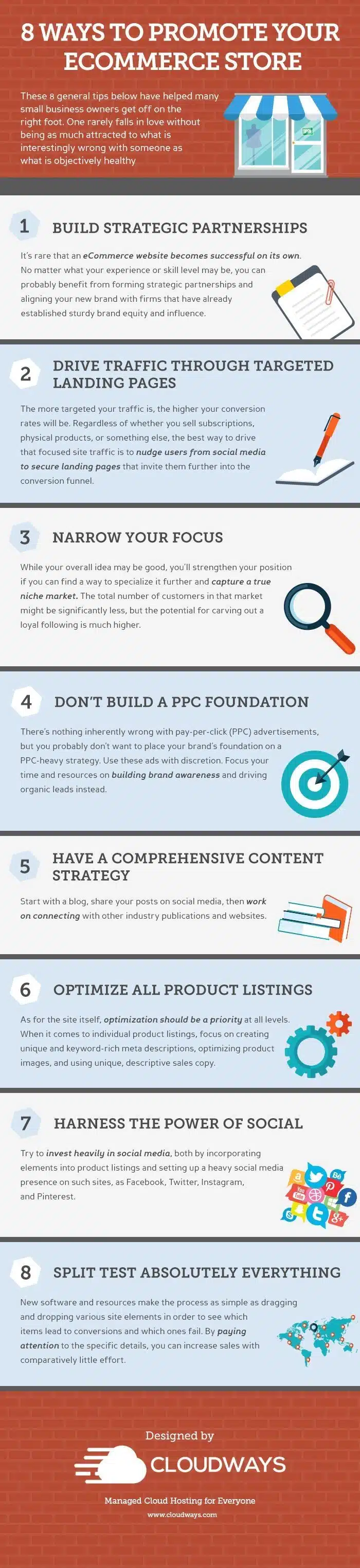
You’ll find some ecommerce basics in this infographic.
Here’s a summary of what’s covered:
- Build Strategic Partnerships
- Drive Traffic Through Targeted Landing Pages
- Narrow Your Focus
- Don’t Build a PPC Foundation
- Have a Comprehensive Content Strategy
- Optimise All Product Listings
- Harness the Power of Social Media
- Split Test Absolutely Everything
Check out the post below for more.
Promoting your ecommerce store doesn’t have to break the bank. In fact, many of the most effective marketing techniques are low-cost or even free. Whether you’re just getting started or looking to improve your store’s performance, the key is consistency and strategy.
This guide walks you through eight proven approaches to help you grow your ecommerce business on a budget—without cutting corners or relying solely on paid ads.
Build Strategic Partnerships
Forming partnerships with established businesses can instantly boost your visibility and reputation. These relationships are particularly valuable when you’re just starting out and don’t yet have a customer base or brand authority. Look for businesses that complement your own and share a similar target audience. Strategic partnerships open the door to collaboration, cross-promotion, and long-term growth.
- Reach out to non-competing brands with a similar customer base to explore co-promotional opportunities.
- Offer a bundled product or discount deal that benefits both sets of customers.
- Create guest content (blogs, videos, or webinars) for each other’s platforms to share expertise and exposure.
- Join local or niche industry networks to discover partnership possibilities and collaborative campaigns.
Drive Traffic Through Targeted Landing Pages
Generic web pages rarely convert—what you need are focused landing pages tailored to specific audiences or offers. Targeted landing pages make it easier to speak directly to customer pain points, leading to higher engagement and conversion rates. When your traffic is directed to a page designed for their needs, they’re more likely to act. This tactic is especially useful when running email, social, or influencer campaigns.
- Create a unique landing page for each marketing campaign or audience segment.
- Focus your copy on one key message or offer to avoid distractions and confusion.
- Include a clear call-to-action (CTA) that guides users toward a specific goal (e.g. buy, sign up, download).
- Use simple analytics tools to track how visitors interact with your landing pages and optimise based on results.
Narrow Your Focus
Trying to appeal to everyone rarely works in ecommerce. Instead, narrowing your focus to a specific niche allows you to build authority, fine-tune your messaging, and stand out from the competition. A targeted approach attracts highly engaged customers who are more likely to convert and stay loyal. The deeper your understanding of your audience, the more efficiently you can serve them.
- Define your ideal customer by demographics, interests, and buying behaviour.
- Study your competitors to see which niches they’re targeting and where you can differentiate.
- Tailor your website content, product descriptions, and visuals to appeal to your niche.
- Continuously gather customer feedback to refine your focus and stay relevant to your audience.
Don’t Build a PPC Foundation
Pay-per-click (PPC) ads can be effective, but relying on them as your main growth engine is risky and expensive. When budgets are tight, PPC should be used strategically, not as a default. Sustainable growth comes from building brand awareness, trust, and organic visibility. Focus on tactics that generate long-term returns rather than short-term traffic spikes.
- Allocate only a small portion of your budget to PPC while prioritising organic methods.
- Use PPC ads for short-term boosts, like seasonal promotions or new product launches.
- Continuously analyse your ad performance to ensure return on ad spend (ROAS) is worth it.
- Focus on building SEO, content, and email marketing for more cost-effective growth.
Have a Comprehensive Content Strategy
Content marketing is one of the most cost-effective tools for ecommerce promotion. A good content strategy not only attracts visitors but builds trust and positions your brand as a helpful resource. By sharing useful, educational, or entertaining content, you give people a reason to engage with your store beyond just making a purchase. Start with one platform and scale your efforts over time.
- Launch a blog focused on solving problems or answering questions your target customers have.
- Repurpose blog content into social media posts, infographics, and email campaigns.
- Write guest posts for relevant industry websites to boost exposure and backlinks.
- Regularly update your content to reflect new trends, products, or customer feedback.
Optimise All Product Listings
If your product listings aren’t converting, no amount of traffic will save your store. Every listing should be written to persuade, inform, and reassure customers. Optimisation means improving your copy, imagery, metadata, and user experience across all devices. Even small tweaks can make a big difference in how often your products show up in search and how many people complete purchases.
- Use descriptive, keyword-rich titles and product descriptions tailored to what people search for.
- Include high-quality product images from multiple angles and, if possible, videos or lifestyle shots.
- Add key selling points, size guides, delivery info, and FAQs to reduce buyer hesitation.
- Ensure your product pages load quickly and are mobile-friendly for smooth navigation.
Harness the Power of Social Media
Social media is a powerful, low-cost way to promote your ecommerce store and build customer relationships. Whether you’re creating content, responding to comments, or running contests, it gives you a direct channel to your audience. You don’t need to be on every platform—just the ones where your ideal customers spend their time. Consistency and engagement matter more than follower count.
- Choose 1–2 platforms your audience uses most and focus your efforts there.
- Post a mix of content types: behind-the-scenes, user-generated, tutorials, product launches.
- Engage with comments and messages promptly to build trust and brand loyalty.
- Use hashtags and social listening tools to join conversations and track trends.
Split Test Absolutely Everything
Every element of your store and marketing can be tested—and should be. Split testing (or A/B testing) helps you identify what works best for your audience without guessing. This approach allows you to improve conversion rates and performance over time using data, not assumptions. It’s one of the most affordable and reliable ways to boost ROI on a budget.
- Test different versions of headlines, CTAs, and product descriptions to find what converts best.
- Experiment with image placements, colour schemes, and layouts to improve engagement.
- Use free or low-cost A/B testing tools integrated into your ecommerce platform.
- Record your findings and apply what works to future campaigns and product pages.
Conclusion
Marketing your ecommerce store doesn’t require a massive budget—just a smart plan. By focusing on strategies like partnerships, content creation, landing pages, and continuous testing, you can drive meaningful growth without overspending.
Every small improvement compounds over time, so keep refining your efforts and learning from your audience. With the right approach and consistent action, your ecommerce store can thrive—even on a budget.

Author:
Mark Ford