How does your website compare to others in your industry? Does it help your business stand out from the crowd?
Creating a website that stands out doesn’t have to mean spending a huge amount of money, sometimes it’s the simple things that can have a far greater effect. And that’s the theme in this infographic from Nicole’s Classes.
Here are 9 simple tips that will help your website stand out.
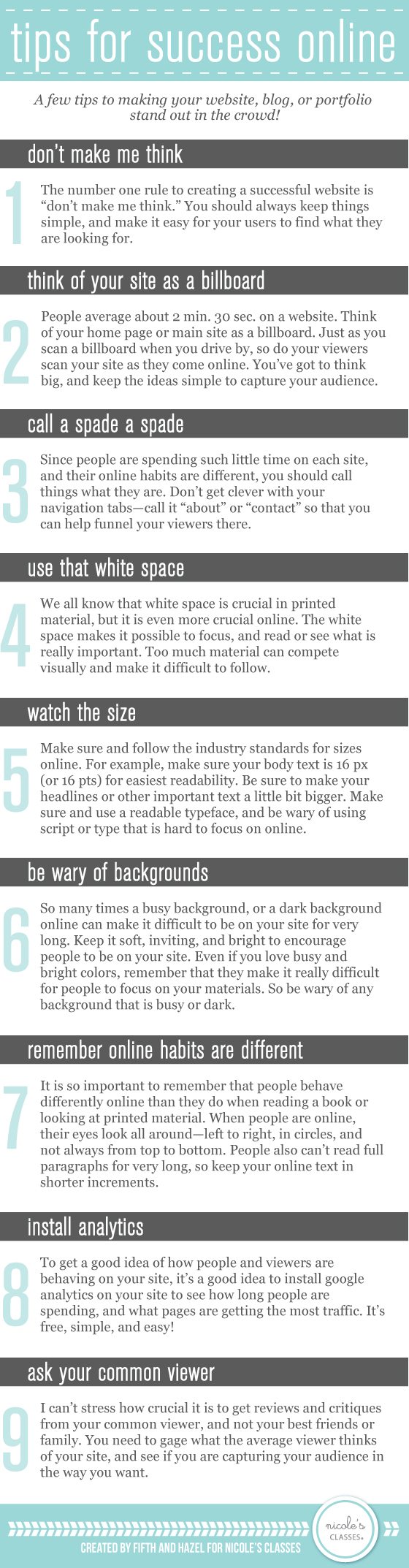
In today’s digital age, a website is often the first point of contact between your business or personal brand and your target audience. With countless websites vying for attention, it’s crucial to ensure that your website not only grabs the visitor’s attention but also leaves a lasting impression. Whether you’re an entrepreneur looking to attract more customers or a blogger trying to engage your readers, making your website stand out is key to your online success. In this blog post, we’ll explore nine simple tips to help you achieve just that.
1. Define Your Unique Selling Proposition (USP)
Before diving into design and content, it’s essential to define your Unique Selling Proposition (USP). Your USP is what sets you apart from your competitors and gives visitors a compelling reason to choose your website over others. Start by answering these questions:
- What makes your website unique?
- What problems does your website solve for your audience?
- Why should visitors trust and engage with your content or products?
Once you’ve identified your USP, make sure it’s prominently featured on your website, such as in your headline or tagline. This will immediately communicate your value to visitors and set the tone for their experience.
2. Optimize Website Speed
In today’s fast-paced world, users expect websites to load quickly. If your site takes too long to load, visitors may leave before even seeing your content. To optimize your website speed, consider the following:
- Use a reliable hosting service.
- Compress images and other media files to reduce their size.
- Minimize the use of large multimedia elements.
- Enable browser caching.
- Use Content Delivery Networks (CDNs) to distribute content efficiently.
By ensuring your website loads swiftly, you not only provide a better user experience but also improve your search engine rankings, as site speed is a factor Google considers when ranking pages.
3. Prioritize Mobile Responsiveness
With an increasing number of users accessing websites on mobile devices, it’s crucial to ensure that your website is mobile-responsive. This means that your site should adapt seamlessly to various screen sizes and orientations. Google also considers mobile-friendliness as a ranking factor, so optimizing for mobile is not just about user experience but also SEO.
To achieve mobile responsiveness, consider using a responsive website design framework or theme. Test your site on various devices to ensure that the layout and content display correctly. Remember to prioritize touch-friendly navigation and keep forms and buttons easily clickable on smaller screens.
4. Craft a Clean and Intuitive Design
A cluttered or confusing website design can drive visitors away. To make your website stand out, opt for a clean and intuitive design. Here are some design principles to follow:
- Choose a visually appealing color scheme that aligns with your brand.
- Use readable fonts and maintain consistent typography throughout the site.
- Ensure ample white space to improve readability and reduce visual noise.
- Implement a clear and intuitive navigation menu.
- Place essential information and calls to action (CTAs) above the fold (the area visible without scrolling).
A well-designed website not only looks appealing but also enhances the user experience, making it easier for visitors to find what they’re looking for.
5. Create High-Quality, Engaging Content
Content is the heart of your website. To truly stand out, you need to create high-quality, engaging content that resonates with your target audience. This includes blog posts, articles, videos, images, and any other content you offer.
Here are some content tips:
- Research your audience’s interests and pain points to create relevant content.
- Craft compelling headlines that pique curiosity.
- Use visuals, such as images and videos, to enhance your content.
- Write in a clear and engaging style.
- Offer valuable and actionable insights.
- Encourage user engagement through comments and social sharing.
Consistency is key when it comes to content creation. Regularly update your website with fresh content to keep your audience engaged and coming back for more.
6. Optimize for Search Engines (SEO)
To make your website stand out in the crowded digital landscape, you need to be discoverable. Search Engine Optimization (SEO) is the practice of optimizing your website to rank higher in search engine results. Here are some SEO tips:
- Research relevant keywords and incorporate them naturally into your content.
- Optimize meta titles and descriptions for each page.
- Use descriptive image alt tags.
- Create a sitemap and submit it to search engines.
- Build high-quality backlinks to your site from reputable sources.
- Monitor your site’s performance with tools like Google Analytics.
By improving your website’s SEO, you increase your chances of appearing on the first page of search results, driving more organic traffic to your site.
7. Incorporate User-Friendly Features
To enhance user experience and make your website memorable, consider incorporating user-friendly features. Some options include:
- A search bar to help visitors find specific content.
- A chatbot for real-time customer support.
- Social media integration for easy sharing.
- A newsletter signup form to build your email list.
- Testimonials and reviews to build trust.
- Interactive elements such as quizzes, polls, or calculators.
These features can not only improve user engagement but also set your website apart from the competition.
8. Focus on Page Loading Speed
In today’s fast-paced world, users expect websites to load quickly. If your site takes too long to load, visitors may leave before even seeing your content. To optimize your website speed, consider the following:
- Use a reliable hosting service.
- Compress images and other media files to reduce their size.
- Minimize the use of large multimedia elements.
- Enable browser caching.
- Use Content Delivery Networks (CDNs) to distribute content efficiently.
By ensuring your website loads swiftly, you not only provide a better user experience but also improve your search engine rankings, as site speed is a factor Google considers when ranking pages.
9. Test and Iterate
Finally, the key to making your website stand out is ongoing improvement. Regularly test different elements of your website, such as headlines, CTAs, and layouts, to see what resonates most with your audience. Use A/B testing tools to compare different versions of a webpage and determine which performs better.
Pay attention to user feedback and analytics data to identify areas for improvement. What are users saying about your site? Are there high bounce rates on specific pages? Use this information to make informed changes that enhance the user experience.
In conclusion, making your website stand out requires a combination of strategic planning, user-centered design, and continuous improvement. By defining your USP, optimizing website speed, prioritizing mobile responsiveness, crafting a clean design, creating high-quality content, optimizing for SEO, incorporating user-friendly features, focusing on page loading speed, and regularly testing and iterating, you can create a website that not only stands out but also delivers value to your audience and drives success for your business or personal brand. Remember that the digital landscape is ever-evolving, so staying adaptable and up-to-date is essential to maintain your website’s competitive edge.

Author:
Mark Ford

Mastering the Art of the Landing Page: Design, Copy, and Conversion in Harmony
Are you trying to design a landing page that not only looks great but actually converts visitors into customers? Want to learn how to balance design, copy, and strategy to create landing pages that work in perfect harmony? […]