Are you ready to discover how AI can help you work smarter, faster, and more creatively as an entrepreneur? Want to learn the essential AI skills that will shape the next generation of successful business leaders?
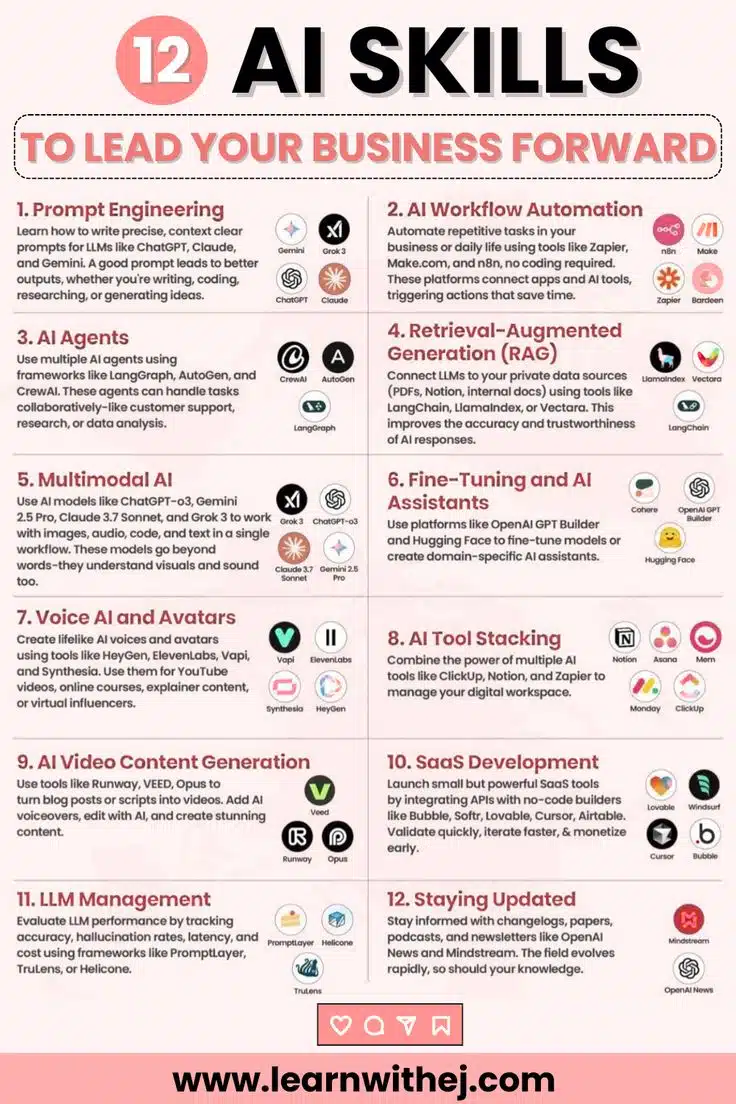
You’ll find the 12 most important AI skills for entrepreneurs in this infographic.
Here’s a summary of what’s covered:
- Prompt Engineering
- AI Workflow Automation
- AI Agents
- Retrieval-Augmented Generation (RAG)
- Multimodal AI
- Fine-Tuning and AI Assistants
- Voice AI and Avatars
- AI Tool Stacking
- AI Video Content Generation
- SaaS Development
- LLM Management
- Staying Updated
Check out the post below for more.
Artificial Intelligence (AI) has moved beyond being a futuristic concept—it’s now a vital business tool reshaping how entrepreneurs lead, innovate, and grow. From automating tasks to enhancing creativity and data analysis, AI allows leaders to make better decisions faster.
Yet, to truly leverage its potential, understanding the key skills behind these tools is essential. This guide explores 12 AI skills every forward-thinking entrepreneur should master to stay competitive in a rapidly evolving landscape.
Prompt Engineering
At the core of every AI interaction lies the prompt—the question or instruction that guides the model’s response. Great entrepreneurs know that precision in prompts leads to clarity in outcomes. Whether it’s for content creation, research, or strategy, learning to communicate effectively with AI tools like ChatGPT, Claude, or Gemini is a skill that separates users from innovators.
- Focus on clarity and context to guide AI outputs effectively.
- Experiment with tone, format, and intent to achieve specific results.
- Use structured prompts for tasks like content planning or market analysis.
- Continuously refine and iterate your prompts to improve consistency.
AI Workflow Automation
Automation allows entrepreneurs to free up time for strategy and innovation by letting AI handle repetitive work. With platforms like Zapier, Make.com, and n8n, you can connect apps and streamline operations without coding. This not only reduces manual effort but also ensures smoother workflows and fewer human errors.
- Map your regular tasks to identify automation opportunities.
- Use automation tools to connect key business apps seamlessly.
- Create triggers for email marketing, data entry, or social media scheduling.
- Regularly review and refine automated workflows for optimal performance.
AI Agents
AI agents represent the next stage of intelligent automation—digital assistants capable of managing complex workflows independently. Using frameworks like LangGraph, AutoGen, or CrewAI, you can deploy agents that collaborate to complete multi-step tasks such as research, data handling, or customer support. These agents act as a virtual team extension, boosting productivity at scale.
- Identify areas where autonomous agents can reduce workload.
- Combine multiple AI agents for layered, collaborative processes.
- Use them to handle tasks like market research or client communication.
- Monitor agent output to maintain accuracy and business alignment.
Retrieval-Augmented Generation (RAG)
RAG enhances the intelligence of large language models by connecting them to your own data sources. By using tools like LangChain, Llamalendex, or Vectara, you can create AI systems that reference internal documents, reports, or PDFs for highly accurate responses. This approach ensures that your business knowledge is built into your AI’s capabilities.
- Integrate your private databases and files for data-driven responses.
- Use RAG to increase trustworthiness in AI-generated information.
- Employ it to streamline internal knowledge-sharing and training.
- Update your data connections regularly to keep insights current.
Multimodal AI
Today’s most advanced AI models can interpret text, images, audio, and even code simultaneously. Tools like ChatGPT-o3, Gemini 2.5 Pro, and Claude 3.7 enable entrepreneurs to create cohesive workflows that combine creative and analytical tasks. This multimodal capability helps in branding, content creation, and technical innovation.
- Use AI to analyse both visual and written assets together.
- Combine text prompts with image or audio inputs for richer output.
- Leverage multimodal tools to create cohesive marketing campaigns.
- Explore cross-medium creativity, from video scripting to data visuals.
Fine-Tuning and AI Assistants
Customisation is key to making AI truly work for your business. Through fine-tuning, you can adapt AI models to match your brand’s voice or focus on specific business challenges. Platforms like OpenAI GPT Builder and Hugging Face allow entrepreneurs to develop tailored assistants that enhance decision-making, research, and customer experience.
- Train AI models on your own content to preserve brand tone.
- Create domain-specific assistants for marketing, sales, or support.
- Test and refine outputs to align with company standards.
- Explore fine-tuning as a scalable, long-term business advantage.
Voice AI and Avatars
As digital communication becomes more immersive, voice and avatar technology offer new ways to connect with audiences. Tools such as HeyGen, ElevenLabs, and Synthesia let entrepreneurs create realistic voiceovers and digital personalities. Whether for explainer videos, e-learning, or brand storytelling, Voice AI enhances engagement and relatability.
- Use AI-generated voices for product demos or tutorials.
- Develop virtual avatars to present your brand visually.
- Incorporate Voice AI into podcasts, webinars, or video marketing.
- Maintain authenticity by adjusting tone and pacing to match your audience.
AI Tool Stacking
Rather than relying on one platform, entrepreneurs are combining multiple AI tools to create powerful, interconnected systems. Known as tool stacking, this approach integrates project management, automation, and data tools for maximum efficiency. Apps like ClickUp, Notion, and Zapier make it easy to centralise tasks across your business ecosystem.
- Identify tools that complement each other’s strengths.
- Sync data across apps to eliminate manual duplication.
- Automate task management and reporting for smoother workflows.
- Periodically review your stack to replace or upgrade outdated tools.
AI Video Content Generation
Video remains one of the most effective mediums for marketing and education—and AI is transforming how it’s produced. Platforms like Runway, VEED, and Opus can turn scripts or blog posts into polished videos automatically. Entrepreneurs can now produce high-quality content faster, making visual storytelling accessible to all.
- Convert existing written content into professional videos.
- Add AI-generated voiceovers and captions for accessibility.
- Use templates and automation to maintain brand consistency.
- Experiment with short-form video formats for social media reach.
SaaS Development
Software as a Service (SaaS) is one of the most scalable business models, and AI makes it easier than ever to create. Entrepreneurs can now build apps without extensive coding knowledge using tools like Bubble, Lovable, and Airtable. These no-code platforms empower small teams to develop, test, and monetise new software quickly.
- Start small by building tools that solve niche problems.
- Integrate APIs and AI models to expand functionality.
- Use feedback loops to iterate and improve user experience.
- Focus on simplicity, scalability, and early monetisation.
LLM Management
Large Language Models (LLMs) are powerful but require active management to maintain quality and reliability. Tracking performance with frameworks such as PromptLayer, Trulens, or Helicone helps you assess accuracy, cost, and efficiency. For entrepreneurs relying on AI for core processes, this ensures long-term stability and trust.
- Monitor metrics like latency, accuracy, and cost per output.
- Identify and address hallucinations or inconsistencies in results.
- Use performance dashboards to manage multiple AI systems.
- Continuously optimise your models to match changing business needs.
Staying Updated
AI evolves at a remarkable pace, and staying informed is essential for any entrepreneur aiming to lead with innovation. Subscribing to industry newsletters, reading changelogs, and following AI research ensures you remain ahead of new developments. Tools like Mindstream and OpenAI News help filter what matters most to your business.
- Set aside time weekly to review AI updates and trends.
- Follow reliable newsletters and research sources consistently.
- Join communities or forums to exchange ideas and insights.
- Encourage your team to explore new AI tools collaboratively.
Conclusion
AI is no longer an optional advantage—it’s a fundamental skill set that defines modern entrepreneurship. The next generation of leaders will be those who not only adopt AI tools but also understand how to integrate, manage, and evolve with them.
From prompt engineering to automation, multimodal creation, and SaaS innovation, mastering these twelve skills will future-proof your business and open limitless opportunities.
By embracing AI with strategy and creativity, entrepreneurs can lead with greater insight, agility, and impact in a world driven by intelligent technology.

Author:
Mark Ford