
Are you tired of dealing with frustrating clients who make web design projects more difficult than they need to be? Want to know which types of clients web designers dread working with the most—and how to handle them?
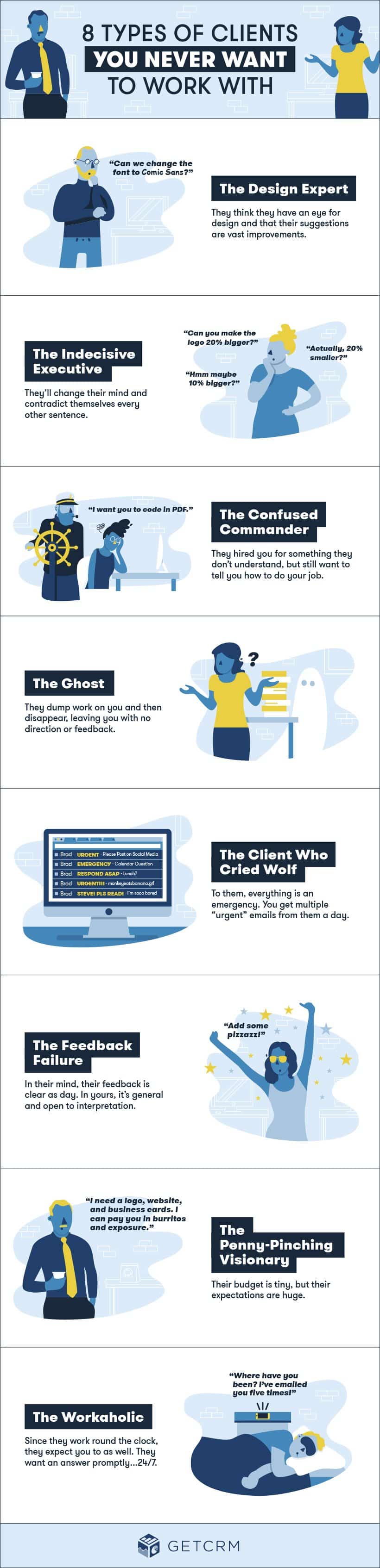
You’ll find the annoying clients to avoid in this infographic from GetCRM.
Here’s what makes the list:
- The Design Expert
- The Indecisive Executive
- The Confused Commander
- The Ghost
- The Client Who Cried Wolf
- The Feedback Failure
- The Penny-Pinching Visionary
- The Workaholic
Check out the infographic for more information.
As a web designer, you’ve likely encountered a wide range of clients—some wonderful and collaborative, others who make the job an absolute nightmare.
While every designer appreciates a well-informed and decisive client, certain types seem to thrive on making projects unnecessarily difficult. If you’ve been in the industry for any length of time, chances are you’ve come across at least a few of these frustrating client types.
Here’s a breakdown of the eight most challenging clients that web designers hate working with.
The “Design Expert”
This client fancies themselves as an artistic visionary, despite having no professional experience in design. They offer unsolicited advice, insist on bizarre font choices (yes, including Comic Sans), and suggest color schemes that make no sense.
Rather than trusting your expertise, they challenge every decision, convinced that their personal taste should dictate the entire website. They’ll send you endless inspiration images of websites they admire but refuse to acknowledge that each has a unique design strategy that might not suit their needs.
How to Handle Them:
Set clear boundaries early on. Offer professional explanations for your design choices, using examples and case studies to demonstrate best practices. If they persist, politely remind them why they hired an expert in the first place.
The Indecisive Client
This client is all over the place. One day they love minimalism; the next, they want a flashy, animation-heavy website. They ask for changes constantly, only to revert to previous versions.
Their indecision drags the project out, causing frustration, delays, and endless revision cycles. You might spend hours perfecting a design only to hear, “Actually, can we go back to the original?
How to Handle Them:
Limit revisions in your contract and set milestone approvals. Encourage them to make decisions based on their business needs rather than personal whims.
The “Everything is Urgent” Client
To this client, everything is a priority. They expect immediate responses, rush requests, and last-minute changes—all with zero consideration for your existing workload.
They’ll send multiple emails a day marked “URGENT,” demand weekend work, and seem oblivious to the fact that good design takes time. If you dare to take a day off, expect a flood of panicked messages asking why their email hasn’t been answered.
How to Handle Them:
Set clear boundaries and turnaround times in your contract. If they push for rush jobs, charge an extra fee for priority work. Manage expectations from the beginning to prevent unrealistic demands.
The “I Know Someone Who Can Do It Cheaper” Client
This client constantly reminds you that they can get the job done cheaper elsewhere. They haggle over pricing, question your rates, and try to get you to match a discount they found on a freelancing platform.
Even after agreeing on a budget, they keep looking for ways to cut costs. They want premium work at bargain prices and act as if your skills are easily replaceable.
How to Handle Them:
Stand firm on your pricing. If they threaten to go elsewhere, let them. Quality clients understand the value of professional work and are willing to invest in expertise.
The “Can You Just Add One More Thing?” Client
Scope creep is inevitable with this client. They start with a simple request but keep adding “just one more” feature until your workload has doubled with no extra pay.
What began as a straightforward five-page website morphs into an e-commerce platform with custom animations, SEO optimization, and a booking system—all without an increase in budget or timeline.
How to Handle Them:
Have a clearly defined scope in your contract and charge for additional work. Politely remind them that any extra requests will require a revised quote.
The Ghost Client
At first, this client is enthusiastic and engaged. Then, they vanish.
You send them drafts, proposals, or revision requests, only to be met with radio silence. Weeks pass, deadlines are missed, and you’re left wondering if the project is still happening.
Eventually, they resurface with last-minute demands, expecting you to drop everything to accommodate their sudden urgency.
How to Handle Them:
Set clear deadlines for client feedback. If they go silent for too long, implement a re-engagement fee or require upfront payment before resuming work.
The Micromanager
This client doesn’t just want a great website—they want to control every step of the process. They hover over your shoulder (figuratively or literally), nitpicking every pixel and questioning every decision.
They insist on approving every minor change, slowing down progress and making creative work nearly impossible. Nothing is ever “quite right” in their eyes.
How to Handle Them:
Explain your workflow and set communication limits. If necessary, update them at set intervals rather than allowing constant input that derails the process.
The “I Have No Idea What I Want” Client
Some clients have no clear vision, which is fine—until they expect you to figure it out for them without providing any direction. They give vague responses like “Just make it look good” or “I’ll know what I want when I see it.”
This lack of clarity leads to endless revisions as they struggle to articulate their preferences. It’s like trying to hit a moving target blindfolded.
How to Handle Them:
Ask detailed questions upfront to gather as much information as possible. Use visual examples to gauge their style preferences and get approval before proceeding.
Final Thoughts
Difficult clients are an inevitable part of web design, but they don’t have to derail your projects. By setting clear boundaries, having solid contracts, and managing expectations from the start, you can minimize stress and keep your business running smoothly.
If you’ve encountered one (or several) of these clients, take comfort in knowing you’re not alone. And remember—there are plenty of great clients out there who appreciate your expertise, value your time, and make the design process a rewarding experience.

Author:
Mark Ford