In the ever-evolving landscape of digital marketing, one term that you’ve likely come across time and time again is “content marketing.” It’s a buzzword in the industry, and for good reason.
Content marketing has become a cornerstone of successful marketing strategies for businesses of all sizes. But what exactly is content marketing, and why should you, as a beginner in the field, care about it?
In this comprehensive guide, we’ll break down the fundamentals of content marketing and explore the compelling reasons why you should make it an integral part of your marketing efforts.
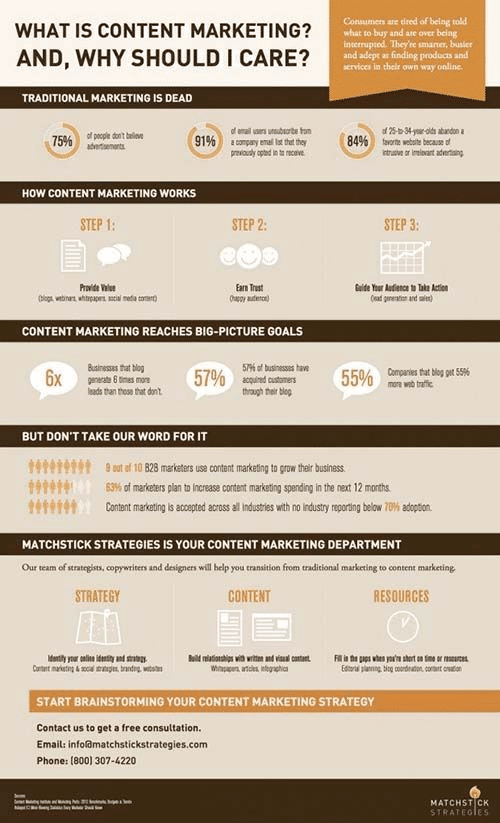
Infographic by Matchstick Strategies.
Chapter 1: Understanding Content Marketing
What is Content Marketing?
Content marketing is a strategic approach to marketing that involves creating and distributing valuable, relevant, and consistent content to attract and engage a clearly defined target audience. Unlike traditional advertising, which focuses on directly promoting products or services, content marketing seeks to provide information, entertainment, or utility to the audience, with the goal of building trust, credibility, and long-term relationships.
Key Components of Content Marketing
To fully grasp content marketing, it’s essential to understand its key components:
- Content Creation: This is the heart of content marketing. It involves creating various types of content, such as blog posts, articles, videos, infographics, podcasts, and more, that resonate with your target audience.
- Audience Research: Effective content marketing begins with a deep understanding of your target audience. You need to know their needs, preferences, pain points, and behaviors to create content that truly resonates.
- Content Distribution: Creating great content is just the first step. You must also strategically distribute it through various channels, such as your website, social media, email marketing, and more, to reach your audience effectively.
- Consistency: Content marketing is a long-term strategy. Consistency in creating and sharing content is crucial for building trust and keeping your audience engaged.
- Measurement and Analysis: To gauge the success of your content marketing efforts, you must track key metrics like website traffic, engagement, conversion rates, and return on investment (ROI). This data helps you refine your strategy over time.
Examples of Content Marketing
Content marketing comes in many forms and can be tailored to suit your business’s unique needs. Here are a few examples:
- Blog Posts: Publishing informative and engaging blog posts that address your audience’s questions or pain points can establish your authority in your industry.
- Video Tutorials: Creating video tutorials or how-to guides related to your products or services can help educate your audience and showcase your expertise.
- Infographics: Visual content like infographics can simplify complex information and make it more shareable on social media.
- Ebooks and Whitepapers: Offering in-depth ebooks or whitepapers can help generate leads by providing valuable insights in exchange for contact information.
- Social Media Content: Consistently posting engaging content on social media platforms helps you build a community and connect with your audience.
Chapter 2: Why Content Marketing Matters
1. Builds Brand Awareness
Content marketing is a powerful tool for increasing brand visibility. When you consistently create and share valuable content, you’re not just promoting your products or services; you’re also establishing your brand as a thought leader and a go-to resource in your industry. As more people come across your content and find it useful, they’ll begin to recognize and trust your brand.
2. Drives Organic Traffic
One of the primary benefits of content marketing is its ability to drive organic traffic to your website. When you create high-quality, SEO-optimized content, you’re more likely to rank higher in search engine results pages (SERPs). This means that when people search for information related to your industry, your content is more likely to show up, bringing organic traffic to your site.
3. Engages Your Audience
Engaging your audience is essential for building lasting relationships. Content marketing provides a platform for you to connect with your target audience on a personal level. Through blog comments, social media interactions, and email conversations, you can gain valuable insights into your audience’s needs and preferences, allowing you to tailor your content to better serve them.
4. Generates Leads and Conversions
Content marketing isn’t just about creating awareness; it’s also a powerful lead generation tool. By offering valuable content in exchange for contact information (such as email addresses), you can build a list of potential customers interested in your products or services. Furthermore, well-crafted content can influence purchase decisions, leading to higher conversion rates.
5. Enhances SEO
Search engines love fresh, relevant content. When you consistently publish valuable content on your website, you’re signaling to search engines that your site is a reputable source of information. This can result in improved search engine rankings and increased visibility in organic search results.
6. Establishes Authority and Trust
In a crowded marketplace, trust and authority are invaluable assets. Content marketing allows you to showcase your expertise and establish yourself as a trusted source of information in your niche. When people trust your brand, they’re more likely to choose your products or services over those of your competitors.
7. Cost-Effective Marketing
Compared to traditional advertising methods, content marketing can be incredibly cost-effective. While it does require an investment of time and resources to create high-quality content, the long-term benefits far outweigh the initial costs. Once your content is published, it continues to work for you, attracting and engaging your audience for years to come.
Chapter 3: Getting Started with Content Marketing
Now that you understand the importance of content marketing, let’s explore how to get started with your own content marketing strategy.
1. Define Your Goals and Objectives
Before you dive into content creation, it’s crucial to establish clear goals and objectives for your content marketing efforts. What do you hope to achieve? Are you looking to increase brand awareness, generate leads, drive website traffic, or boost conversions? Setting specific, measurable goals will guide your strategy and help you track your progress.
2. Know Your Audience
To create content that resonates with your target audience, you must first understand them thoroughly. Conduct audience research to identify their needs, preferences, pain points, and online behavior. Creating buyer personas can be a helpful exercise to visualize your ideal customers.
3. Choose the Right Content Types
Consider the types of content that will best serve your audience and align with your goals. Will blog posts, videos, infographics, podcasts, or a combination of these work best for your target demographic? Keep in mind that variety can be beneficial in keeping your audience engaged.
4. Develop a Content Calendar
Consistency is key in content marketing. Create a content calendar that outlines the topics, formats, and publication schedule for your content. This will help you stay organized and ensure that you’re consistently delivering valuable content to your audience.
5. Create High-Quality Content
When it comes to content marketing, quality should always take precedence over quantity. Invest time and effort in creating content that is well-researched, informative, and engaging. High-quality content not only attracts readers but also encourages them to share it with others.
6. Optimize for SEO
Search engine optimization (SEO) is crucial for getting your content discovered by a wider audience. Conduct keyword research to identify relevant keywords and phrases, and optimize your content accordingly. Pay attention to on-page SEO elements such as meta titles, descriptions, and headings.
7. Promote Your Content
Creating great content is only half the battle. You also need to promote it effectively. Share your content on social media platforms, email newsletters, and relevant online communities. Building backlinks from reputable websites can also boost your content’s visibility and authority.
8. Monitor and Measure
Regularly monitor the performance of your content marketing efforts. Use tools like Google Analytics to track website traffic, engagement metrics, and conversion rates. Analyze the data to identify what’s working and what needs improvement, then make adjustments to your strategy accordingly.
9. Adapt and Evolve
The digital landscape is constantly changing. To stay relevant and effective, be prepared to adapt and evolve your content marketing strategy as needed. Stay up-to-date with industry trends and emerging technologies to ensure your content remains competitive.
Chapter 4: Common Content Marketing Challenges
While content marketing offers numerous benefits, it’s not without its challenges. Here are some common hurdles you may encounter and how to address them:
1. Producing Consistent Content
Consistency is essential in content marketing, but it can be challenging to maintain. To overcome this challenge, create a content calendar and batch-produce content in advance. Consider outsourcing content creation to freelancers or agencies if needed.
2. Standing Out in a Crowded Space
With so much content being created and shared online daily, it can be difficult to stand out. Focus on producing unique, high-quality content that provides genuine value to your audience. Use storytelling and a unique brand voice to differentiate yourself from competitors.
3. Measuring ROI
Measuring the return on investment (ROI) of content marketing can be complex. To tackle this challenge, use analytics tools to track the performance of your content. Look at metrics such as website traffic, engagement, lead generation, and conversion rates. Over time, you’ll gain a clearer understanding of your content’s impact on your business.
4. Adapting to Algorithm Changes
Social media algorithms and search engine algorithms change frequently, affecting how your content is distributed and discovered. Stay informed about algorithm updates and be prepared to adjust your strategy accordingly. Diversify your content distribution channels to reduce reliance on a single platform.
5. Scaling Content Production
As your content marketing efforts grow, scaling content production can become a logistical challenge. Consider automating certain aspects of content distribution and investing in content management tools to streamline the process.
Chapter 5: Success Stories in Content Marketing
To inspire you on your content marketing journey, let’s take a look at a few success stories from companies that have excelled in content marketing:
1. Red Bull
Red Bull is known for its adventurous and extreme sports content. The company’s “Red Bull Stratos” campaign, which involved Austrian skydiver Felix Baumgartner breaking the sound barrier during a freefall from the edge of space, generated massive media coverage and social media buzz. Red Bull consistently produces exciting and shareable content, aligning with its brand image.
2. Blendtec
Blendtec, a manufacturer of blenders, gained worldwide recognition with its “Will It Blend?” video series. In these videos, the company’s founder, Tom Dickson, blended unconventional items like iPhones and golf balls to demonstrate the power of Blendtec blenders. The series went viral, showcasing how creative and entertaining content can drive brand awareness and engagement.
3. HubSpot
HubSpot, a marketing and sales software company, has established itself as an authority in the field of inbound marketing. They offer a wealth of educational content, including blog posts, ebooks, webinars, and courses, all designed to help businesses improve their marketing strategies. HubSpot’s content marketing efforts have not only attracted a massive audience but have also positioned them as a trusted resource in the industry.
Chapter 6: Conclusion
Content marketing is a dynamic and ever-evolving strategy that can yield remarkable results for businesses willing to invest time, effort, and creativity into their content. As a beginner in the field, understanding the fundamentals of content marketing and its significant benefits is the first step towards developing a successful strategy.
Remember that content marketing is a long-term commitment that requires consistent effort and adaptation. By defining clear goals, understanding your audience, creating valuable content, and promoting it effectively, you can build brand awareness, engage your audience, generate leads, and ultimately drive business growth.
As you embark on your content marketing journey, stay inspired by the success stories of companies like Red Bull, Blendtec, and HubSpot. They serve as reminders of the transformative power of content marketing when executed strategically and creatively.
So, why should you care about content marketing as a beginner? Because it has the potential to be the driving force behind your business’s success in the digital age. Embrace content marketing, and you’ll not only connect with your audience but also build a brand that stands out in a crowded marketplace. The possibilities are limitless, and the journey is both challenging and rewarding. Start creating compelling content today, and watch your business flourish in the world of content marketing.

Author:
Mark Ford

The Complete Content Mix: What Every Business Should Be Publishing
Are you struggling to decide what types of content your business should be publishing to attract more traffic and engagement? Want to learn how to build the perfect content mix that keeps your audience interested and your brand growing? […]