
Are you struggling to understand all the SEO jargon that gets thrown around in digital marketing? Want to finally decode the terms and acronyms that can make or break your online visibility?
You’ll find clear explanations of essential SEO terms in this guide.
Here’s a summary of what’s covered:
- SEO (Search Engine Optimisation)
- SMO (Social Media Optimisation)
- ASO (App Store Optimisation)
- AEO (Answer Engine Optimisation)
- LLMO (Large Language Model Optimisation)
- ORM (Online Reputation Management)
- CRO (Conversion Rate Optimisation)
- CTR (Click Through Rate)
- EEAT (Expertise, Experience, Authoritativeness, Trustworthiness)
- PPC (Pay Per Click)
Check out the post below for more.
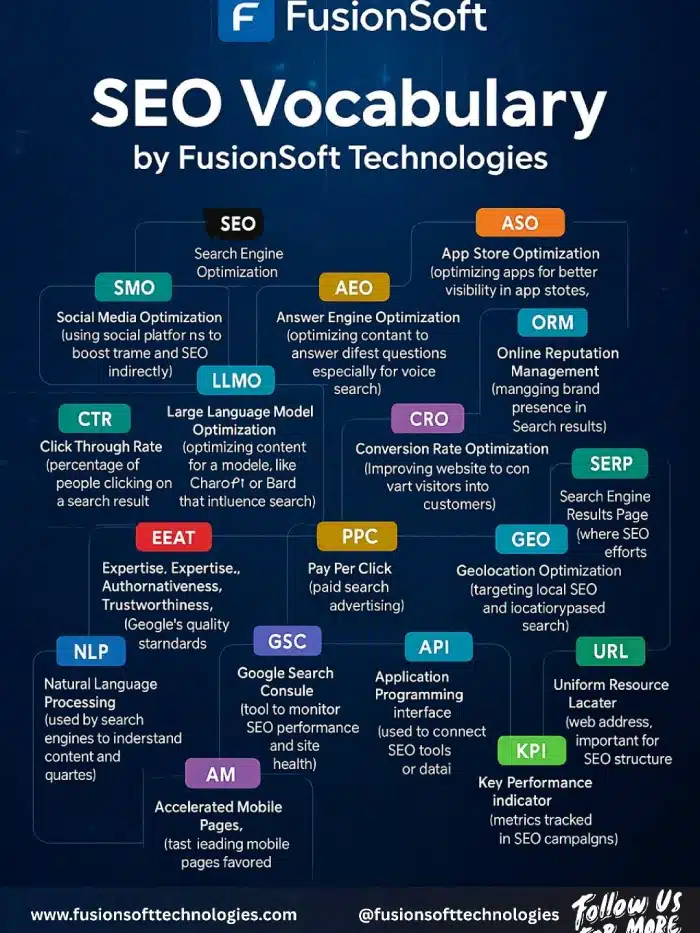
Search Engine Optimisation (SEO) is full of acronyms, technical jargon, and fast-evolving concepts that can leave even experienced marketers struggling to keep up. Understanding SEO vocabulary isn’t just about knowing the words – it’s about recognising how they connect to your digital strategy.
When you can speak the language of SEO, you make smarter marketing decisions, improve collaboration with technical teams, and see better results. This guide breaks down the essential SEO terms every marketer should know and how they fit into your broader digital strategy.
SEO (Search Engine Optimisation)
Search Engine Optimisation is the process of improving your website so it ranks higher in search engine results. It’s the foundation of all digital visibility and determines how easily your audience finds you online. From keyword research to technical performance, SEO connects every element of your web presence. Understanding SEO helps marketers make their content discoverable, relevant, and effective.
- Focus on keyword intent to match user searches with your content goals.
- Ensure your website is mobile-friendly and technically sound for crawling.
- Create valuable, original content that builds authority and trust.
- Use analytics tools to track ranking improvements and site performance.
SMO (Social Media Optimisation)
Social Media Optimisation supports SEO by increasing engagement and traffic through social platforms. While social signals don’t directly affect rankings, a strong presence can enhance brand awareness and attract valuable backlinks. When your social content resonates, it drives users to your site and strengthens your overall online authority.
- Share website content across your social channels to increase reach.
- Optimise social profiles with consistent branding and relevant keywords.
- Encourage sharing through engaging headlines and visual content.
- Monitor analytics to identify which platforms drive the most traffic.
ASO (App Store Optimisation)
App Store Optimisation focuses on improving an app’s visibility in app stores like Google Play and Apple’s App Store. It follows the same principles as SEO but applies them to mobile applications. By optimising titles, descriptions, and visuals, marketers can boost downloads and attract users searching for specific solutions.
- Research keywords used in app store searches and integrate them naturally.
- Use clear, compelling app titles and descriptions that reflect user needs.
- Incorporate high-quality screenshots and videos to increase conversions.
- Encourage positive reviews and regular updates to improve rankings.
AEO (Answer Engine Optimisation)
Answer Engine Optimisation is the next step beyond traditional SEO, focusing on providing direct, concise answers to user questions. It’s especially important in the age of voice search and AI-driven results. By structuring content to answer intent-based queries, marketers can secure featured snippets and voice responses.
- Use natural language in your content to mirror conversational search.
- Optimise headings and paragraphs around specific user questions.
- Include FAQ sections to target common search queries.
- Aim for clarity and brevity to increase the chance of being featured.
LLMO (Large Language Model Optimisation)
Large Language Model Optimisation prepares content for AI models like ChatGPT and Bard that influence search behaviour. These tools interpret, summarise, and surface content differently from traditional search engines. Optimising for LLMs means creating content that’s accurate, structured, and contextually rich.
- Write in a clear, factual style that AI models can easily interpret.
- Use structured data and semantic keywords for better contextual accuracy.
- Prioritise depth and authority over keyword repetition.
- Keep content updated so AI models recognise it as current and trustworthy.
ORM (Online Reputation Management)
Online Reputation Management involves shaping how your brand appears in search results. It’s about monitoring mentions, addressing negative feedback, and strengthening positive brand visibility. A strong ORM strategy ensures potential customers find accurate, positive information about your business.
- Track mentions of your brand and respond promptly to feedback.
- Publish authoritative content that reinforces your expertise.
- Encourage satisfied customers to share reviews or testimonials.
- Manage online listings to ensure consistent and accurate brand information.
CRO (Conversion Rate Optimisation)
Conversion Rate Optimisation focuses on turning website visitors into customers. It blends analytics, design, and psychology to refine the user journey. Effective CRO makes every click count by reducing friction, building trust, and guiding users toward meaningful actions.
- Use A/B testing to identify which design or message performs best.
- Simplify navigation and calls-to-action to reduce barriers.
- Highlight trust signals like reviews, certifications, or guarantees.
- Analyse user behaviour to uncover where conversions drop off.
CTR (Click Through Rate)
Click Through Rate measures how many people click on your content after seeing it in search results. It’s a vital indicator of relevance and appeal. High CTR means your headlines and descriptions resonate with users, improving both engagement and ranking potential.
- Write compelling meta titles and descriptions that encourage action.
- Use emotional or curiosity-driven language in headlines.
- Ensure URLs and snippets clearly reflect the search intent.
- Track CTR through Google Search Console to refine your content strategy.
EEAT (Expertise, Experience, Authoritativeness, Trustworthiness)
Google’s EEAT framework assesses the quality of content and the credibility of its creators. It’s a key factor in determining which pages rank well, especially in sensitive niches like health, finance, or news. Demonstrating EEAT helps build user confidence and long-term visibility.
- Include author bios that highlight relevant qualifications or expertise.
- Reference credible sources and data throughout your content.
- Keep all information accurate, up to date, and well structured.
- Build backlinks from authoritative websites to strengthen your domain trust.
PPC (Pay Per Click)
Pay Per Click advertising drives targeted traffic to your website through paid search placements. It complements SEO by generating immediate visibility while organic rankings grow. A well-managed PPC campaign ensures your budget is spent attracting qualified leads.
- Conduct keyword research to find high-intent, cost-effective terms.
- Write concise, persuasive ad copy with clear calls-to-action.
- Regularly monitor and adjust bids for optimal performance.
- Align ad landing pages with search intent for better conversions.
GSC (Google Search Console)
Google Search Console is an essential tool for tracking your website’s SEO performance. It reveals how Google views your site, highlighting issues and opportunities. Marketers use it to monitor indexing, fix errors, and measure keyword performance over time.
- Check regularly for crawl errors and resolve technical issues.
- Review performance reports to identify high- and low-performing pages.
- Submit XML sitemaps to help Google index your content efficiently.
- Use data insights to refine keywords and content focus areas.
API (Application Programming Interface)
An Application Programming Interface allows different software tools to communicate with one another. In SEO, APIs automate data collection, analysis, and reporting. They save time and improve accuracy by connecting analytics platforms, keyword tools, and performance dashboards.
- Integrate APIs to automate SEO tracking and data retrieval.
- Use APIs from Google, Ahrefs, or SEMrush for deeper insights.
- Customise reporting tools to fit your business metrics.
- Ensure secure connections and proper authentication between platforms.
URL (Uniform Resource Locator)
A URL is the address that leads users to a specific web page. It plays a crucial role in SEO structure, helping search engines understand your site’s hierarchy and relevance. Clean, keyword-friendly URLs improve both usability and ranking potential.
- Keep URLs short, descriptive, and aligned with page content.
- Use hyphens to separate words instead of underscores.
- Avoid unnecessary parameters or symbols that confuse crawlers.
- Maintain a consistent structure across your entire website.
KPI (Key Performance Indicator)
Key Performance Indicators measure the success of your SEO and marketing campaigns. They translate data into actionable insights, helping you identify what’s working and what isn’t. Choosing the right KPIs ensures your strategy stays focused on meaningful outcomes.
- Define KPIs that align with your business goals and SEO objectives.
- Track organic traffic growth, conversion rates, and engagement metrics.
- Use dashboards to visualise trends and identify improvement areas.
- Reassess KPIs regularly as your campaigns evolve.
GEO (Geolocation Optimisation)
Geolocation Optimisation focuses on improving visibility for location-based searches. It’s vital for businesses that rely on local customers, from restaurants to service providers. By tailoring your SEO strategy to your area, you attract nearby users ready to take action.
- Optimise Google Business Profile listings with accurate details.
- Include local keywords and location names in your content.
- Encourage local reviews and engagement to boost credibility.
- Ensure NAP (Name, Address, Phone) information is consistent everywhere.
SERP (Search Engine Results Page)
The Search Engine Results Page is where users see listings after entering a query. Understanding SERPs helps marketers identify opportunities for visibility, from organic listings to featured snippets. Monitoring changes in SERP layout keeps your strategy aligned with new trends.
- Analyse which SERP features appear for your target keywords.
- Aim for featured snippets, knowledge panels, and image results.
- Track competitors’ positions to refine your SEO approach.
- Adapt content format to align with evolving SERP features.
AMP (Accelerated Mobile Pages)
Accelerated Mobile Pages are designed for fast loading on mobile devices. They enhance user experience and can improve ranking on mobile searches. Implementing AMP ensures your content performs well even on slower connections.
- Use lightweight, clean code to minimise loading time.
- Optimise images and videos for mobile performance.
- Test your AMP pages in Google’s validation tool.
- Monitor analytics to track engagement and performance gains.
NLP (Natural Language Processing)
Natural Language Processing enables search engines to interpret meaning and intent within content. It powers semantic search, allowing algorithms to deliver more accurate results. For marketers, understanding NLP means writing content that connects with human language and AI comprehension.
- Use conversational phrasing and avoid keyword stuffing.
- Focus on topic clusters rather than isolated keywords.
- Write with clear structure so search engines can identify relationships.
- Include synonyms and contextually relevant terms for better reach.
Conclusion
SEO is far more than a list of tactics – it’s a language that connects technology, creativity, and human behaviour. By understanding the vocabulary behind it, marketers can bridge the gap between strategy and execution.
Each term, from AEO to NLP, represents a piece of the puzzle that determines how your brand performs online. Learn the language, apply the principles, and your marketing strategy will speak fluently in the world of search.

Author:
Mark Ford