Do you struggle to understand what SEO is all about? Not sure why Google ranks your competitors websites above yours?
If you don’t know your domain authority from your backlinks having a conversation about SEO will be difficult. And if you don’t understand something you’re more than likely not going to invest in it which could mean you don’t push your business forward.
For an explanation even your grannie would understand take a look at this infographic from iCandy Graphics.
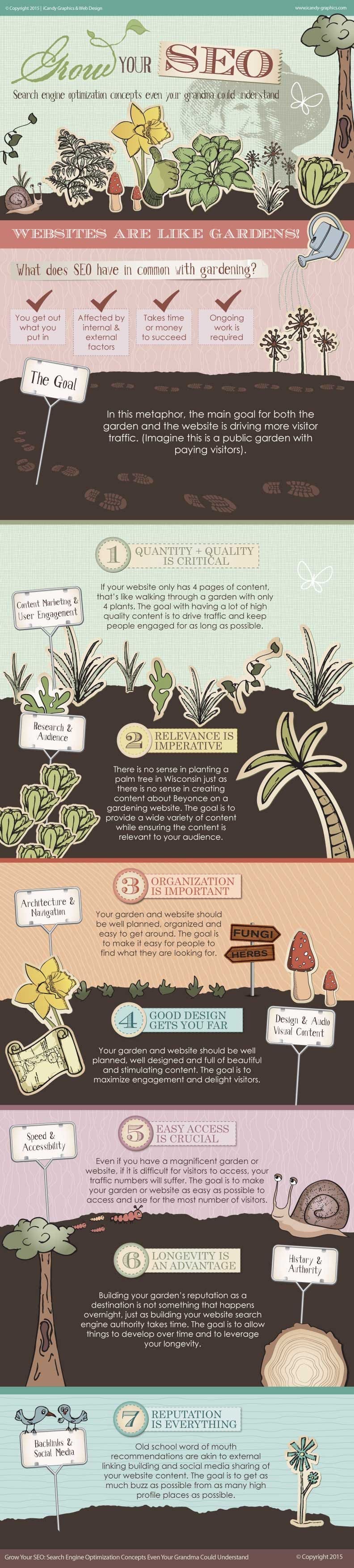
Search Engine Optimization, or SEO for short, is a term that gets thrown around a lot in the digital world. If you’re like most people, you’ve probably heard of it but may not fully grasp what it entails. Don’t worry; you’re not alone! SEO can seem like a complex and technical concept, but it doesn’t have to be. In this blog post, we’re going to break down SEO into simple terms that even your grandma would understand.
Chapter 1: What is SEO?
SEO stands for Search Engine Optimization, and it’s all about making your website more visible on search engines like Google, Bing, and Yahoo. Imagine the internet as a vast library filled with billions of books (websites). When you want to find a specific book (website), you go to the library’s search engine (Google) and type in your query. The search engine then scans its shelves (indexes the web) and shows you a list of books (websites) that match your search.
So, where does SEO come in? Well, think of it as the librarian’s job to organize the books in the library. The librarian wants to make sure that when you’re looking for a book on gardening, you don’t end up with books about cooking. SEO is like the librarian’s cataloging system for the internet, helping search engines understand what each website is about so they can deliver the most relevant results to your search queries.
Chapter 2: Keywords – The Building Blocks of SEO
Now that we’ve covered the basics, let’s dive a bit deeper. One of the fundamental concepts in SEO is keywords. Keywords are the words and phrases people use when searching for information online. For instance, if you’re looking for a recipe for chocolate chip cookies, your keywords might be “chocolate chip cookie recipe.”
In our library analogy, keywords are like the titles and topics of the books. When you optimize your website for specific keywords related to your content or business, you’re essentially telling the librarian (search engine) that your website has information about those topics.
For example, if you have a website about gardening, you’d want to include keywords like “gardening tips,” “how to plant flowers,” and “organic gardening” throughout your content. When someone searches for any of these keywords, your website is more likely to appear in the search results.
Chapter 3: On-Page SEO – Organizing Your Bookshelf
Now that we understand the importance of keywords let’s talk about on-page SEO. On-page SEO is like organizing your bookshelf to make it easier for the librarian to find the right books. Here are some key aspects of on-page SEO:
- Title Tags: Your website’s title tag is like the title of a book. It should be descriptive and contain your primary keyword. For example, if your website is about healthy eating, your title tag might be “Healthy Eating Tips and Recipes.”
- Meta Descriptions: Think of meta descriptions as the brief summaries you find on the back of books. They provide a sneak peek of what readers (searchers) can expect to find on your website. Include your keyword and make it enticing to encourage clicks.
- Headers (H1, H2, H3, etc.): Headers are like the chapter titles in a book. They break up your content and make it more organized and reader-friendly. Use headers to structure your content and incorporate keywords when it makes sense.
- Quality Content: Your content should be informative, well-written, and relevant to your target audience. Think of it as the content inside the book. If it’s engaging and valuable, people are more likely to read it and share it.
- Images and Alt Text: Images on your website need proper descriptions (alt text). This helps search engines understand what the images are about, making your content more accessible to all users, including those with visual impairments.
Chapter 4: Off-Page SEO – Building Relationships
Now, let’s discuss off-page SEO, which involves activities outside of your website to improve your online presence. Think of this as building relationships in the real world to gain credibility and recognition.
- Backlinks: Backlinks are like endorsements from other websites. When reputable websites link to your content, it’s like them recommending your book to their readers. The more high-quality backlinks you have, the more credible your website appears to search engines.
- Social Media: Social media shares and engagement are like word-of-mouth recommendations. When people share your content on platforms like Facebook, Twitter, and Instagram, it helps increase your website’s visibility and authority.
- Guest Blogging: Guest blogging is like being invited to write a chapter in someone else’s book. When you contribute valuable content to other websites in your niche, you can include links back to your site, which can drive traffic and improve your SEO.
Chapter 5: Technical SEO – Behind the Scenes
Now, let’s peek behind the scenes at technical SEO. This aspect of SEO focuses on the technical aspects of your website that affect its performance and search engine rankings.
- Site Speed: Site speed is like the speed at which pages turn in a book. A slow-loading website can frustrate visitors and lead to higher bounce rates. Search engines prefer fast websites, so optimizing your site speed is crucial.
- Mobile Optimization: With so many people using smartphones and tablets, it’s essential to have a mobile-friendly website. Think of this as making your book available in different formats so readers can enjoy it on any device.
- Sitemaps: A sitemap is like the table of contents in a book. It helps search engines navigate and index your website’s pages more efficiently.
- SSL Certificate: An SSL certificate is like a security feature that ensures your website is safe for users. It’s like knowing that the book you’re reading hasn’t been tampered with.
Chapter 6: Monitoring and Adaptation – The Ever-Evolving Library
SEO isn’t a one-and-done task; it’s an ongoing process. Think of it as constantly updating your library to keep it relevant and organized.
- Analytics: Analytics tools are like library statistics. They provide insights into how people are using your website, what keywords they’re searching for, and which pages are the most popular. This data helps you make informed decisions to improve your website’s performance.
- Algorithm Changes: Search engines like Google frequently update their algorithms (rules for organizing the library). Keeping up with these changes and adapting your SEO strategies is essential to maintaining your website’s visibility.
- Competition: Imagine other websites as neighboring libraries. You’ll want to keep an eye on what they’re doing and find ways to stay competitive. Are there new topics or keywords you should explore? Are there opportunities to collaborate or share resources?
Conclusion
SEO doesn’t have to be a mysterious and complex concept. It’s all about making your website more visible and accessible on the internet. Think of it as helping the librarian (search engine) organize the vast library of the internet so that your book (website) gets discovered by the right readers (searchers).
By understanding the basic principles of SEO, such as keywords, on-page and off-page optimization, technical aspects, and continuous monitoring, you can improve your website’s visibility and reach a wider audience. So, whether you’re a digital native or someone who still prefers physical books, you can now explain SEO to your grandma in terms she’ll understand. Happy optimizing!

Author:
Mark Ford