
So you own an Ecommerce website, you’re looking for ways to increase sales in 2017, what marketing trends should you be investing in?
The world of ecommerce is constantly evolving, and staying ahead of the curve is essential for online shop owners. In 2017, the ecommerce landscape saw significant changes and emerging trends that had a profound impact on how businesses marketed their products and services.
In this blog post, we will explore 20 trends in ecommerce marketing that were prevalent in 2017 and continue to shape the industry today.
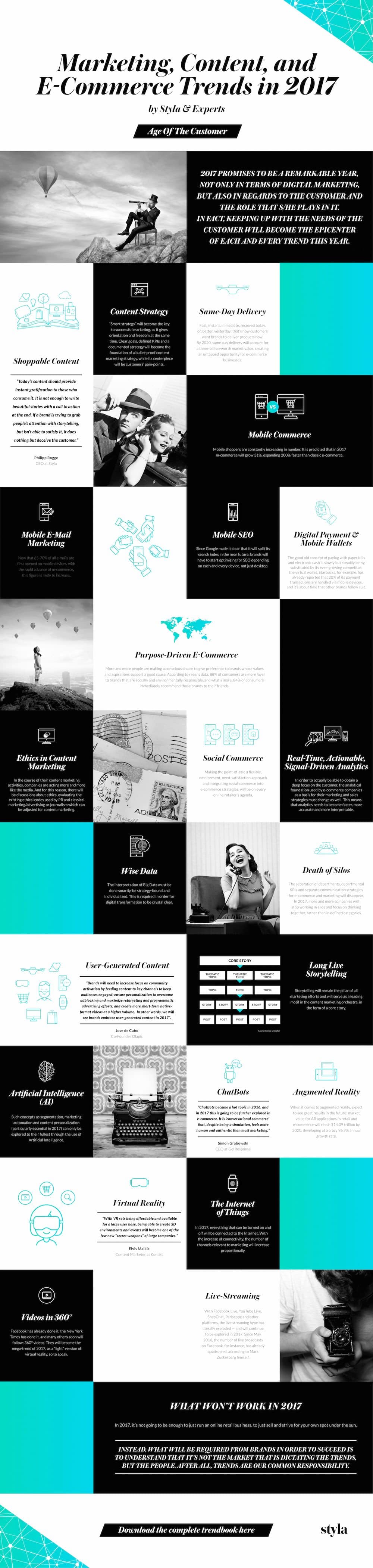
Styla share their Ecommerce marketing tips in this infographic.
1. Mobile-First Approach
Mobile devices became the primary gateway to the internet in 2017, and ecommerce businesses had to adapt. A mobile-first approach meant ensuring that websites were responsive, easy to navigate on small screens, and optimized for mobile search. Google’s mobile-first indexing made this even more critical, as websites that performed well on mobile devices were given preference in search rankings.
2. Personalization
Personalization became a key strategy in 2017. Ecommerce platforms and marketing tools allowed businesses to tailor their messaging and product recommendations based on user behavior and preferences. This led to higher engagement, conversion rates, and customer satisfaction.
3. Content Marketing
Content marketing continued to gain importance in 2017. Ecommerce businesses started focusing on creating valuable, informative, and engaging content that resonated with their target audience. Blog posts, videos, infographics, and social media updates played a significant role in building brand awareness and trust.
4. Social Commerce
Social media platforms like Facebook, Instagram, and Pinterest evolved into shopping destinations. Ecommerce businesses leveraged these platforms to showcase their products and enable direct purchases. Social commerce features, such as shoppable posts and buy buttons, made it easier for users to make purchases without leaving their favorite social apps.
5. Influencer Marketing
Influencer marketing gained momentum in 2017. Ecommerce businesses collaborated with social media influencers to promote their products to a wider and more engaged audience. Influencers’ authentic endorsements helped build trust and credibility.
6. Video Marketing
Video content became increasingly popular in 2017. Ecommerce marketers utilized video for product demonstrations, reviews, and storytelling. Live streaming on platforms like Facebook Live and Instagram Live allowed businesses to engage with their audience in real-time.
7. Chatbots and AI
Chatbots and artificial intelligence made their presence felt in customer service and marketing. Ecommerce websites integrated chatbots to provide instant assistance to customers, answer questions, and guide them through the purchase process. AI algorithms also improved product recommendations and personalized marketing.
8. Voice Search Optimization
With the rise of voice-activated devices like Amazon Echo and Google Home, optimizing for voice search became crucial. Ecommerce businesses started tailoring their SEO strategies to accommodate natural language queries, focusing on long-tail keywords and conversational content.
9. User-Generated Content
User-generated content, such as reviews, ratings, and customer photos, played a vital role in building trust and credibility. Ecommerce businesses encouraged customers to share their experiences and opinions, both on their websites and on social media.
10. Subscription Services
Subscription-based ecommerce models gained traction in 2017. Businesses offered subscription boxes and services, providing customers with a convenient and personalized shopping experience while securing recurring revenue.
11. Augmented Reality (AR) and Virtual Reality (VR)
AR and VR technologies were explored by ecommerce businesses to enhance the shopping experience. Customers could try on clothing virtually or visualize how furniture would look in their homes before making a purchase.
12. Social Proof and FOMO
Social proof and the fear of missing out (FOMO) were leveraged in marketing campaigns. Ecommerce businesses used tactics like limited-time offers, low-stock notifications, and social validation to drive conversions.
13. Email Marketing Automation
Email marketing continued to be a powerful tool, but automation took it to the next level. Ecommerce businesses used email marketing automation to send personalized product recommendations, abandoned cart reminders, and post-purchase follow-ups.
14. Sustainability and Ethical Shopping
Consumers in 2017 were increasingly concerned about the environment and ethical business practices. Ecommerce businesses responded by highlighting their commitment to sustainability, fair trade, and ethical sourcing.
15. Cross-Channel Marketing
Ecommerce marketers recognized the importance of a cohesive customer journey across multiple channels. They integrated their marketing efforts across email, social media, search, and other platforms to provide a seamless experience.
16. Big Data and Analytics
Big data analytics allowed ecommerce businesses to gain valuable insights into customer behavior. They used data-driven decision-making to optimize their marketing strategies, product offerings, and pricing.
17. Retargeting and Remarketing
Retargeting and remarketing campaigns became more sophisticated in 2017. Ecommerce businesses used dynamic ads and personalized messages to re-engage users who had shown interest but hadn’t completed a purchase.
18. Mobile Payments and Wallets
The convenience of mobile payments and digital wallets gained popularity among consumers. Ecommerce businesses integrated options like Apple Pay, Google Wallet, and PayPal to streamline the checkout process.
19. Social Messaging Apps
Ecommerce businesses explored the use of messaging apps like WhatsApp and Facebook Messenger for customer support and marketing. Chatbots were often integrated into these apps to provide instant assistance.
20. Reviews and Ratings as SEO Signals
In 2017, search engines began considering reviews and ratings as SEO signals. Ecommerce businesses encouraged customers to leave reviews, as positive feedback could improve their search engine rankings.
In conclusion, 2017 was a transformative year for ecommerce marketing. The trends mentioned above reshaped how online shop owners approached their marketing strategies. While some of these trends have evolved further, others have remained relevant in subsequent years. Staying informed about current trends and adapting to changing consumer behavior remains essential for success in the ever-evolving world of ecommerce. As we look back at these trends from 2017, we can see the foundation they laid for the future of ecommerce marketing.

Author:
Mark Ford