
Are you looking for smarter ways to increase conversions and reduce expenses in your ecommerce business? Want to discover how AI is transforming online retail through automation, personalisation, and real-time insights?
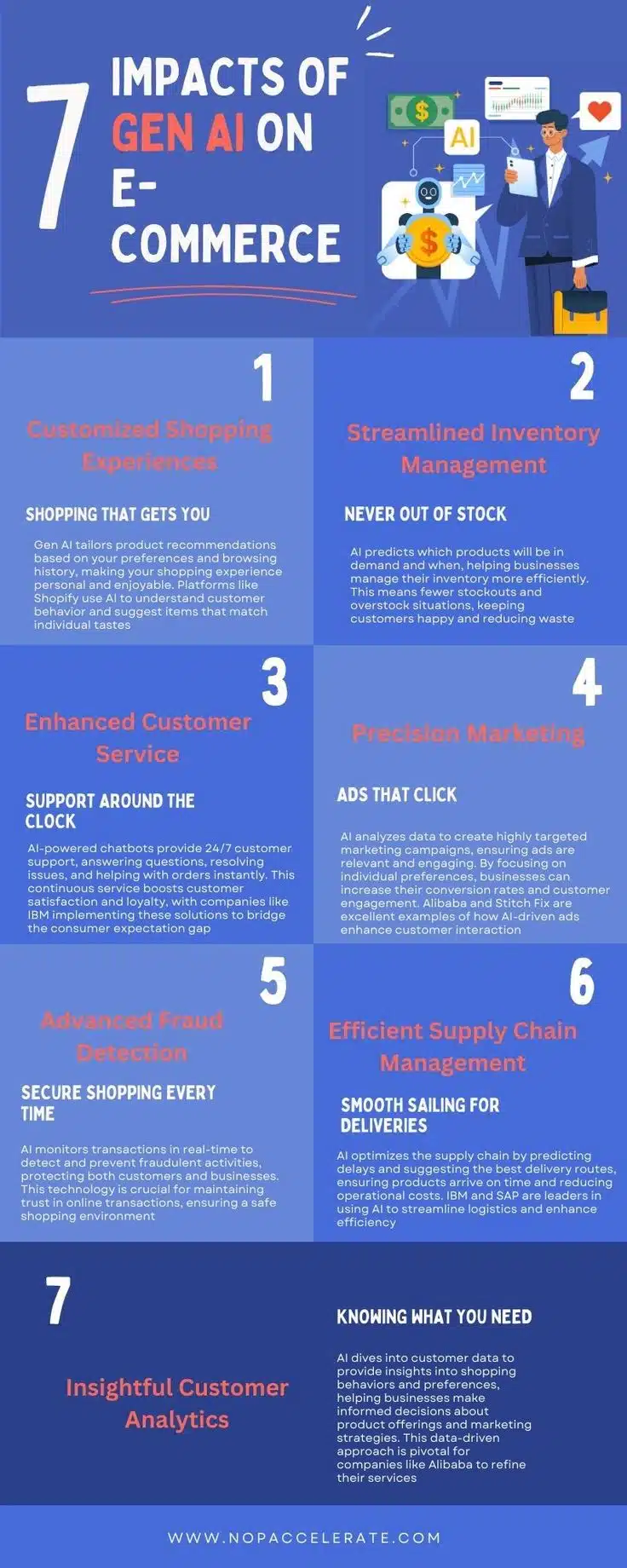
You’ll find some AI basics in this infographic.
Here’s a summary of what’s covered:
- Personalised Shopping Experiences
- Smarter Inventory Management
- Round-the-Clock Customer Service
- Targeted Marketing Campaigns
- Stronger Fraud Prevention
- Optimised Supply Chain Logistics
- Deeper Customer Insights
Check out the post below for more.
Artificial intelligence (AI) is no longer a futuristic concept—it’s a present-day powerhouse for ecommerce. From personalising the shopping experience to managing supply chains and detecting fraud, AI is transforming how online retailers operate.
Businesses that embrace AI are reaping the benefits of higher conversion rates and leaner operating costs. In this post, we’ll explore how AI is driving these results across seven key areas of ecommerce.
Personalised Shopping Experiences
Modern consumers expect more than just a basic online store—they want personalised experiences that reflect their tastes. AI makes this possible by analysing customer data to deliver targeted product recommendations. These tailored suggestions improve engagement, boost satisfaction, and ultimately drive conversions. The more relevant the shopping experience, the more likely customers are to buy.
- Use AI to recommend products based on browsing and purchase history.
- Incorporate dynamic content that adjusts based on individual preferences.
- Create automated follow-up emails with product suggestions tailored to past behaviour.
- A/B test personalisation strategies to identify what drives higher engagement.
Smarter Inventory Management
Inventory challenges can derail customer satisfaction and profitability. AI addresses this by predicting demand patterns and helping businesses stock products more efficiently. This reduces the risk of stockouts or overstocking, leading to smoother operations and reduced holding costs. Effective inventory management not only saves money but also protects the customer experience.
- Use predictive analytics to forecast sales trends and stock levels.
- Implement AI systems that auto-reorder best-selling items.
- Reduce waste and clearance costs by avoiding over-purchasing slow-moving stock.
- Sync inventory data across channels to maintain accurate stock visibility.
Round-the-Clock Customer Service
In a 24/7 digital economy, customers expect fast, accessible support—anytime, anywhere. AI-powered chatbots and virtual assistants provide instant answers to common queries, order issues, and product questions. This availability boosts trust, improves satisfaction, and frees up human teams for more complex tasks. Always-on service creates a seamless customer journey that enhances conversions.
- Deploy chatbots to handle FAQs, returns, and basic support tasks.
- Use AI to escalate more complex queries to live agents automatically.
- Analyse chatbot transcripts to refine responses and improve accuracy.
- Integrate AI chat into multiple touchpoints like websites, apps, and social platforms.
Targeted Marketing Campaigns
Generic advertising is quickly becoming obsolete. With AI, ecommerce businesses can build laser-focused marketing campaigns that speak directly to each customer segment. By analysing behaviour and preferences, AI ensures that the right message reaches the right person at the right time. This level of precision boosts ad performance while reducing wasted ad spend.
- Leverage AI tools to segment audiences by behaviour, interest, and demographics.
- Optimise ad copy and creatives through machine learning insights.
- Use predictive analytics to determine the best time to serve ads.
- Continuously test and refine campaigns to maximise ROI and lower CPCs.
Stronger Fraud Prevention
Fraud is a major concern for online retailers, and AI is proving to be a powerful deterrent. By monitoring transactions in real time, AI systems can flag suspicious activity before damage is done. This proactive approach not only protects businesses financially but also reinforces customer trust. Safe shopping environments are essential to sustaining conversions.
- Implement real-time transaction monitoring for unusual patterns.
- Use AI to detect identity theft, account takeovers, and bot-driven fraud.
- Set up adaptive verification measures based on risk profiles.
- Regularly update fraud detection models using the latest data and trends.
Optimised Supply Chain Logistics
A slow or unreliable delivery process can quickly undo all your hard work in marketing and sales. AI helps ecommerce brands streamline logistics by forecasting delays, optimising routes, and managing delivery windows. This leads to faster fulfilment, happier customers, and lower shipping costs. An efficient supply chain supports both growth and margin control.
- Use AI to analyse traffic, weather, and historical data for route optimisation.
- Forecast peak periods and pre-empt potential fulfilment bottlenecks.
- Partner with logistics providers that offer AI-enhanced delivery tracking.
- Monitor performance KPIs like delivery time, cost-per-package, and error rates.
Deeper Customer Insights
Data is the fuel of AI—and when analysed correctly, it provides invaluable insights into customer behaviour. AI tools can spot trends, predict needs, and recommend strategic actions for product development and marketing. This intelligence helps ecommerce businesses stay one step ahead, offering what customers want before they ask for it. Smarter decisions drive better results.
- Use AI to identify high-value customer segments and their behaviours.
- Track onsite actions to understand what influences conversion paths.
- Feed insights into product planning, merchandising, and pricing strategies.
- Combine AI insights with customer feedback for well-rounded optimisation.
Conclusion
AI is not just enhancing ecommerce—it’s redefining what’s possible. By improving personalisation, streamlining operations, reducing risk, and deepening customer understanding, AI empowers businesses to convert more customers while lowering costs.
Those who embrace AI technologies today will be better equipped to compete, grow, and lead in the digital marketplace of tomorrow. The future of ecommerce isn’t just digital—it’s intelligent. Now is the time to take advantage.

Author:
Mark Ford