
Are you trying to improve your website’s visibility in Google search results? Want to know which SEO factors have the biggest impact on your rankings?
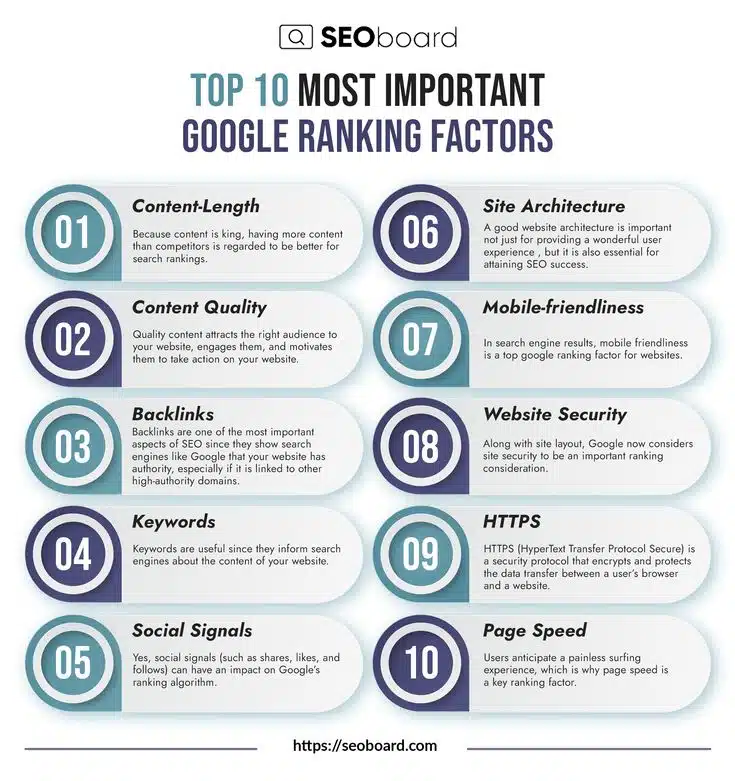
You’ll discover the building blocks of SEO in this infographic from SEOboard.
Here’s what makes the list:
- Content Length
- Content Quality
- Backlinks
- Keywords
- Social Signals
- Site Architecture
- Mobile-Friendliness
- Website Security
- HTTPS
- Page Speed
Check out the post below for more.
Getting your website noticed on Google isn’t just about having great content—it’s about understanding what Google actually looks for. With so many factors affecting your rankings, it can be difficult to know where to focus your efforts.
That’s why we’ve broken down the ten most important SEO ranking factors you need to know. Master these, and you’ll be well on your way to better visibility, more traffic, and stronger online performance.
Content-Length
Longer content tends to perform better in search results because it allows you to provide more comprehensive information. It also gives you space to naturally include relevant keywords, answer related questions, and build topical authority. But more doesn’t always mean better—you still need to maintain quality. Focus on creating valuable long-form content that fully covers the topic.
- Aim for blog posts and pages with at least 1,000 words to provide depth.
- Use subheadings and bullet points to improve readability of long content.
- Include a clear introduction and summary to guide users through the page.
- Research competitors’ content length for your target keywords and aim to exceed it.
Content Quality
High-quality content is what keeps visitors engaged, earns backlinks, and signals to Google that your site is valuable. It should be well-written, informative, and genuinely useful to your target audience. Quality also means originality—avoid duplicate content and strive to offer something better than what’s already out there. If users love your content, Google will too.
- Write for your audience, not just for search engines—answer real questions.
- Use data, examples, and statistics to support your points and build credibility.
- Keep your content up to date, especially on fast-changing topics.
- Avoid keyword stuffing—focus on natural, conversational writing.
Backlinks
Backlinks are still one of the most powerful ranking factors. When other reputable sites link to yours, it tells Google that your content is trustworthy and authoritative. Not all backlinks are equal, though—quality matters more than quantity. Building backlinks takes time, but it’s worth the effort for long-term SEO growth.
- Reach out to industry blogs and websites for guest posting opportunities.
- Create link-worthy content such as original research, guides, or infographics.
- Use tools to identify and replicate your competitors’ backlink profiles.
- Avoid spammy or irrelevant links that could harm your site’s credibility.
Keywords
Keywords help Google understand what your content is about, making them a critical part of any SEO strategy. But modern keyword use isn’t about stuffing the same phrase into every paragraph. It’s about understanding user intent and using relevant terms in a natural, useful way. Smart keyword targeting can dramatically improve your rankings.
- Do keyword research to identify high-volume, low-competition search terms.
- Include keywords in key places like the title, headings, URL, and meta description.
- Use variations and related terms to help capture more search queries.
- Map specific keywords to individual pages to avoid keyword cannibalisation.
Social Signals
While social media shares and likes don’t directly affect Google rankings, they can still influence your SEO. Social signals can drive traffic to your site, increase engagement, and help content get noticed by bloggers and journalists who might link to it. In this way, social visibility supports your overall SEO efforts.
- Share all new content across your main social media platforms.
- Encourage users to share your content with clear call-to-actions.
- Add social sharing buttons to your website to make it easy for visitors.
- Repurpose blog posts into social-friendly formats like carousels or short videos.
Site Architecture
A well-organised website structure helps users navigate your site and allows search engines to crawl it more efficiently. When your site is easy to explore, Google is more likely to index your pages and understand how they relate to each other. Good architecture also improves the user experience, which can indirectly impact your rankings.
- Use a clear, logical hierarchy with categories, subcategories, and internal links.
- Make sure every page is accessible within a few clicks from the homepage.
- Create an XML sitemap and submit it to Google Search Console.
- Avoid broken links and redirect chains that can confuse users and bots.
Mobile-Friendliness
With the majority of searches now happening on mobile devices, mobile-friendliness is no longer optional. Google uses mobile-first indexing, meaning it looks at the mobile version of your site to decide where you rank. If your site isn’t easy to use on a phone, you’re losing both traffic and rankings.
- Use a responsive design that automatically adjusts to different screen sizes.
- Ensure text is readable without zooming and buttons are easy to tap.
- Test your site with Google’s Mobile-Friendly Test tool.
- Avoid mobile popups that interrupt the user experience and can trigger penalties.
Website Security
Security isn’t just important for protecting your users—it’s also a ranking signal for Google. Websites that use HTTPS are prioritised over those that don’t. If your site isn’t secure, users may be warned before visiting, which can hurt both trust and traffic. Making your site secure is a simple but essential SEO step.
- Install an SSL certificate to enable HTTPS across your entire site.
- Regularly update your CMS, plugins, and themes to patch vulnerabilities.
- Use strong passwords and limit access to your website admin area.
- Monitor your site for malware and remove any security threats immediately.
HTTPS
HTTPS (HyperText Transfer Protocol Secure) encrypts data between the user and your website, adding an extra layer of protection. Google has confirmed that HTTPS is a ranking signal, and browsers often warn users when visiting non-secure sites. If you’re still using HTTP, now is the time to switch.
- Choose a reputable hosting provider that offers free or low-cost SSL certificates.
- Migrate your site to HTTPS carefully, using 301 redirects for all HTTP pages.
- Update all internal links and canonical tags to point to HTTPS versions.
- Test your site with tools like SSL Labs to ensure your HTTPS setup is secure.
Page Speed
Page speed plays a huge role in both user experience and SEO. If your site takes too long to load, users will leave—and Google will take notice. A fast website helps reduce bounce rates, increase engagement, and improve your position in search results. With Core Web Vitals now a ranking factor, speed matters more than ever.
- Optimise images by compressing them without sacrificing quality.
- Minify CSS, JavaScript, and HTML to reduce file sizes and load times.
- Use a content delivery network (CDN) to serve content faster to global users.
- Choose fast, reliable hosting and consider upgrading if your site is slow.
Final Thoughts
If you want to climb the search rankings, you need more than just a basic understanding of SEO. You need to know exactly what Google values—and then optimise your site around those factors. From creating better content and earning quality backlinks to improving mobile usability and site speed, these 10 ranking signals offer a roadmap to SEO success.
Remember, SEO is not a one-time fix. It’s a long-term strategy that requires consistent effort and regular updates. Focus on these key factors, monitor your performance, and keep refining your approach. With time and persistence, you’ll see your rankings—and your results—start to grow.

Author:
Mark Ford