
Want to boost your rankings by creating content Google actually trusts? Curious how to apply E-E-A-T principles to improve your SEO performance?
You’ll find some SEO basics in this infographic.
Here’s a summary of what’s covered:
- Experience
- Expertise
- Authoritativeness
- Trustworthiness
Check out the post below for more.
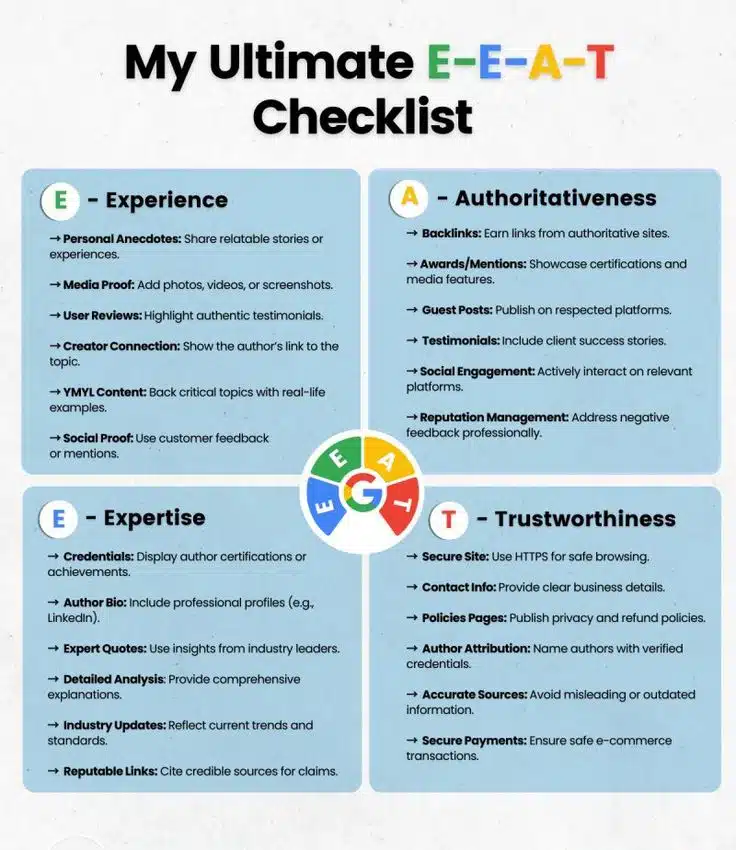
Google no longer rewards content that simply hits a keyword quota. Today, if you want to rank well and earn long-term trust from both users and search engines, you need to focus on quality—and that means aligning with Google’s E-E-A-T principles: Experience, Expertise, Authoritativeness, and Trustworthiness.
In this blog post, you’ll learn how to master each E-E-A-T pillar by understanding what it means and how to demonstrate it effectively. With practical tips and examples, this guide will help you improve your SEO through content that’s not just optimised—but genuinely credible.
Experience
Experience is about demonstrating first-hand knowledge of the subject you’re writing about. Google wants to see that content has been created by someone who has personally engaged with the topic. This makes your content more trustworthy and relatable, especially when it reflects real-world insight or use.
- Share personal anecdotes: Include real stories or case studies that show how you’ve engaged with the topic first-hand.
- Use original media: Support your narrative with your own photos, videos, or screenshots to reinforce authenticity.
- Highlight creator involvement: Make it clear that the author has lived the subject—whether through work, lifestyle, or events.
- Feature user feedback: Add reviews or testimonials that reflect shared experiences and support your perspective.
Expertise
Expertise is about demonstrating knowledge, qualifications, and depth of understanding. Google assesses whether the content creator has the ability to accurately explain or analyse the subject. This is especially important for content in YMYL (Your Money or Your Life) categories such as health, finance, or legal advice.
- Display credentials: Show relevant qualifications, certifications, or years of experience to validate your authority on the topic.
- Use detailed explanations: Go beyond surface-level content—offer in-depth insights that reflect advanced understanding.
- Include expert quotes: Incorporate commentary from recognised professionals in your field to support your content.
- Link to author bios: Provide clear author attribution with bios that outline why they’re qualified to write about the subject.
Authoritativeness
Authoritativeness goes a step further than expertise. It reflects how others perceive your brand or content in the wider online ecosystem. Google looks at external signals—such as backlinks, media coverage, and mentions—to determine whether your content comes from a trusted, recognised source.
- Earn quality backlinks: Secure links from reputable, relevant websites in your niche to boost your authority.
- Showcase recognition: Mention any awards, endorsements, or media features that signal your credibility.
- Include client testimonials: Use genuine customer feedback to demonstrate industry reputation and satisfaction.
- Contribute to respected platforms: Publish articles or opinions on well-known websites or industry forums to expand your profile.
Trustworthiness
Trustworthiness underpins all of the E-E-A-T principles. Even with deep experience and expert knowledge, your content must be reliable and your site must be secure. Google rewards websites that are transparent, honest, and safe to use—especially when dealing with sensitive or transactional content.
- Secure your website: Use HTTPS and reliable hosting to protect user data and build confidence.
- Add clear contact information: Display your business address, phone number, and email to establish legitimacy.
- Publish important policies: Include up-to-date privacy, cookie, and refund policies that are easy to find.
- Fact-check your content: Avoid misleading or outdated information by referencing trusted sources and citing them clearly.
Conclusion
E-E-A-T isn’t just another SEO acronym—it’s a framework that reflects how Google defines quality. By showing real-world experience, backed by proven expertise, reinforced through authoritative signals, and delivered with full transparency, your content can rise above the noise and perform better over time.
If your SEO strategy still revolves around keyword density alone, it’s time to rethink. Focus on creating content that users find valuable, credible, and safe—and Google will reward you accordingly.

Author:
Mark Ford