
Are you trying to make your content easier to find through voice search? Want to learn how to optimise your site for natural, spoken queries in just three simple steps?
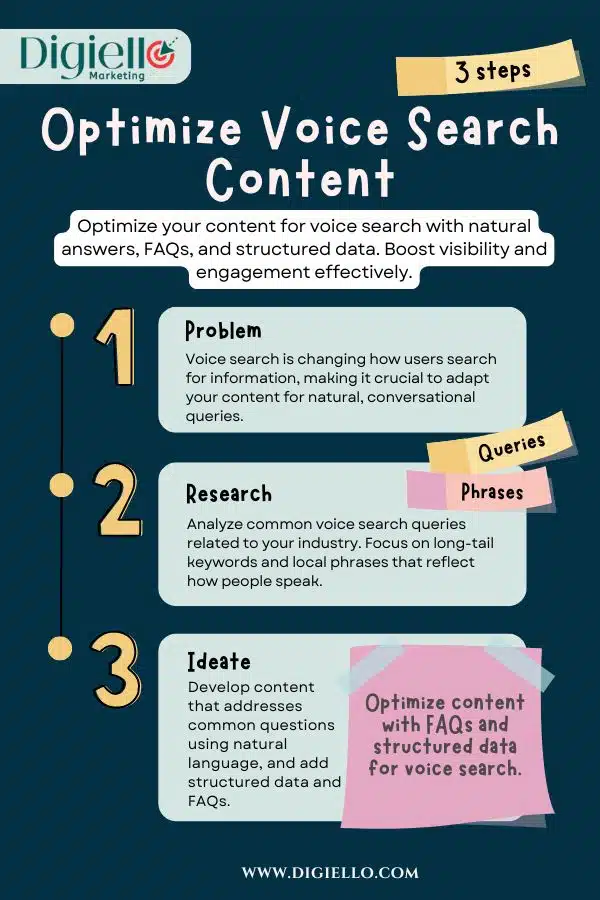
You’ll find some voice SEO basics in this infographic from Digiello Marketing.
It breaks things down as follows:
- Identify the Problem
- Conduct Research
- Ideate and Create
Check out the post below for more.
Voice search is no longer just a tech trend—it’s a digital shift that’s transforming the way users interact with search engines. As more people turn to voice assistants like Siri, Alexa and Google Assistant, optimising your content for voice search is crucial for staying visible and relevant.
The good news? You don’t need to overhaul your entire strategy. Just follow these three simple steps to get started.
Identify the Problem
Voice search has changed how people ask questions and seek information online. Instead of typing fragmented keywords, users now ask complete, natural-sounding questions. This shift means your content must match the way people speak—not just how they type. By understanding this change, you’ll be in a better position to create content that answers spoken queries clearly and effectively.
- Think conversation-first: Focus on how someone would verbally ask a question rather than how they’d type it. For example, “What’s the best way to clean a leather sofa?” instead of “clean leather sofa tips.”
- Review your existing content: Identify content that relies heavily on keyword stuffing or robotic phrasing, and rewrite it using natural, flowing language.
- Use tools like Google’s “People Also Ask”: These insights reveal how real users frame questions, helping you better understand the voice search mindset.
- Study your own FAQs: Look at common questions customers ask via email, phone or social media—these are often direct reflections of voice-style queries.
Conduct Research
Effective voice search optimisation starts with understanding what people are actually saying into their devices. This means shifting your focus from short, typed keywords to longer, more conversational phrases. Research plays a critical role here—especially around user intent, question formats, and localised expressions. The more you tune into how people speak, the more accurate your content targeting becomes.
- Use long-tail keyword tools: Tools like AnswerThePublic or Ubersuggest can reveal question-based searches that mimic voice queries.
- Look for local variations: Voice search often has a local intent (e.g. “Where’s the best pizza near me?”), so include phrases that reflect regional speech patterns or place names.
- Analyse competitor content: See which sites rank for voice-friendly queries and examine how they structure their content and language.
- Focus on intent-based searches: Break queries down into categories like informational (“how do I…”), navigational (“where can I…”), and transactional (“can I buy…”), then match your content accordingly.
Ideate and Create
Now it’s time to turn your research into action. The key is to create content that mirrors how people speak and search. Use clear, concise language, and aim to answer specific questions quickly. Adding structured data and dedicated FAQ sections will help your content get picked up by voice assistants, increasing your chances of appearing in voice-driven search results.
- Build an FAQ page: Create a dedicated FAQ section where each question mirrors how someone might ask it out loud. Provide direct, succinct answers.
- Use schema markup: Structured data helps search engines understand your content and surface it in voice results—especially for rich snippets.
- Write for featured snippets: Use short, clear paragraphs that directly answer common questions, making it easier for Google to pull your content for voice responses.
- Keep it mobile-friendly: Most voice searches happen on mobile, so make sure your pages load quickly, are easy to navigate, and deliver immediate value.
Bonus Tips to Supercharge Your Voice Search Strategy
Voice search optimisation doesn’t stop with content creation—it extends to your website’s overall performance and user experience. These bonus tips will help ensure your site is ready for voice-first search behaviour, from technical SEO to conversational content strategy.
- Improve page speed: Fast-loading pages are critical for voice search success. Use tools like Google PageSpeed Insights to find and fix slow-loading elements.
- Optimise for mobile devices: A responsive, easy-to-use mobile site is essential since voice searches are almost always mobile.
- Leverage Google My Business: For local voice queries, your GMB listing must be accurate and up to date, including contact details, hours, and service categories.
- Keep content scannable: Use short sentences, bullet points, and subheadings so voice assistants can easily parse and deliver your information.
Why Voice Search Optimisation Is Worth It
Investing in voice search optimisation isn’t just a future-proofing strategy—it’s a smart move for increasing visibility, traffic, and engagement today. As the technology continues to improve, users are getting more comfortable asking longer, more complex queries aloud. That’s a huge opportunity for brands that provide clear, helpful, and conversational answers.
- Voice search is growing fast: With smart speaker usage and mobile voice assistants on the rise, optimising now puts you ahead of the curve.
- It boosts discoverability: Being featured in voice search results often means securing the top spot—driving more visibility than traditional SEO alone.
- It creates trust and authority: Answering user questions clearly and directly builds credibility and positions your brand as a helpful expert.
- It supports other SEO goals: Many of the practices for voice search—like using structured data and creating FAQs—also enhance your broader search engine performance.
Final Thoughts
Voice search isn’t a passing fad—it’s reshaping the SEO landscape. As people continue to rely on voice assistants for quick, conversational answers, your content needs to rise to meet that demand. The good news? With just three simple steps—identifying the problem, conducting research, and ideating with purpose—you can start making your content voice-ready today. Add in structured data, FAQs, and a mobile-first mindset, and you’ll be well-positioned to speak your audience’s language—literally.
Need help creating voice-optimised content? Whether it’s building out FAQs, researching voice-friendly keywords, or formatting your site for success, we’re here to help. Get in touch today to start the conversation.

Author:
Mark Ford