
Are you looking for a smarter way to outrank your competitors and boost your SEO traffic? Want to learn how to use ChatGPT to uncover hidden keyword opportunities and create winning content strategies?
You’ll find some ChatGPT basics in this infographic.
Here’s a summary of what’s covered:
- Seed Keywords List
- Top Keywords
- Content Outline
- Simplify Content
- Questions That Your Customers May Ask
Check out the post below for more.
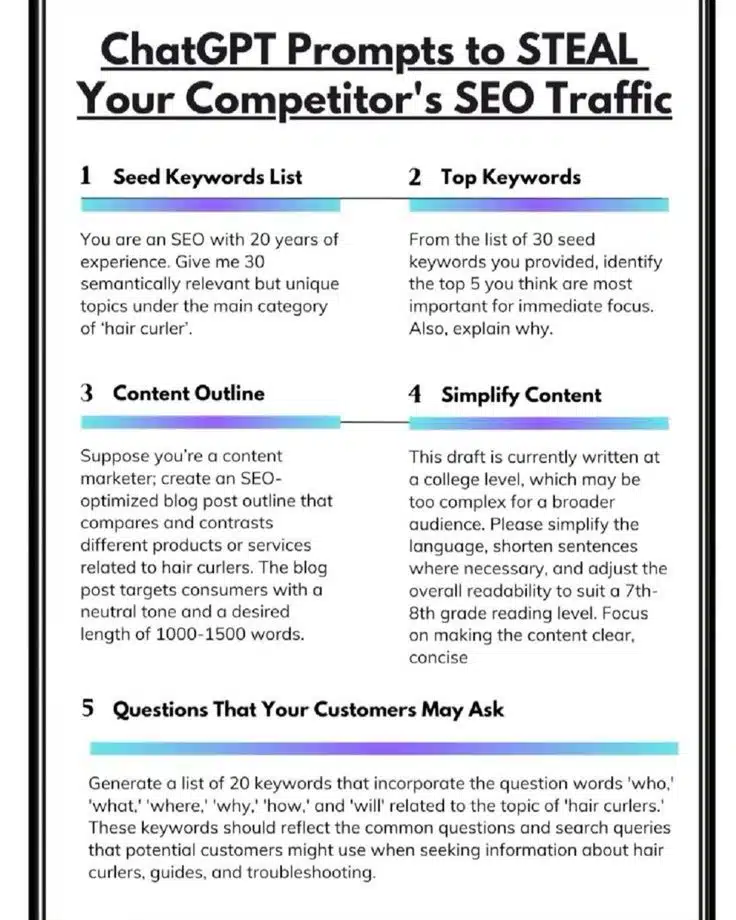
Stealing your competitor’s SEO traffic isn’t about shady tactics—it’s about being smarter, faster, and more strategic. With the right prompts, ChatGPT can help you discover gaps in your competitor’s strategy and build content that captures their audience.
In this post, we’ll break down exactly how to do it, step-by-step, using targeted prompts to fuel your SEO efforts. Let’s dive straight in.
Seed Keywords List
It all starts with generating a powerful list of seed keywords that you can build your content around. By focusing on unique, semantically relevant topics, you can cover areas your competitors might have missed. ChatGPT can quickly brainstorm a rich set of keyword ideas to form the foundation of your SEO plan. Here’s how to make the most of it:
- Ask ChatGPT to act as an SEO expert with 20 years’ experience: Frame your prompt to get the most sophisticated, niche suggestions.
- Focus on semantically related topics: Don’t just grab obvious keywords—expand into less saturated but related ideas.
- Specify a main category: Always anchor your request to a primary keyword to maintain relevance and theme.
- Request a large volume: Aim for at least 30 keyword ideas to ensure you have enough material to refine later.
Top Keywords
Once you have your seed list, it’s time to prioritise. Not every keyword will have the same impact, so you’ll want to identify the most valuable opportunities. ChatGPT can help you sort through your list and pick the best options for maximum traffic gain. Here’s how to get it right:
- Ask ChatGPT to rank the keywords by potential traffic value: This will save you time and highlight immediate opportunities.
- Request explanations for each top pick: Understanding why a keyword matters helps you make better strategic decisions.
- Focus on low competition, high intent keywords: These will give you quicker wins without a long battle for rankings.
- Use insights to guide content creation: Build your first pieces of content around the top 5 keywords for fastest results.
Content Outline
Knowing which topics to target is only half the battle—you also need a clear, structured plan for the content itself. A strong outline keeps your blog post focused and optimised for SEO without feeling robotic. ChatGPT can produce detailed outlines that set you up for success. Here’s how to structure your request:
- Tell ChatGPT to create an SEO-optimised blog outline: Make sure it understands that search performance is a priority.
- Specify your content goals: Mention tone (neutral), target audience (consumers), and word count (1000–1500 words).
- Request a comparison structure: Comparison posts often perform well because they directly help consumers choose products.
- Use the outline to streamline writing: A good outline ensures a faster writing process and keeps your post SEO-friendly.
Simplify Content
Even the best ideas can flop if the content is too complicated for your audience to follow. Simplifying your writing style makes your blog posts more accessible and enjoyable to read. With ChatGPT’s help, you can adapt complex language into clear, concise communication. Here’s how to optimise for readability:
- Ask ChatGPT to rewrite your draft for 7th–8th grade level: Simpler text reaches a broader audience and improves dwell time.
- Request shorter sentences and plain language: This makes your posts easier to scan, especially on mobile.
- Focus on clarity and conciseness: Eliminate jargon and unnecessary words that clutter the message.
- Test readability scores: Tools like Hemingway App or Grammarly can help verify the final reading level.
Questions That Your Customers May Ask
Answering customer questions directly is one of the most powerful ways to capture organic search traffic. By predicting the queries people are typing into Google, you can position your content as the immediate solution. ChatGPT can help you build a bank of relevant questions for easy wins. Here’s how to prompt it:
- Ask ChatGPT for question-based keywords: Incorporate words like ‘who,’ ‘what,’ ‘where,’ ‘why,’ ‘how,’ and ‘will.’
- Focus on informational search intent: These questions often signal someone early in the buying process.
- Create FAQ sections in your blog posts: This structure satisfies both users and search engines looking for quick answers.
- Use the questions as headings or subheadings: This improves SEO structure and makes posts easier to navigate.
Final Thoughts
Stealing your competitor’s SEO traffic isn’t about copying—it’s about outsmarting. By using ChatGPT creatively with well-designed prompts, you can generate better keyword lists, build stronger outlines, simplify complex information, and directly address customer needs. The key is to approach SEO with strategy, structure, and a willingness to go deeper than your competitors are willing to go.
Instead of fighting for scraps, lead the conversation. Outpace them at every step by thinking sharper, acting quicker, and delivering more value through your content.
If you’re serious about growing your SEO traffic, start using these ChatGPT prompts today—and watch how quickly you can turn their audience into yours.

Author:
Mark Ford