Struggling to get your product pages noticed on Google? Want to write descriptions that drive traffic and turn browsers into buyers?
You’ll find some ecommerce basics in this infographic.
Here’s a summary of what’s covered:
- Length and Structure
- Language
- SEO
- Customer Value
- Call-to-Action
- Buyer Persona
Check out the post below for more.
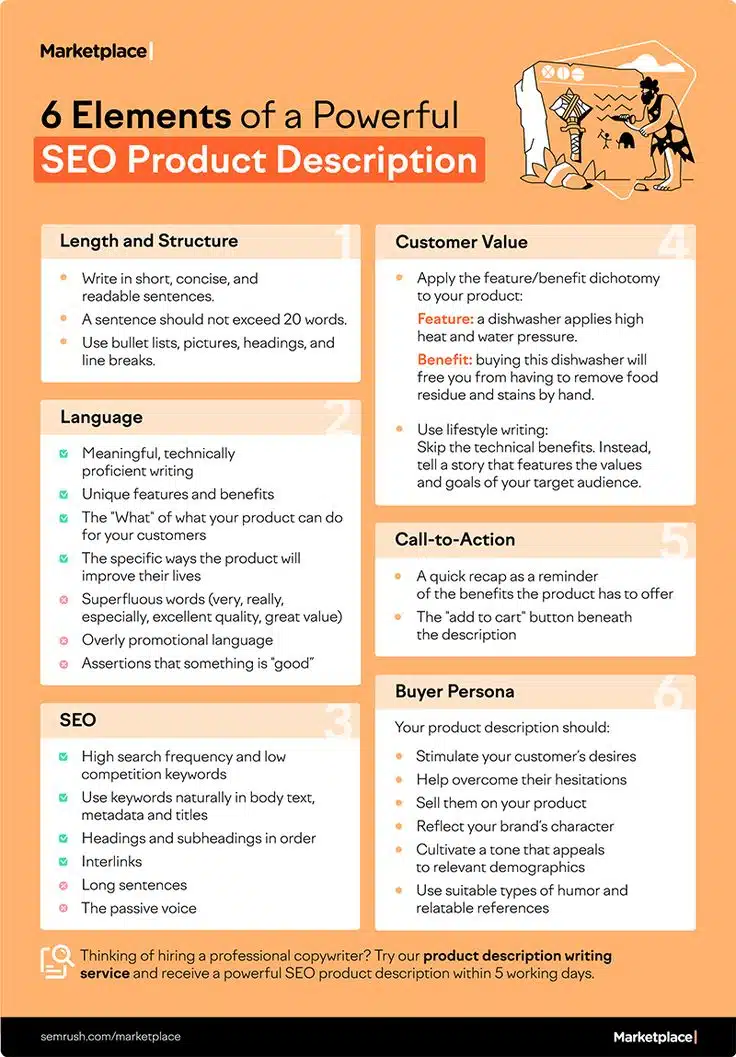
A great product might never reach its potential if its description fails to capture attention or convince buyers. In today’s crowded digital marketplace, product descriptions do more than just inform—they persuade, guide, and rank.
To truly succeed in ecommerce, your copy needs to strike the perfect balance between SEO and conversion-driven content. Here’s how to craft ecommerce product descriptions that both rank well on search engines and convert browsers into buyers.
Length and Structure
Before diving into content, consider how your description is structured. Online readers have short attention spans, and bulky paragraphs are a fast track to lost interest. A well-organised product description should be easy to scan, making key information stand out quickly. Formatting is just as important as the message.
- Keep sentences short—aim for 20 words or fewer for clarity and readability.
- Break content into digestible chunks using bullet points and line breaks.
- Use headings and subheadings to guide users through features and benefits.
- Incorporate product images or icons to enhance visual appeal and aid understanding.
Language
Your choice of words can make or break a product description. Clear, technically sound, and benefit-focused language builds trust and keeps the reader engaged. Avoid empty phrases and instead communicate what truly matters—how your product solves a problem or improves the customer’s life.
- Use meaningful, professional language that reflects an understanding of your product.
- Highlight what sets your product apart with unique features and tangible benefits.
- Show how the product will enhance the customer’s daily routine or experience.
- Avoid fluff words like “very”, “excellent”, and “great quality”—let the facts impress.
SEO
An effective product description needs to perform well in search as well as sales. That means optimising your copy with the right keywords without sounding robotic. With Google’s algorithms evolving to favour natural, helpful content, keyword stuffing is no longer an option. Instead, smart SEO should feel effortless to the reader.
- Use keywords with high search volume and low competition to increase visibility.
- Integrate keywords naturally into your body copy, metadata, and titles.
- Structure content with clear headings, subheadings, and logical progression.
- Avoid long, passive-voice sentences that dilute clarity and weaken SEO signals.
Customer Value
One of the biggest mistakes in ecommerce copy is listing features without explaining why they matter. Your goal is to connect those features to real-life outcomes—this is where the feature-benefit approach shines. Think beyond product specs to show how the item enhances the buyer’s lifestyle or solves a pain point.
- Explain both the feature and its benefit (e.g. “high water pressure” means faster, cleaner dishes).
- Focus on emotional and practical outcomes—what will the customer gain or avoid?
- Use real-life scenarios to paint a picture of how the product fits into daily life.
- Avoid jargon; favour clear, benefit-led language that resonates with your audience.
Call-to-Action
You’ve educated the customer and piqued their interest—now what? A compelling call-to-action (CTA) is the final nudge they need to buy. Rather than relying on generic CTAs, tailor yours to reinforce the value and benefits mentioned in your description. Keep it confident, clear, and customer-focused.
- Summarise the product’s key benefit to reinforce its value before the CTA.
- Use persuasive language like “Get yours today”, “Experience the difference”, or “Shop now”.
- Make sure the CTA is visible and positioned just beneath the main description.
- Use urgency or exclusivity where appropriate (“Limited stock available”, “Today only”).
Buyer Persona
A powerful product description speaks directly to your ideal customer. This requires knowing their desires, hesitations, and style of communication. Every line should reflect not just your product, but your customer’s worldview—why it matters to them and how it fits into their identity or goals.
- Identify what motivates your customers—status, convenience, price, quality, etc.
- Anticipate and address common objections (e.g. “Will it fit?” or “Is it easy to install?”).
- Reflect your brand’s tone in a way that resonates with your demographic (fun, expert, friendly, etc.).
- Use relatable language, references, or humour that appeals to your customer’s lifestyle.
Conclusion
Writing ecommerce product descriptions that rank and convert isn’t about stuffing keywords or pushing sales—it’s about clarity, connection, and consistency. When your descriptions are well-structured, customer-focused, SEO-optimised, and reflective of your brand, they do more than inform—they influence.
By applying these six principles, you can transform your product pages into powerful sales tools that work for both your customers and search engines. Take the time to get it right, and you’ll see the results in both traffic and conversions.

Author:
Mark Ford