
Are you worried that your SEO tactics might be putting your blog at risk? Want to find out which common optimisation practices could lead to costly Google penalties?
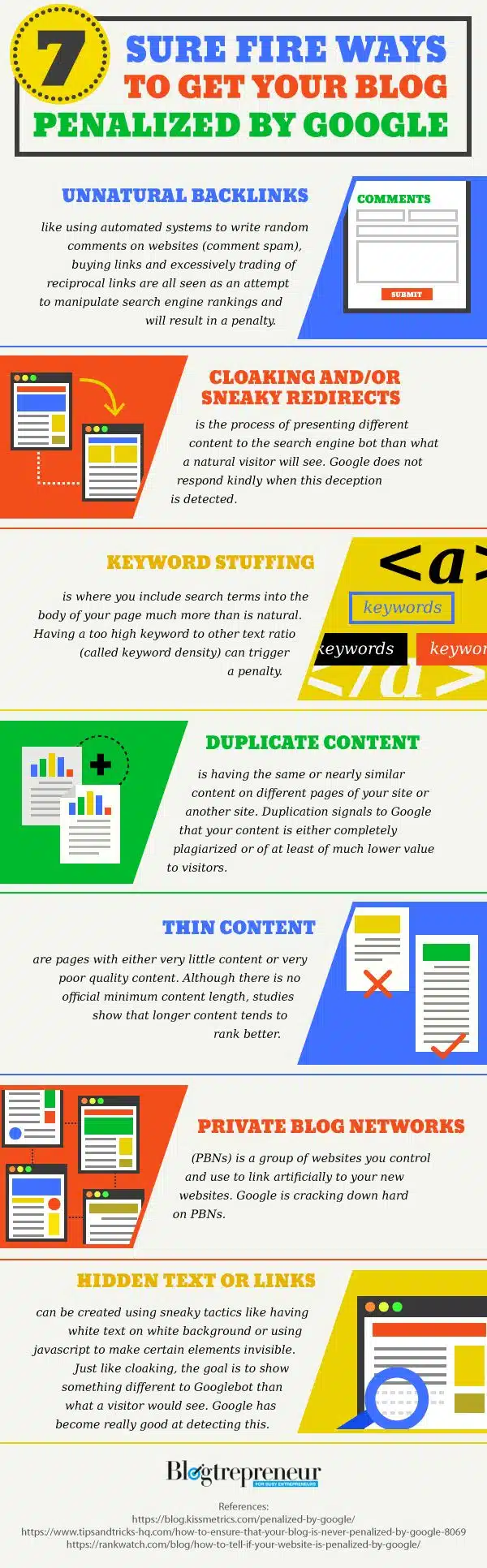
You’ll find some SEO basics in this infographic.
Here’s a summary of what’s covered:
- Unnatural Backlinks
- Cloaking and Sneaky Redirects
- Keyword Stuffing
- Duplicate Content
- Thin Content
- Private Blog Networks (PBNs)
- Hidden Text or Links
- Recognising the Signs of a Google Penalty
- Recovering from a Penalty
- How to Protect Your Blog from Future Penalties
Check out the post below for more.
Every blogger wants to see their content climb the search rankings, but not all optimisation methods are safe. Some SEO tactics that once promised quick wins can now trigger harsh penalties from Google.
Whether intentional or not, these practices can seriously damage your blog’s visibility, traffic, and credibility. Understanding what causes penalties is the first step to keeping your site in good standing — and your rankings intact.
Unnatural Backlinks
Backlinks are an essential ranking factor, but Google penalises sites that use manipulative methods to acquire them. Automated link-building tools, spammy comments, and paid link exchanges are all red flags. When links look unnatural or come from irrelevant or low-quality sources, Google views them as attempts to game the system. A healthy backlink profile is built through relevance, quality, and authenticity.
- Build backlinks through genuine relationships with reputable sites in your niche.
- Avoid buying or exchanging links purely for SEO value.
- Audit your backlink profile regularly using tools like Google Search Console.
- Focus on creating shareable, authoritative content that earns links naturally.
Cloaking and Sneaky Redirects
Cloaking involves showing different content to search engines than to users, often to manipulate rankings. Sneaky redirects send users to unrelated or misleading pages, damaging trust and violating Google’s Webmaster Guidelines. These tactics may seem clever, but they’re easy for Google to detect and can result in severe ranking penalties or even de-indexing. Always ensure consistency between what search engines see and what your visitors experience.
- Serve the same content to both users and search engine crawlers.
- Avoid redirecting users to irrelevant or spammy pages.
- Check your redirects periodically to ensure they’re functioning as intended.
- Use 301 redirects responsibly for legitimate URL changes or site migrations.
Keyword Stuffing
Keywords help search engines understand your content, but overusing them can do more harm than good. Keyword stuffing creates a poor reading experience and signals manipulation to Google’s algorithms. Rather than repeating phrases unnaturally, use synonyms and write for humans first. Balanced, natural keyword usage improves readability and ranking potential.
- Use keywords sparingly and in context, not in every sentence.
- Focus on topic relevance rather than keyword density.
- Incorporate long-tail keywords naturally into your content.
- Read your post aloud — if it sounds repetitive, adjust the wording.
Duplicate Content
Duplicate content occurs when similar or identical text appears across multiple pages of your website or other sites. Google’s algorithms prefer unique, original material and may penalise pages that appear copied or redundant. Whether intentional or accidental, duplication reduces the perceived value of your content and confuses search engines about which version to rank.
- Write unique content for each page or post on your website.
- Use canonical tags to indicate preferred versions of duplicated pages.
- Regularly audit your site for repeated or scraped content.
- Avoid publishing manufacturer descriptions or syndicated text without modification.
Thin Content
Thin content refers to pages that lack substance, depth, or value for the reader. Examples include doorway pages, scraped articles, and overly brief posts with no clear purpose. Google’s goal is to serve users high-quality, informative results — so thin content can quickly harm your site’s reputation. Building comprehensive, relevant content ensures stronger rankings and reader engagement.
- Expand posts to include real insights, data, and expert advice.
- Combine related short articles into detailed, in-depth resources.
- Use headings, images, and examples to add context and depth.
- Focus on answering user intent rather than hitting a word count.
Private Blog Networks (PBNs)
Private Blog Networks were once a popular black-hat SEO tactic, allowing site owners to link multiple domains they controlled for artificial authority. Today, Google’s algorithms and manual reviewers easily detect these link schemes. Participating in or building a PBN can lead to de-indexed sites and severe ranking losses. Sustainable SEO success comes from genuine authority, not manufactured backlinks.
- Avoid linking between sites you own purely for ranking benefit.
- Build backlinks from trusted, high-quality domains only.
- Steer clear of “link farms” or low-quality directories promising quick results.
- Focus on outreach and guest posting opportunities with genuine editorial merit.
Hidden Text or Links
Hidden text or links attempt to deceive Google by displaying content invisible to users but readable to crawlers. Common examples include white text on a white background or links concealed behind images. These tactics violate Google’s guidelines and are easily detected by algorithms. Transparency and user experience should always guide your optimisation strategy.
- Avoid any text or links not meant for users to see.
- Review your site’s code to ensure no hidden elements exist.
- Use CSS and JavaScript only for design purposes, not deception.
- Keep your SEO visible, honest, and user-friendly.
Recognising the Signs of a Google Penalty
Google penalties can appear in two forms: algorithmic and manual. Algorithmic penalties happen automatically when your site violates ranking criteria, while manual actions are imposed by Google reviewers. Recognising the early warning signs can help you act before your rankings collapse. Regular monitoring keeps your blog’s SEO health in check.
- Watch for sudden drops in organic traffic or rankings.
- Check Google Search Console for manual action notifications.
- Compare keyword performance to identify potential penalties.
- Conduct regular site audits to detect technical or content-related issues.
Recovering from a Penalty
If your blog has been penalised, recovery is possible with the right approach. Start by identifying the root cause — whether unnatural links, low-quality content, or technical manipulation. Cleaning up your site and submitting a reconsideration request can restore your rankings over time. The key is transparency, patience, and commitment to long-term SEO best practices.
- Use Google Search Console to locate and fix the offending issues.
- Remove or disavow spammy backlinks from your site.
- Rewrite or expand low-quality content to add genuine value.
- Submit a reconsideration request once your fixes are complete.
How to Protect Your Blog from Future Penalties
The best defence against penalties is adopting ethical, white-hat SEO practices. Google rewards websites that prioritise quality content and user experience. Avoid shortcuts and focus on sustainable growth strategies. Building your site’s authority the right way ensures long-term stability and visibility in search results.
- Follow Google’s official Webmaster Guidelines closely.
- Keep up to date with SEO algorithm updates and best practices.
- Invest time in producing original, well-researched content.
- Build backlinks through authentic relationships and PR efforts.
Conclusion
Google penalties can devastate your blog’s visibility, but they’re entirely preventable with the right approach. The temptation of quick SEO wins often leads bloggers down risky paths that do more harm than good.
By understanding what triggers penalties and maintaining ethical practices, you’ll build lasting authority and trust with both Google and your audience. Sustainable SEO is about patience, transparency, and a genuine focus on delivering value — and that’s what keeps your blog thriving in the long run.

Author:
Mark Ford