
Are you trying to understand why users search the way they do? Want to learn how to align your content with keyword intent to drive better results?
You’ll find some SEO basics in this infographic.
Here’s a summary of what’s covered:
- Informational Intent: Building Awareness Through Answers
- Navigational Intent: Guiding Users to Known Destinations
- Commercial Intent: Helping People Compare Before They Buy
- Transactional Intent: Converting Visitors into Customers
- How to Identify Keyword Intent in Your Research
- Aligning Your Content Strategy with Keyword Intent
- Balancing SEO and PPC by Intent
- Common Mistakes When Ignoring Keyword Intent
- Turning Keyword Intent Into Strategic Action
Check out the post below for more.
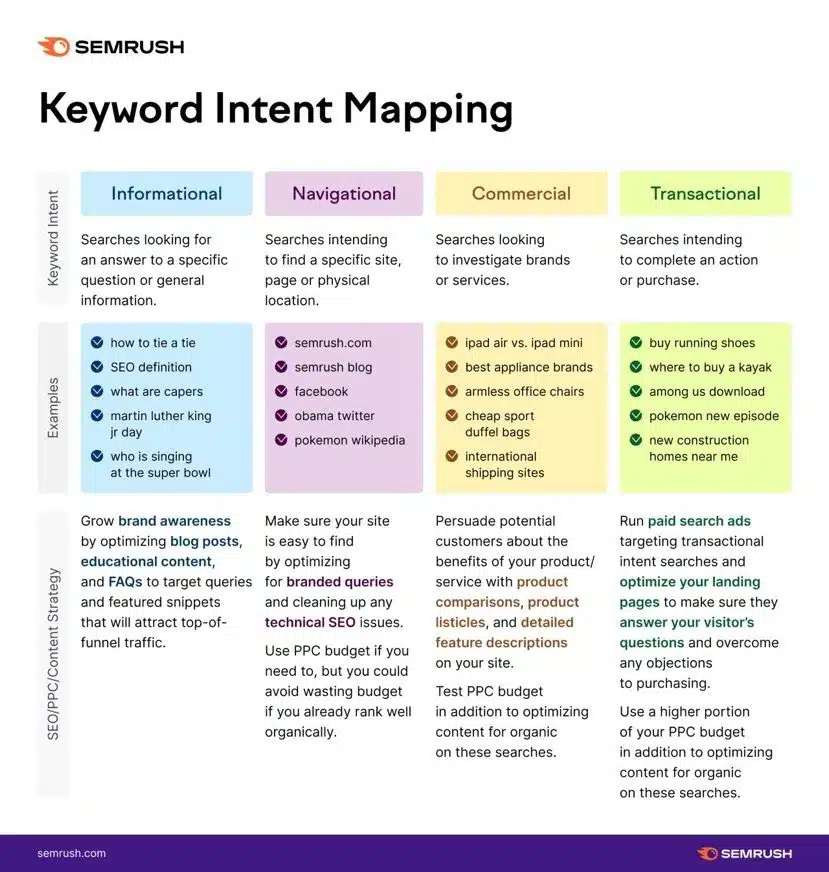
Understanding keyword intent is crucial for building an effective SEO and content strategy. It’s not enough to target popular search terms—you need to understand why someone is searching. Keyword intent reveals the motivation behind a search, helping you deliver content that aligns with your audience’s expectations.
In this post, we’ll break down the four main types of keyword intent and explain how to optimise your content for each stage—from awareness to action.
Informational Intent: Building Awareness Through Answers
At the top of the funnel, users are looking for general information or answers to specific questions. These searchers aren’t ready to buy—they’re in research mode. Capturing their attention with useful, educational content helps build trust and visibility. It’s the first step in guiding them toward becoming loyal customers.
- Focus on blog posts, guides, how-tos, and FAQs that answer common questions clearly.
- Use structured data to target featured snippets and “People Also Ask” results.
- Include internal links to related content that moves users deeper into your site.
- Avoid hard selling—your goal here is to inform, not convert.
Navigational Intent: Guiding Users to Known Destinations
Navigational intent reflects searches made by users looking for a specific website, brand, or page. They already know what they want and are using search engines as a shortcut to get there. Your job is to make sure your site appears prominently when users look for you by name.
- Optimise for branded keywords including variations and common misspellings.
- Keep your technical SEO clean so your homepage and key pages are indexed properly.
- Build a strong presence on review sites, Wikipedia, and business directories.
- Use minimal PPC if you rank organically—protect your brand but avoid overspending.
Commercial Intent: Helping People Compare Before They Buy
Users with commercial intent are evaluating their options—they’re looking at different brands, reading reviews, and comparing features. This is mid-funnel territory where you want to persuade, not push. The goal is to make your offer look like the best fit for their needs.
- Create product comparison pages, “best of” lists, and buyer’s guides.
- Highlight benefits over features to demonstrate real-world value.
- Use high-quality images, charts, or tables to simplify comparisons.
- Support content with reviews, case studies, and user testimonials.
Transactional Intent: Converting Visitors into Customers
At the bottom of the funnel, transactional keywords signal strong purchase intent. The user has done their research and is ready to take action—whether that’s making a purchase, booking a service, or downloading software. This is your moment to close the deal.
- Use clear, persuasive CTAs and remove friction from landing pages.
- Ensure your PPC ads match the user’s intent with relevant offers.
- Add trust signals like guarantees, reviews, and secure payment badges.
- Optimise for speed, mobile usability, and minimal distractions.
How to Identify Keyword Intent in Your Research
Recognising keyword intent during your research phase can transform how you build content. While some keywords are obviously transactional (“buy now”), others are subtler. Use a mix of context, modifiers, and SERP analysis to determine what users are truly after.
- Look for intent-based modifiers like “how,” “buy,” “compare,” or “near me.”
- Study the top 10 search results to see what type of content is ranking.
- Use keyword tools that categorise intent or filter by content type.
- Test and adjust by monitoring bounce rates, time on page, and conversions.
Aligning Your Content Strategy with Keyword Intent
Your content should reflect the user’s journey—from awareness through to decision. Matching the right content formats to the appropriate intent stage improves engagement, lowers bounce rates, and increases conversions. Think of each keyword as a clue to what the user wants to experience.
- Map keywords to the funnel: informational (top), commercial (middle), transactional (bottom).
- Use blog posts and educational content for awareness and engagement.
- Deploy comparison and review content to aid in evaluation.
- Optimise landing pages and product pages to support conversions.
Balancing SEO and PPC by Intent
Keyword intent also helps determine where to invest your budget—organically or through paid ads. While top-of-funnel terms might be best served through SEO, bottom-of-funnel queries often benefit from PPC precision. The key is knowing where each type of intent fits in your marketing mix.
- Focus SEO efforts on informational and commercial keywords with long-term value.
- Prioritise PPC spend on high-intent transactional queries for faster ROI.
- Use commercial keywords in both SEO and PPC to reinforce your brand mid-funnel.
- Avoid wasting ad spend on keywords where you already rank #1 organically.
Common Mistakes When Ignoring Keyword Intent
Failing to consider keyword intent can lead to mismatched content, low engagement, and wasted budget. Many marketers fall into the trap of chasing high-volume keywords without understanding what the user actually wants. The result is poor performance across the board.
- Don’t try to sell on an informational page—it disrupts the user’s journey.
- Avoid ranking for branded terms you don’t own—it creates user frustration.
- Don’t over-optimise transactional pages for SEO—focus on conversions.
- Avoid generic content that doesn’t align with any clear user need.
Turning Keyword Intent Into Strategic Action
When you understand keyword intent, you can build a content and marketing strategy that resonates deeply with your audience. It’s not about volume—it’s about relevance. From blog posts to landing pages, aligning with intent turns visitors into leads and leads into loyal customers.
- Group your keywords by intent before building out content.
- Assign goals to each page type: educate, compare, or convert.
- Use analytics to assess how well your content aligns with user behaviour.
- Keep refining—user intent can shift over time, and so should your strategy.
Conclusion: Intent Is the Missing Link Between Search and Success
Keyword intent isn’t just another SEO metric—it’s the foundation for how people search and engage online. By understanding whether users are looking to learn, navigate, compare, or buy, you can tailor your content and campaigns with far greater precision.
From awareness to action, each stage of intent offers a new opportunity to meet your audience where they are—and guide them to where you want them to be. Get the intent right, and everything else falls into place.

Author:
Mark Ford