
Are you ready to take your SEO skills to a professional level? Want to discover the best tools, courses, and communities to help you master SEO and build lasting results?
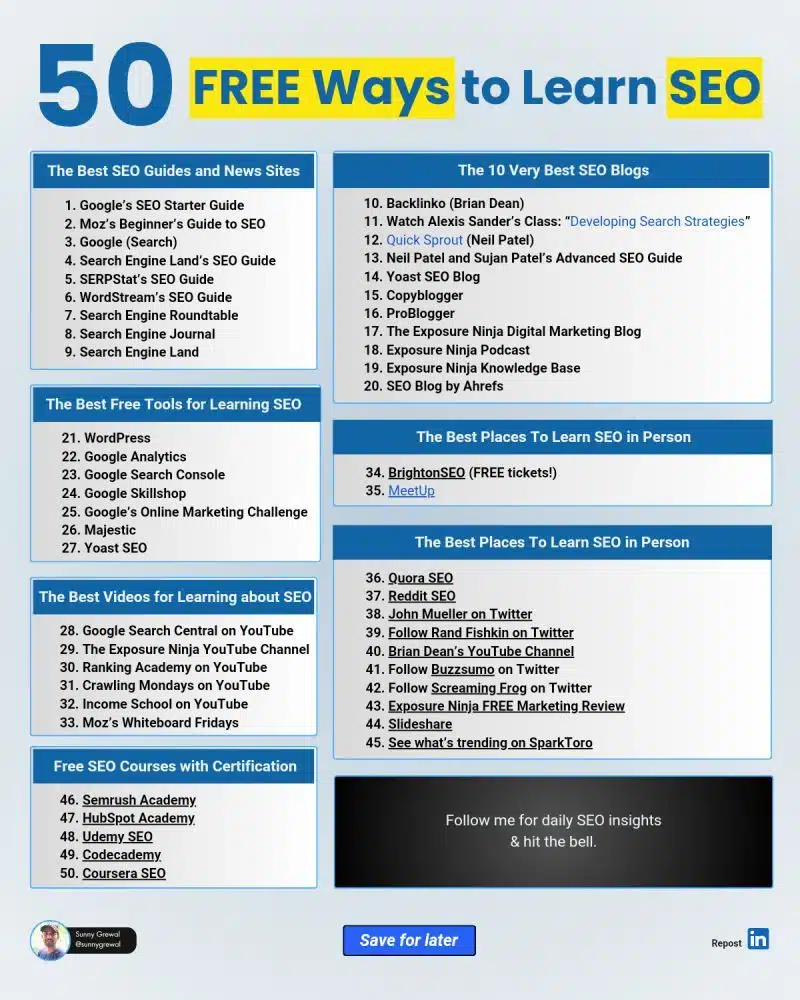
You’ll find some SEO basics in this infographic.
Here’s a summary of what’s covered:
- The Best SEO Guides & News Sites
- The 10 Most Influential SEO Blogs
- The Most Useful Tools for Learning and Applying SEO
- The Most Insightful SEO Video Channels
- Where to Learn SEO in Person
- The Best Online Communities for SEO Discussions
- Structured Courses with Certification
- Learning Directly from Google’s Platforms
- YouTube Channels That Simplify SEO
- Influential SEO Experts to Follow
Check out the post below for more.
Search Engine Optimisation (SEO) can feel like an ever-shifting puzzle — full of algorithms, analytics, and technical jargon. But the truth is, mastering SEO isn’t about luck or budget. It’s about understanding how search engines work and applying that knowledge with the right tools, structured learning, and the support of others who’ve done it before.
This guide brings together fifty of the best tools, courses, and communities that will help you develop SEO expertise from the ground up. Whether you’re starting your first website or sharpening your professional skills, these resources will guide you every step of the way.
The Best SEO Guides & News Sites
If you’re new to SEO, start by building a strong foundation. Guides and news sites give you the background knowledge to understand what SEO really means — from crawling and indexing to keywords and backlinks. They’ll also help you stay updated as search engines evolve, ensuring your strategies always reflect best practice.
- Begin with Google’s SEO Starter Guide, a definitive overview straight from the search engine itself.
- Explore Moz’s Beginner’s Guide to SEO for clear explanations and visual learning.
- Read Search Engine Journal and Search Engine Land to keep up with algorithm updates and industry trends.
- Visit WordStream and SERPStat for actionable tutorials and strategic insights.
The 10 Most Influential SEO Blogs
Once you understand the basics, you’ll want to learn from professionals who test and innovate daily. Industry blogs provide practical strategies, tested experiments, and expert commentary that help you think like an SEO specialist. Following these voices will sharpen your judgement and help you adapt to real-world challenges.
- Follow Brian Dean’s Backlinko for detailed case studies and advanced link-building tactics.
- Read Neil Patel’s Quick Sprout for results-driven digital marketing advice.
- Subscribe to Yoast’s SEO Blog to learn the art of on-page optimisation and readability.
- Explore Copyblogger and ProBlogger for insights into how quality content drives search performance.
The Most Useful Tools for Learning and Applying SEO
Understanding SEO theory is one thing — applying it is another. The right tools let you see how search engines interpret your website, giving you data to guide your decisions. Experimenting with analytics, keyword research, and site audits will accelerate your understanding and show how theory connects to measurable results.
- Use Google Analytics and Google Search Console to assess performance and user behaviour.
- Install Yoast SEO to practise optimisation on real web pages.
- Explore Majestic to understand backlinks and domain authority.
- Use Google Skillshop to build practical confidence with data-driven tools.
The Most Insightful SEO Video Channels
If you’re a visual learner, video tutorials make complex SEO topics easier to understand. Watching professionals demonstrate keyword research, audits, and strategy creation in real time bridges the gap between explanation and execution. These channels offer structured learning with clarity and depth.
- Subscribe to Google Search Central for the most accurate, up-to-date insights on SEO practices.
- Watch Crawling Mondays for technical guidance from industry experts.
- Follow Ranking Academy for step-by-step lessons designed for both beginners and intermediates.
- Check out Moz’s Whiteboard Fridays for engaging explanations of SEO concepts.
Where to Learn SEO in Person
While online learning is flexible, face-to-face interaction can deepen understanding and build confidence. Attending conferences and meetups exposes you to different approaches and experiences. The opportunity to ask questions and exchange ideas helps turn SEO theory into skill through shared insight.
- Attend BrightonSEO, the UK’s leading SEO conference known for its expert sessions.
- Use MeetUp to find groups of marketers and SEO specialists near you.
- Join discussions on Quora SEO to explore real-world questions and answers.
- Follow industry figures like John Mueller and Rand Fishkin to learn from their live talks and commentary.
The Best Online Communities for SEO Discussions
Becoming part of an active SEO community allows you to learn collaboratively. Whether through forums, Twitter threads, or specialist groups, engaging with others will expose you to new tactics, perspectives, and problem-solving methods. It’s one of the fastest ways to keep your knowledge current.
- Join Reddit’s SEO community to share experiences and discover emerging techniques.
- Follow BuzzSumo and Screaming Frog for data-driven insights and expert analysis.
- Engage with Brian Dean’s YouTube Channel for strategy breakdowns and real case studies.
- Explore SparkToro and Slideshare for deeper marketing analytics and thought leadership.
Structured Courses with Certification
Taking a course helps bring order to your learning. Certification programmes guide you through the essentials, combining theory with assessment. The credentials also demonstrate credibility to clients and employers, showing that you’ve mastered the principles behind SEO success.
- Enrol in Semrush Academy to learn keyword research, technical SEO, and competitive analysis.
- Take HubSpot Academy’s SEO course to understand how optimisation fits within inbound marketing.
- Try Udemy’s structured SEO training for comprehensive lessons and real-world projects.
- Complete Coursera or Codecademy SEO modules to reinforce your learning through exercises.
Learning Directly from Google’s Platforms
Since Google is at the centre of all SEO, its official platforms are some of the best places to learn how search works. These tools and courses give you direct insight into what affects visibility, rankings, and site performance. They’re practical, data-driven, and built by the very engineers who shape search results.
- Use Google Search Console to monitor indexing and troubleshoot performance.
- Access Google Skillshop for step-by-step lessons on search analytics and Ads.
- Review Google’s SEO Starter Guide to refresh best practices.
- Take part in Google’s Online Marketing Challenge to apply learning in a live campaign environment.
YouTube Channels That Simplify SEO
YouTube can transform SEO learning from theoretical to hands-on. The most valuable creators use simple visuals and real examples to explain everything from technical fixes to link-building strategies. Regular viewing can help you maintain consistency and motivation as you learn.
- Watch Exposure Ninja for practical advice on digital marketing and SEO growth.
- Follow Ranking Academy to understand how SEO applies to small businesses.
- Subscribe to Crawling Mondays for advanced discussions on algorithms and site audits.
- Learn through Income School for guidance on building SEO-driven content websites.
Influential SEO Experts to Follow
Learning from experienced professionals accelerates your progress and helps you avoid common pitfalls. These experts share tested methodologies, new findings, and updates that reflect the real world of search marketing. By following them, you’ll always stay one step ahead of industry change.
- Read Brian Dean’s Backlinko for evidence-based strategies and proven frameworks.
- Follow Rand Fishkin and explore SparkToro for audience intelligence insights.
- Learn from John Mueller’s regular updates to better understand Google’s guidelines.
- Keep up with Neil Patel’s Quick Sprout for tips that blend SEO with digital marketing.
Comprehensive Multi-Format Learning Hubs
Some platforms combine everything — tutorials, blogs, podcasts, and community discussions — into one learning destination. These hubs provide flexibility, letting you consume content however you prefer while maintaining focus on the same goal: better SEO results.
- Explore Exposure Ninja for its mix of articles, case studies, and podcasts.
- Follow Ahrefs’ SEO Blog for tool-based tutorials and data-backed research.
- Visit Search Engine Journal for expert opinions, webinars, and practical updates.
- Read Search Engine Roundtable to see how professionals interpret Google changes.
Bridging the Gap Between Learning and Doing
Knowledge becomes powerful only when applied. To master SEO, you must combine research with experimentation — testing ideas and tracking outcomes. Each adjustment to your site gives insight into how search engines and users respond. This iterative process turns learning into mastery.
- Apply lessons using Google Analytics and measure progress weekly.
- Practise optimisation by publishing content on a WordPress blog.
- Share experiences in SEO communities to gather feedback and refine your skills.
- Use Search Console to test the effects of technical improvements in real time.
Why Structured Learning Yields Better SEO Results
Without a plan, SEO learning can feel overwhelming. A structured approach ensures that you build knowledge in the right order — from fundamentals to advanced analysis. It also helps you identify gaps and measure improvement over time, keeping you focused on results rather than noise.
- Create a learning path that progresses from beginner guides to certification courses.
- Schedule regular reviews of analytics to connect learning with performance.
- Use expert blogs and videos to supplement your structured lessons.
- Revisit each topic periodically to refresh and strengthen your understanding.
How Community Learning Accelerates Growth
SEO isn’t something you need to learn in isolation. Collaborating with others gives you new perspectives and exposes you to techniques you might never have tried. The exchange of ideas in online spaces and at events can dramatically improve your ability to adapt and problem-solve.
- Join discussion groups on Reddit or LinkedIn to share strategies and ask questions.
- Follow industry experts to stay informed about algorithm changes.
- Attend BrightonSEO or virtual summits to connect with peers.
- Contribute to conversations on Twitter and SEO forums to build confidence and credibility.
Building a Sustainable SEO Learning Routine
Like any skill, SEO mastery comes from consistent practice. Setting up a routine helps you retain knowledge, measure progress, and maintain motivation. Whether you dedicate a few hours a week or make it part of your professional schedule, regular learning keeps your skills sharp.
- Set aside weekly time to study blogs such as Ahrefs, Yoast, and Backlinko.
- Track your site metrics monthly through Google Analytics.
- Review expert insights from Search Engine Journal to stay current.
- Refresh certifications annually to align with new SEO developments.
Conclusion
Becoming skilled in SEO isn’t about shortcuts — it’s about developing understanding, consistency, and curiosity. With the right blend of tools, structured courses, and community engagement, you can grow from a beginner into a confident, data-driven professional.
The resources outlined here offer everything you need to build that foundation: reliable guides, powerful tools, expert instruction, and supportive communities. Approach each with patience, practise what you learn, and stay adaptable. In time, you’ll not only understand SEO — you’ll think like a strategist, optimise with precision, and achieve results that last.

Author:
Mark Ford