
Are you trying to boost your website’s visibility but unsure how factors beyond your site affect your rankings? Want to understand how backlinks, social shares, and online reputation influence your position on Google?
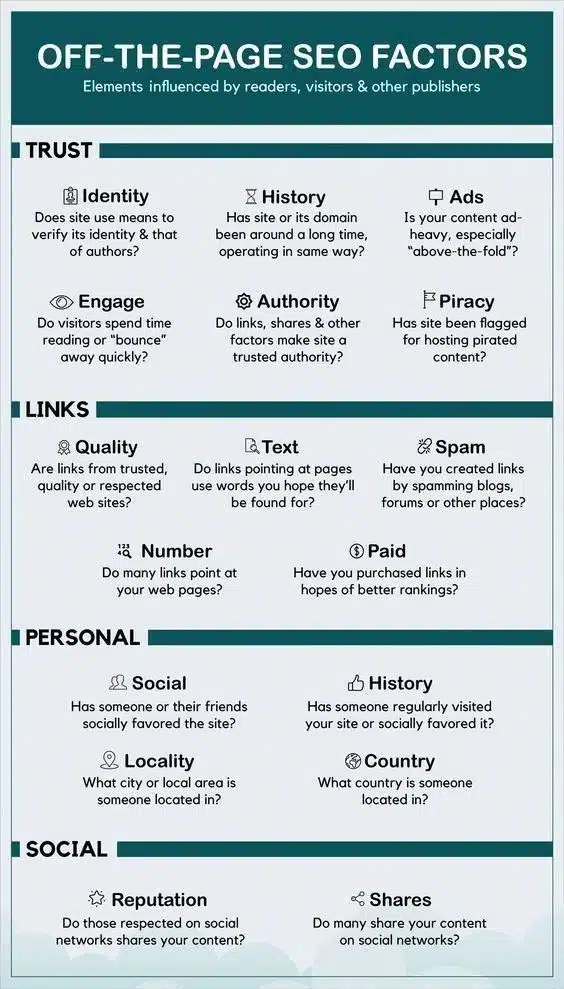
You’ll find some SEO basics in this infographic.
Here’s a summary of what’s covered:
- Trust
- Authority
- Piracy
- Links
- Quality
- Spam
- Paid
- Reputation
- Shares
Check out the post below for more.
When it comes to SEO, most discussions revolve around on-page tactics—keywords, meta tags, and content structure. But off-page SEO plays an equally crucial role in how search engines evaluate your site.
Off-page SEO refers to all the factors that occur outside your website yet still impact your rankings. These include backlinks, social signals, brand mentions, and user behaviour across the web.
In this post, we’ll break down the key off-page SEO elements into four core categories: Trust, Links, Personal, and Social. Let’s explore how each one contributes to your site’s overall visibility and credibility in the eyes of search engines.
Trust
Search engines want to rank websites that users trust. Trust-based factors help determine the reliability and legitimacy of a site. Google uses various signals to assess whether a website has a good reputation, is free from spam, and offers a safe experience.
- Identity: Use clear author bios and verify your business details with tools like Google Business Profile and schema markup.
- History: Maintain consistent branding, content updates, and domain activity over time to build a reliable history.
- Ads: Avoid excessive or disruptive advertising—especially above-the-fold placements that crowd out content.
- Engagement: Focus on delivering high-value content that encourages time on page, scrolling, and interaction.
Authority
Authority is earned when other sources consider your site a leader in its niche. Backlinks, shares, and citations all play a role in signalling to search engines that your content is worth referencing. The more your site is cited by others, the higher its perceived authority.
- Earn backlinks from reputable websites in your industry to demonstrate your thought leadership and relevance.
- Publish research, case studies or original insights that other websites and journalists can reference.
- Encourage natural sharing through engaging, insightful content that answers specific user questions.
- Build topic clusters and interlink related content to show depth and subject matter expertise.
Piracy
Search engines actively penalise websites that host pirated or copyrighted content. Even a single infringement can affect your credibility, making it essential to stay vigilant about the originality and legality of your material.
- Use plagiarism checkers like Copyscape or Grammarly to ensure all content is unique and original.
- Only publish licensed or self-created media such as images, videos, and downloadable content.
- Regularly audit your site for user-uploaded content that could pose copyright risks.
- Respond promptly to DMCA takedown notices and remove any flagged materials immediately.
Links
Links remain one of the most important off-page SEO factors. They act as “votes of confidence” from one site to another. But not all links are equal. Quality, context, and the number of links all influence how they’re interpreted by search engines.
- Seek backlinks from authoritative and niche-relevant domains to improve both trust and relevance.
- Ensure anchor text contains relevant keywords without being spammy or over-optimised.
- Avoid link schemes, blog comment spam, or forum link drops that could lead to penalties.
- Build a diverse link profile that includes guest posts, citations, press coverage, and organic mentions.
Quality
The quality of the sites linking to you matters more than the quantity. A few high-quality backlinks from respected domains will do more for your rankings than hundreds of low-tier ones. Quality signals trust and topical relevance.
- Target industry-specific sites, directories, and publications with established reputations.
- Use link analysis tools like Ahrefs or SEMrush to vet the quality of your backlinks.
- Collaborate with influencers and thought leaders for co-branded or joint content opportunities.
- Focus on editorial-style links embedded naturally within valuable content—not in footers or sidebars.
Text
The words used in the hyperlink (anchor text) provide important context about the linked page. When these words match the page’s content or targeted keywords, it improves relevance and boosts visibility in search results.
- Use natural-sounding anchor text that blends with the surrounding content.
- Avoid keyword stuffing in anchor links to maintain a good user experience and avoid penalties.
- Mix branded, generic, and long-tail keyword anchor texts for a natural backlink profile.
- Ensure linked pages deliver on the promise of the anchor text to reduce bounce rates and increase trust.
Spam
Spammy linking tactics can tank your rankings. Google is quick to penalise behaviour that manipulates its algorithms—whether it’s link farming, comment spamming, or forum abuse. Clean link-building is essential for long-term success.
- Avoid buying low-quality links or participating in private blog networks (PBNs).
- Never use automated tools to build backlinks—they often lead to poor-quality and irrelevant links.
- Disavow toxic backlinks using Google’s Disavow Tool if you’ve been hit with a penalty.
- Use manual outreach to build genuine relationships that result in organic, valuable backlinks.
Number
While quality beats quantity, the total number of backlinks still plays a role in how your site is perceived. More links typically mean more authority, assuming they’re from diverse and relevant sources.
- Grow your backlink profile steadily by publishing consistent, share-worthy content.
- Create evergreen content that continues to attract backlinks long after publication.
- Leverage PR strategies to get coverage in news media and blogs.
- Monitor your competitors’ backlink profiles and identify opportunities they’re capitalising on.
Paid
Search engines want to rank content based on merit, not manipulation. That’s why paid links that pass SEO value are against Google’s guidelines. If you do use paid placements, they should be marked as sponsored or nofollow.
- Avoid paying for dofollow links unless you’re sure they comply with search engine policies.
- Use proper tagging (rel=”sponsored” or rel=”nofollow”) for any paid promotions or advertorials.
- Be transparent about partnerships and sponsored content on your site and others.
- Focus on earning editorial links through quality content rather than relying on financial transactions.
Personal
Personalisation plays a growing role in how search engines deliver results. Search history, location, and social signals from a specific user can influence how prominently a site appears in their search results.
- Optimise your site for local SEO to appear in location-based searches relevant to your target audience.
- Encourage repeat visits with engaging content that builds familiarity and loyalty over time.
- Tailor offers or CTAs based on user behaviour using cookies and simple personalisation techniques.
- Ensure fast, mobile-friendly experiences since personal signals often come from mobile users.
Social
Social media isn’t a direct ranking factor, but its influence can’t be ignored. The more your content is shared, liked, and talked about, the more likely it is to earn backlinks and brand mentions—key components of off-page SEO.
- Share your content across multiple platforms to increase its reach and visibility.
- Engage with your audience to build brand loyalty and encourage organic sharing.
- Collaborate with influencers who can amplify your content to their networks.
- Optimise your content for sharing with strong visuals, clear messages, and compelling headlines.
Reputation
Reputation is a culmination of trust, authority, and public perception. If your content is consistently shared by respected voices in your industry, search engines take notice. These trust signals can have a powerful indirect impact on your rankings.
- Establish relationships with industry experts who can validate and share your work.
- Collect and publish testimonials, case studies, and endorsements that boost your credibility.
- Respond to negative reviews professionally to protect your brand reputation.
- Get featured in trustworthy media outlets and publications to enhance visibility and trust.
Shares
While social shares don’t directly influence search rankings, they help distribute your content and generate the engagement that search engines track. A widely shared piece is more likely to earn links, mentions, and traffic.
- Include sharing buttons on all blog posts and landing pages to make sharing effortless.
- Craft attention-grabbing headlines and visuals that are more likely to be reposted.
- Use platform-specific formats (e.g., carousels on Instagram, threads on X/Twitter) to maximise shareability.
- Monitor which content gets shared most often and use those insights to shape future topics.
Final Thoughts
Off-page SEO is all about what people and platforms say about your website when you’re not in the room. From link quality and site history to social signals and authority, these external factors shape how search engines rank your content.
Focusing on genuine value, ethical link-building, and trusted relationships will put your site in a strong position for long-term SEO success.

Author:
Mark Ford