Are you still relying on outdated SEO tactics that no longer deliver results? Want to understand how modern SEO strategies can help you rank higher and reach the right audience?
You’ll find some SEO basics in this infographic.
Here’s a summary of what’s covered:
- Site Design and User Experience
- Keyword Strategy
- Content Creation Approach
- Content Structure
- Content Formats
- Keyword Usage
- SERP Focus
- Link Building Strategy
- Link Building Effort
- Link Quality
Check out the post below for more.
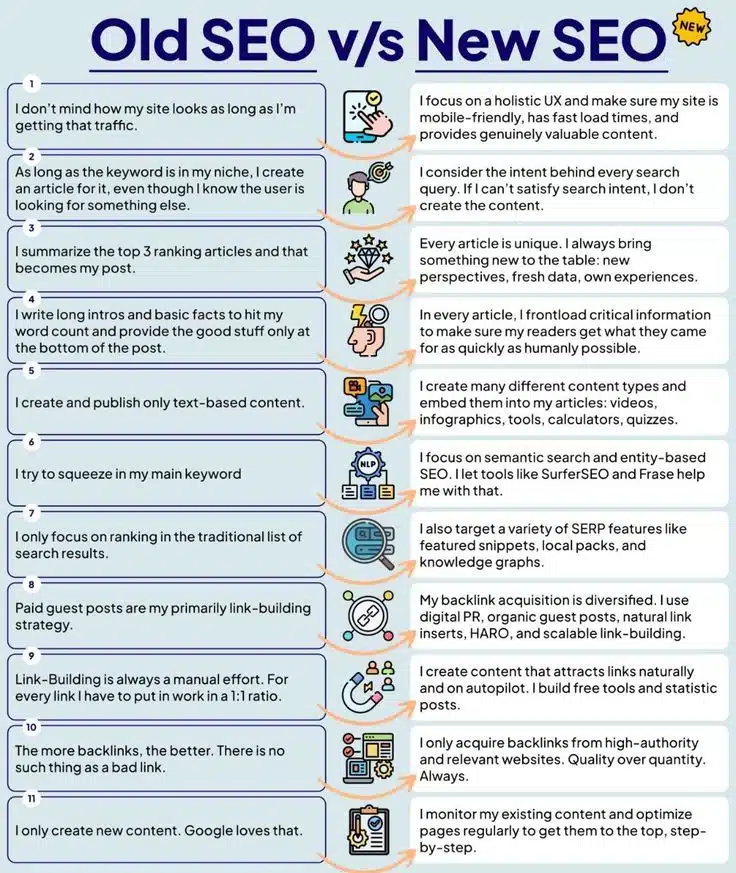
Search engine optimisation has evolved far beyond keywords and backlinks. What once worked in a simpler, algorithm-driven world now barely scratches the surface of what it takes to rank today.
Modern SEO is about user experience, content quality, intent alignment, and smarter strategies. In this post, we’ll explore the major differences between old and new SEO, and why staying current is essential for sustained success.
Site Design and User Experience
In the past, many website owners didn’t care how their site looked—as long as it got traffic. But times have changed. Today, Google considers site performance and user satisfaction in its ranking signals. A fast, intuitive, mobile-friendly site isn’t just a bonus—it’s a requirement.
- Make sure your site is mobile responsive and loads quickly across all devices.
- Focus on user experience (UX), including clean navigation and logical site structure.
- Use tools like Google PageSpeed Insights and Core Web Vitals to monitor performance.
- Prioritise accessibility with readable fonts, proper contrast, and keyboard navigation.
Keyword Strategy
Old SEO often meant writing content around keywords regardless of user intent. That led to mismatched content that didn’t really serve the reader. New SEO begins with understanding the real reason behind a search query and delivering the exact information users are looking for.
- Research search intent before choosing a keyword—informational, transactional, or navigational.
- Use tools like Ahrefs or SEMrush to map keyword intent to content formats.
- Avoid targeting keywords if you can’t fully satisfy the searcher’s need.
- Include natural language variations and related questions within your content.
Content Creation Approach
A common outdated tactic was to look at the top three ranking articles, summarise them, and call it a day. But modern SEO rewards originality. Your content must add something new—whether it’s a fresh perspective, deeper analysis, or first-hand experience.
- Offer unique value by sharing personal insights, case studies, or original data.
- Go beyond what’s already ranking—don’t just reword existing articles.
- Use your own voice and tone to stand out in crowded niches.
- Identify content gaps or unanswered questions and fill them in your post.
Content Structure
Long intros, basic fluff, and burying the real value at the bottom used to work fine. Now, people want answers fast. Google also rewards content that delivers quickly. New SEO demands clarity, structure, and value upfront to capture attention and satisfy users.
- Begin with the most important information—use the inverted pyramid approach.
- Break long sections into skimmable subheadings and bullet points.
- Add summaries or TL;DR sections at the top for quick readers.
- Use formatting (bold, bullets, spacing) to make key points stand out.
Content Formats
Old SEO was all about text—and lots of it. But readers now expect dynamic, multimedia content. Search engines favour pages that offer a rich experience. Including visuals, tools, or interactive elements can greatly enhance your SEO performance.
- Add videos, infographics, charts, and other media formats to support the text.
- Use custom tools like calculators or quizzes to engage visitors longer.
- Embed relevant YouTube videos or slide decks to diversify the page.
- Repurpose content into visual formats for wider distribution and backlinks.
Keyword Usage
Cramming in exact-match keywords was once the norm. Now, search engines use natural language processing and understand context. Semantic and entity-based SEO is the future—where relationships between topics matter more than repetition.
- Use keyword variations, synonyms, and semantically related terms throughout your content.
- Let keyword use flow naturally rather than forcing awkward phrasing.
- Focus on topical relevance by building content clusters and internal links.
- Leverage tools like SurferSEO, Clearscope, or Frase for content optimisation.
SERP Focus
Ranking in the traditional list of blue links is no longer the only game in town. Featured snippets, knowledge panels, People Also Ask boxes, and other SERP features now dominate results. Winning SEO means targeting these features too.
- Optimise for featured snippets by using Q&A formats and concise definitions.
- Add structured data (schema markup) to qualify for rich results.
- Target local SEO elements like map packs and reviews where relevant.
- Use headers, lists, and tables to increase visibility in diverse result types.
Link Building Strategy
Link building once relied heavily on paid guest posts. While links are still vital, Google now prioritises relevance and trust. Modern SEO involves a broader strategy that includes digital PR, mentions, and scalable outreach efforts.
- Pitch stories to journalists via platforms like HARO (Help a Reporter Out).
- Focus on getting mentions in industry-relevant, authoritative sources.
- Build relationships with influencers and site owners in your niche.
- Create linkable assets like free tools, research, or visual resources.
Link Building Effort
In older strategies, you had to manually build each link—often through cold outreach or article swaps. Now, the best links are often earned passively through high-value content. Think in terms of systems and scalability, not just 1:1 exchanges.
- Create evergreen content that naturally attracts links over time.
- Publish original data or research that others will cite in their own content.
- Offer templates, checklists, or free downloads as link magnets.
- Promote your best content on social and email to increase discovery.
Link Quality
Quantity once ruled the link game—any backlink was a good backlink. Today, Google can spot spammy or irrelevant links and penalise your site. High-quality, relevant backlinks from trusted domains matter far more than sheer volume.
- Focus on relevance—links from niche-specific sites are more valuable.
- Prioritise authority—target domains with strong trust signals and organic traffic.
- Disavow or remove toxic backlinks to protect your site’s health.
- Track your backlink profile regularly using tools like Ahrefs or Google Search Console.
Content Lifecycle
Old SEO encouraged constantly creating new content, assuming Google preferred freshness. But pumping out new posts without strategy creates clutter. New SEO values optimisation—updating and improving existing content can deliver even better results.
- Audit your site regularly to find underperforming or outdated pages.
- Refresh content with new stats, links, visuals, and formatting.
- Consolidate similar posts to avoid keyword cannibalisation.
- Use internal links to strengthen content clusters and boost rankings.
Conclusion
SEO has come a long way from the days of keyword stuffing, text-only posts, and link chasing. What matters today is intent, quality, user experience, and smart strategy.
By adopting modern SEO principles, you’ll build a more sustainable, effective presence online that not only ranks—but actually delivers value. If you’re still relying on outdated tactics, now is the time to pivot.
The search landscape is evolving—your strategy should too.

Author:
Mark Ford