Are you in the process of creating a new business website? Want to create more engaging website copy to impress your visitors?
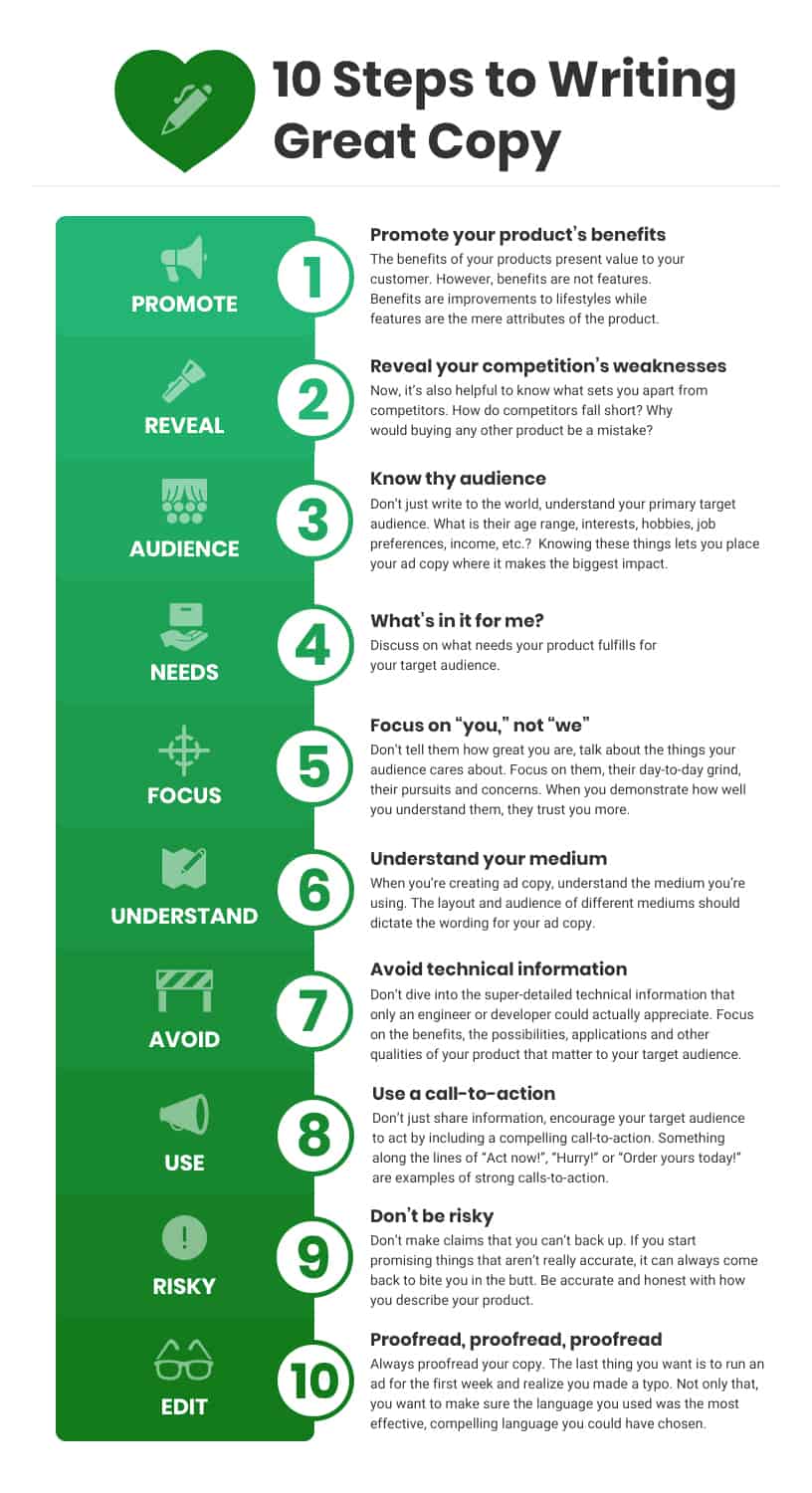
Venngage share their website copywriting tips in this infographic.
Here’s a quick summary:
- Promote your products benefits
- Reveal your competitions weaknesses
- Know thy audience
- What’s in it for me?
- Focus on “you” not “we”
- Understand your medium
- Avoid technical information
- Use a call to action
- Don’t be risky
- Proofread
Check out the infographic for more detail.
In the digital age, your website is often the first impression a potential customer has of your brand. High-quality website content is not just about filling pages with words; it’s about crafting a message that resonates with your audience, drives engagement, and ultimately converts visitors into customers.
Whether you’re a seasoned content creator or new to the game, these ten tips will help you create compelling, high-quality website content that will impress your visitors and keep them coming back for more.
Promote Your Product’s Benefits
Promoting the benefits of your products is a crucial strategy for small businesses aiming to stand out in a crowded market. While it may be tempting to focus on the features of your product or service, especially if you’ve put a lot of effort into developing them, it’s the benefits that truly resonate with customers.
Here’s a more detailed guide on how to effectively promote your product’s benefits, tailored specifically for small businesses.
Understand the Difference Between Features and Benefits
Before you can effectively promote your product’s benefits, it’s essential to understand the distinction between features and benefits. Features are the attributes or characteristics of your product—what it does or includes. Benefits, on the other hand, are the positive outcomes that these features deliver to the user.
For example, if you sell an ergonomic office chair, a feature might be its adjustable lumbar support. The benefit, however, is the reduced back pain and increased comfort that the user will experience, leading to better productivity and well-being.
Identify Your Target Audience’s Pain Points
To promote benefits effectively, you need to first understand the problems your customers are facing. What are their pain points? What challenges are they trying to overcome? By identifying these pain points, you can tailor your messaging to directly address how your product or service provides a solution.
For instance, if you own a small bakery, and your customers are busy professionals looking for quick, healthy breakfast options, the benefit of your freshly baked, grab-and-go items would be the convenience and healthiness they offer, helping your customers start their day right without the hassle.
Translate Features into Benefits
Once you have a clear understanding of your product’s features and your customers’ pain points, the next step is to translate those features into benefits. This involves thinking from the customer’s perspective: How does each feature improve their life or solve a problem?
For example, let’s say you run a small IT consulting firm, and one of your services includes 24/7 technical support. The feature here is the round-the-clock availability, but the benefit to the customer is the peace of mind they gain knowing that their business operations will not be disrupted, even if technical issues arise at odd hours.
Use Customer-Centric Language
When promoting benefits, it’s important to use customer-centric language. This means framing your benefits in a way that speaks directly to the customer’s needs and desires. Instead of saying, “Our software includes advanced data encryption,” you could say, “Your sensitive data will be protected against cyber threats, giving you the confidence to focus on your business.”
Customer-centric language often involves using words like “you,” “your,” and “yours” to make the benefits feel more personal and relevant to the reader.
Leverage Testimonials and Case Studies
One of the most effective ways to promote your product’s benefits is through the voices of satisfied customers. Testimonials and case studies provide real-world evidence of the benefits your product delivers, making your claims more credible and relatable.
For instance, if you run a small landscaping business, you could share a case study of how one of your clients transformed their backyard into a beautiful, low-maintenance space that they now enjoy daily. Include quotes from the client about how your service saved them time and effort while enhancing their outdoor living experience.
Create Benefit-Focused Content
Your website, blog, and social media channels are powerful tools for promoting your product’s benefits. Create content that highlights these benefits in various formats—blog posts, videos, infographics, and more.
For example, if you sell organic skincare products, you could write a blog post titled “How Organic Skincare Can Improve Your Skin Health in Just 30 Days,” focusing on the benefits such as reduced irritation, healthier-looking skin, and a more radiant complexion. Complement this with before-and-after photos, customer testimonials, and tips for integrating your products into a skincare routine.
Visualize the Benefits
Sometimes, seeing is believing. Use visuals to showcase the benefits of your product in action. This could be through videos, infographics, or high-quality images that illustrate the positive outcomes your product delivers.
For a small home renovation business, for example, before-and-after photos of past projects can effectively communicate the transformative benefits of your services. You can also create short video testimonials where customers explain how your renovation services improved their living spaces and overall quality of life.
Focus on Emotional Benefits
While functional benefits are important, don’t overlook the emotional benefits that your product or service provides. Emotional benefits tap into the feelings and experiences that customers associate with using your product.
For example, if you own a small boutique that sells handmade jewelry, the emotional benefit might be the sense of uniqueness and self-expression that your customers feel when wearing a one-of-a-kind piece. Emphasize how your jewelry allows them to express their individuality and stand out from the crowd.
Address Potential Objections
When promoting your product’s benefits, it’s also important to anticipate and address potential objections that customers might have. This shows that you understand their concerns and have thought through how your product can still deliver value despite these concerns.
For example, if you run a small subscription box service and potential customers are worried about being locked into a long-term commitment, you could highlight the benefit of flexible subscription plans or a hassle-free cancellation process. This reassures customers that they can enjoy the benefits of your service without any long-term risk.
Incorporate Benefits into Your Call to Action
Your call to action (CTA) is a critical part of your content, and it should reinforce the benefits of your product or service. Instead of using a generic CTA like “Buy Now,” consider something more benefit-oriented, such as “Start Enjoying Better Sleep Tonight” if you sell mattresses, or “Experience Stress-Free Event Planning” if you offer event planning services.
By incorporating the benefits into your CTA, you’re giving customers a compelling reason to take the next step. It ties the action directly to the positive outcome they’ll achieve by choosing your product or service.
Conclusion
As a small business, you might not have the same resources or brand recognition as larger competitors, but by effectively promoting the benefits of your products, you can create a compelling narrative that resonates with your target audience. Focus on understanding your customers’ needs, translating features into benefits, and communicating those benefits clearly and persuasively across all your marketing channels.
Remember, your product or service exists to make your customers’ lives better in some way. By highlighting the benefits—both functional and emotional—you’ll not only attract more visitors to your website but also convert them into loyal customers who see real value in what you offer.
Reveal Your Competition’s Weaknesses
In the competitive world of small business, one of the most effective strategies for positioning your brand is to subtly highlight your competition’s weaknesses.
This tactic allows you to differentiate your product or service and build a compelling case for why potential customers should choose you over others. However, this strategy must be approached with care, tact, and a clear focus on delivering value rather than simply criticizing competitors.
Here’s a detailed guide on how small businesses can reveal their competition’s weaknesses in a way that strengthens their brand.
Conduct Comprehensive Competitor Research
Before you can reveal your competition’s weaknesses, you must have a thorough understanding of who your competitors are and what they offer. Start by identifying your direct competitors—those who offer similar products or services to the same target market. Then, conduct a detailed analysis of their strengths and weaknesses.
This research should include:
- Product or Service Offerings: What do they sell, and how do their offerings compare to yours in terms of quality, features, and pricing?
- Customer Feedback: What are customers saying about them in reviews, on social media, and on forums? Pay attention to recurring complaints or negative feedback.
- Market Positioning: How do they position themselves in the market? What are their key selling points, and how do they communicate them?
- Marketing and Branding: What are their marketing strategies? How do they engage with their audience, and what tone do they use in their messaging?
- Website and User Experience: Evaluate their website’s usability, design, and content. Is it easy to navigate? Does it provide a good user experience?
By gathering this information, you can identify areas where your competitors fall short, which will help you craft your messaging to highlight how your business fills those gaps.
Highlight Your Unique Selling Proposition (USP)
Your unique selling proposition (USP) is the distinct advantage that sets your product or service apart from the competition. Once you’ve identified your competitors’ weaknesses, you can frame your USP in a way that directly addresses those shortcomings.
For example, if your competitor is known for poor customer service, your USP could emphasize your company’s commitment to providing exceptional, personalized customer support. If their product is expensive but lacks certain features, you could highlight your offering as a more affordable solution that includes all the features customers need.
Your USP should be clearly communicated across all your marketing materials, from your website and social media profiles to your sales pitches and advertising campaigns. Make sure it directly addresses the weaknesses of your competitors in a way that positions your brand as the better choice.
Use Comparison Content Wisely
Comparison content, such as side-by-side product comparisons or “vs.” articles, can be an effective way to reveal your competition’s weaknesses without directly attacking them. This type of content allows you to objectively present the differences between your product and your competitors’, giving potential customers the information they need to make an informed decision.
When creating comparison content, keep the following tips in mind:
- Be Objective: Focus on facts and data rather than opinions. Use clear, quantifiable metrics to compare products or services, such as price, features, customer ratings, and performance metrics.
- Highlight Key Differentiators: Emphasize the areas where your product outperforms the competition, especially in areas that are important to your target audience.
- Stay Positive: Avoid negative language or outright criticism of your competitors. Instead, position your product as the superior option by focusing on the value it provides.
For instance, if you run a small coffee shop and your competitor is known for long wait times, you could create a blog post comparing the customer experience at different coffee shops in your area, highlighting your shop’s quick service and friendly staff.
Leverage Customer Testimonials and Reviews
Customer testimonials and reviews can be powerful tools for revealing your competition’s weaknesses. When potential customers see that others have had positive experiences with your product—especially in areas where competitors are lacking—they’re more likely to trust your brand.
Encourage satisfied customers to share their experiences, particularly if they switched to your product from a competitor. Highlighting testimonials that specifically mention how your product solved a problem they had with a competitor’s product can be particularly effective.
For example, if you run a small fitness studio and a customer mentions in a review that they switched from a larger gym because your studio offers more personalized training, showcase that review prominently on your website and in your marketing materials. This not only highlights your competitor’s weakness (impersonal service) but also reinforces your strength (personalized attention).
Create Content that Addresses Competitor Shortcomings
Another subtle way to reveal your competition’s weaknesses is by creating content that addresses common issues customers face with your competitors. This could be in the form of blog posts, videos, or social media content that educates your audience on how to avoid or solve these problems—naturally positioning your product as the solution.
For example, if your competitor’s product is known for being difficult to set up, you could create a guide or video tutorial titled “How to Easily Set Up [Your Product Name] in 5 Minutes.” This content not only provides value to potential customers but also subtly points out the complexity of your competitor’s product without directly naming them.
This approach positions your business as helpful and customer-focused, while also highlighting the ease of use and user-friendly nature of your product.
Focus on Areas Where You Excel
It’s essential to focus on areas where your business truly excels, especially in contrast to your competitors. If you know your competitor has a weakness in a particular area, double down on promoting your strengths in that domain.
For instance, if your competitor’s product is often criticized for poor durability, emphasize the longevity and robust construction of your product in your marketing materials. Use phrases like “Built to Last” or “Engineered for Durability” in your content, and provide evidence—such as warranties, certifications, or customer testimonials—to back up your claims.
Focusing on your strengths in relation to your competitors’ weaknesses helps build credibility and trust, making your product the more attractive option.
Use Data and Case Studies
Data and case studies can be extremely persuasive in revealing your competition’s weaknesses. They provide concrete evidence that your product or service delivers superior results, especially when compared to your competitors.
For example, if you own a small digital marketing agency and your competitor has a reputation for overpromising and underdelivering, you could publish a case study showing how your agency helped a client achieve a specific goal, such as a 50% increase in website traffic within three months. Include data, charts, and client testimonials to substantiate your claims.
By using hard data and real-world examples, you not only highlight your competitor’s shortcomings but also demonstrate your ability to deliver tangible results.
Be Mindful of Legal and Ethical Considerations
While it’s important to differentiate your brand by revealing your competition’s weaknesses, it’s equally important to be mindful of legal and ethical considerations. Directly attacking competitors or making false claims can backfire, leading to legal issues or damaging your brand’s reputation.
Here are some guidelines to keep in mind:
- Avoid Defamation: Never make false or misleading statements about your competitors. Stick to facts and objective comparisons.
- Respect Intellectual Property: Avoid using your competitor’s logos, images, or branding without permission.
- Maintain Professionalism: Always keep your tone respectful and professional. Avoid personal attacks or overly aggressive language.
By adhering to these guidelines, you can effectively reveal your competition’s weaknesses while maintaining your brand’s integrity and professionalism.
Monitor Your Competitors Continuously
The business landscape is constantly evolving, and your competitors will likely make changes in response to market demands. To stay ahead, continuously monitor your competitors and update your strategy accordingly.
Set up Google Alerts for your competitors’ names, regularly check their websites and social media profiles, and stay informed about any new product launches or marketing campaigns they introduce. By staying on top of their activities, you can quickly identify any new weaknesses or opportunities to highlight your strengths.
For example, if a competitor suddenly raises their prices, you could respond by emphasizing your commitment to affordability and value in your next marketing campaign. Continuous monitoring allows you to stay agile and responsive, keeping your brand positioned as the superior choice.
Highlight Your Ethical and Social Responsibility
In today’s market, consumers are increasingly concerned about the ethical practices and social responsibility of the companies they support. If your competitors have been criticized for unethical practices, poor treatment of employees, or a lack of environmental responsibility, you can highlight your own commitment to ethical business practices as a key differentiator.
For example, if your competitor is known for using unsustainable materials, and your business offers eco-friendly alternatives, emphasize your dedication to sustainability in your marketing. Use phrases like “Environmentally Friendly” or “Ethically Sourced” and provide transparency about your supply chain and business practices.
This not only reveals a competitor’s weakness but also aligns your brand with the values that are important to your customers, making your product more appealing.
Conclusion
For small businesses, revealing your competition’s weaknesses is a strategic way to position your brand as the superior choice. By conducting thorough research, focusing on your strengths, and creating content that subtly highlights where competitors fall short, you can differentiate your business in a crowded market.
Remember to approach this strategy with tact and professionalism, always prioritizing the delivery of value to your customers. When done correctly, revealing your competition’s weaknesses can not only enhance your brand’s reputation but also drive customer loyalty and increase sales.
Know Thy Audience
Understanding your audience is one of the most critical elements of successful marketing and content creation. For small businesses, knowing your audience goes beyond just identifying basic demographics; it involves a deep understanding of their needs, preferences, behaviors, and challenges.
When you truly know your audience, you can tailor your messaging, products, and services to meet their specific needs, thereby increasing your chances of success in a competitive market.
Here’s an in-depth guide on how small businesses can better understand and connect with their audience.
Conduct Audience Research
The foundation of knowing your audience is thorough research. Start by gathering data on your current customers and potential market. This research can be done through various methods:
- Surveys and Questionnaires: Create and distribute surveys to your existing customers to gather insights about their preferences, pain points, and behaviors. Ask open-ended questions to encourage detailed responses that provide deeper insights.
- Interviews: Conduct one-on-one interviews with a select group of customers. This allows for more in-depth conversations where you can explore their needs, challenges, and how they perceive your brand.
- Social Media Listening: Monitor social media platforms to see what your audience is saying about your brand, your competitors, and the industry as a whole. This can give you real-time insights into trends and customer sentiments.
- Website Analytics: Use tools like Google Analytics to understand how visitors interact with your website. Analyze metrics such as page views, bounce rates, and conversion rates to identify what content resonates with your audience and what needs improvement.
- Competitor Analysis: Study your competitors’ audiences by examining their social media followers, customer reviews, and any available market research. This can help you identify gaps in the market that your business can fill.
By combining these research methods, you’ll develop a comprehensive understanding of your audience, which is essential for creating effective marketing strategies.
Create Detailed Buyer Personas
Once you’ve gathered enough data, the next step is to create buyer personas. A buyer persona is a semi-fictional representation of your ideal customer based on the data you’ve collected. These personas should include detailed information such as:
- Demographics: Age, gender, income level, education, occupation, and location.
- Psychographics: Interests, values, lifestyle, and personality traits.
- Behavioral Traits: Buying habits, brand loyalty, decision-making processes, and preferred communication channels.
- Pain Points: The specific problems or challenges that your audience faces.
- Goals and Motivations: What drives your audience to seek out your product or service? What are they hoping to achieve?
For example, if you own a small health and wellness business, one of your buyer personas might be “Healthy Hannah,” a 35-year-old working mother who prioritizes organic products and is looking for convenient, healthy meal options for her family. Understanding Hannah’s needs and motivations allows you to tailor your content and marketing efforts specifically to her.
Create multiple personas if your business caters to different segments of the market. Each persona should guide your content creation, product development, and overall marketing strategy.
Segment Your Audience
Not all customers are the same, even within your target market. Audience segmentation involves dividing your broader audience into smaller, more specific groups based on shared characteristics. This allows you to deliver more personalized and relevant content, which is crucial for engagement and conversion.
Common ways to segment your audience include:
- Demographic Segmentation: Grouping customers by age, gender, income, education, etc.
- Geographic Segmentation: Targeting customers based on their location, whether it’s by city, region, or country.
- Behavioral Segmentation: Segmenting based on purchasing behavior, brand loyalty, and user status (e.g., new vs. returning customers).
- Psychographic Segmentation: Dividing your audience based on lifestyle, values, or personality traits.
For example, if you run a small clothing boutique, you might segment your audience into different groups, such as “young professionals,” “college students,” and “stay-at-home parents,” and tailor your marketing campaigns to address the unique needs and preferences of each group.
Segmentation helps you create more targeted and effective marketing campaigns that resonate with specific groups within your audience, rather than adopting a one-size-fits-all approach.
Tailor Your Messaging
Knowing your audience allows you to craft messages that speak directly to their needs and desires. Tailored messaging increases the relevance of your content and makes it more likely to resonate with your audience, leading to higher engagement and conversion rates.
Here are some tips for tailoring your messaging:
- Use the Right Tone and Language: The tone and language you use should align with your audience’s preferences. For example, a casual and conversational tone might work well for a younger audience, while a more formal and professional tone might be better suited for an older or more business-oriented audience.
- Address Their Pain Points: Your content should focus on solving the specific problems that your audience faces. For instance, if your audience struggles with time management, your messaging should highlight how your product saves time and simplifies their lives.
- Highlight Benefits that Matter to Them: Emphasize the benefits of your product or service that are most relevant to your audience. If you’re targeting budget-conscious consumers, focus on affordability and value for money.
- Speak to Their Aspirations: Connect with your audience on an emotional level by addressing their goals and aspirations. For example, if your audience is health-conscious, your messaging could focus on how your product helps them achieve their wellness goals.
Tailored messaging makes your audience feel understood and valued, which strengthens their connection to your brand and increases the likelihood of them becoming loyal customers.
Engage with Your Audience on Their Preferred Channels
Understanding where your audience spends their time online is just as important as knowing who they are. Different segments of your audience may prefer different communication channels, whether it’s social media platforms, email, or direct mail.
Here’s how to effectively engage with your audience on their preferred channels:
- Social Media: Identify which social media platforms your audience uses most frequently. If your audience is predominantly young adults, platforms like Instagram or TikTok may be most effective. For a more professional audience, LinkedIn might be the better option. Tailor your content to the style and format of the platform, such as using visually appealing images and short videos on Instagram.
- Email Marketing: Email remains a powerful tool for reaching your audience directly. Segment your email list based on audience characteristics and send personalized emails that address their specific needs and interests. Use engaging subject lines and content that is relevant to each segment.
- Content Marketing: Your audience may also prefer to consume content through blogs, podcasts, or videos. Create content that provides value, such as how-to guides, industry insights, or case studies, and share it on the platforms where your audience is most likely to find it.
By engaging with your audience on the channels they prefer, you increase the chances of your message being seen and acted upon.
Monitor and Adapt to Changing Audience Needs
Your audience’s needs and preferences are not static—they evolve over time. Regularly monitor changes in your audience’s behavior, preferences, and challenges to ensure that your business remains relevant and responsive.
Here’s how to stay in tune with your audience’s evolving needs:
- Stay Updated with Market Trends: Keep an eye on industry trends and changes in consumer behavior that may affect your audience. For example, shifts in economic conditions, technological advancements, or cultural trends can all impact what your audience values.
- Solicit Feedback Regularly: Regularly ask your customers for feedback through surveys, interviews, and social media interactions. Use this feedback to make informed decisions about product development, marketing strategies, and customer service improvements.
- Analyze Data Continuously: Use analytics tools to track how your audience interacts with your content and marketing campaigns. Look for patterns in engagement, conversion rates, and customer behavior, and use this data to refine your strategies.
- Be Agile and Flexible: Be prepared to adapt your approach as your audience’s needs change. This might involve tweaking your product offerings, updating your messaging, or exploring new marketing channels.
By staying attuned to your audience’s changing needs, you can continuously refine your strategies to keep your business relevant and competitive.
Develop a Relationship with Your Audience
Building a strong relationship with your audience is key to fostering loyalty and long-term engagement. When customers feel a personal connection to your brand, they are more likely to choose you over competitors, recommend you to others, and remain loyal over time.
Here’s how to build and maintain strong relationships with your audience:
- Personalize the Customer Experience: Use the data you’ve collected to personalize interactions with your audience. This could include personalized email greetings, tailored product recommendations, or customized marketing messages.
- Engage in Two-Way Communication: Encourage dialogue with your audience by responding to comments on social media, engaging in discussions, and addressing customer inquiries promptly. Show that you value their input and are listening to their needs.
- Show Appreciation: Regularly show appreciation for your customers through loyalty programs, exclusive offers, and personalized thank-you messages. Small gestures of appreciation can go a long way in strengthening customer relationships.
- Be Transparent and Authentic: Authenticity is crucial in building trust with your audience. Be transparent about your business practices, values, and any challenges you face. Authentic communication fosters trust and creates a deeper connection with your audience.
By focusing on building relationships, you not only gain loyal customers but also create brand advocates who will help spread the word about your business.
Conclusion
For small businesses, knowing your audience is not just an advantage—it’s a necessity. By deeply understanding who your customers are, what they need, and how they interact with your brand, you can create more effective marketing strategies, build stronger relationships, and ultimately drive growth.
Invest time and resources into audience research, segmentation, and engagement. Tailor your messaging and marketing efforts to speak directly to your audience’s needs and preferences. Stay flexible and responsive to changing trends and behaviors.
By doing so, you’ll position your business as a customer-focused, trustworthy brand that resonates with your target market and stands out in a competitive landscape.
What’s in It for Me?
One of the most critical aspects of crafting effective website content is ensuring that it answers the question every potential customer is silently asking: “What’s in it for me?” This question reflects a universal truth about consumer behavior—people are inherently self-interested when it comes to making purchasing decisions.
They want to know how your product or service will benefit them, solve their problems, or improve their lives. For small businesses, effectively communicating this is essential to capturing attention and driving conversions.
Here’s an in-depth guide on how to address the “What’s in it for me?” question in your marketing and content strategies.
Shift Your Focus from Features to Benefits
While it’s important to highlight the features of your product or service, those features won’t matter to your customers unless they understand how they’ll benefit from them. The key is to shift your focus from describing what your product does (features) to explaining what it does for the customer (benefits).
For example, if you sell noise-canceling headphones, don’t just list “active noise cancellation technology” as a feature. Instead, explain the benefit: “Enjoy your music without distractions, whether you’re on a noisy commute or working in a busy office.” This shifts the focus from the technical aspect of the product to the personal experience and value it provides to the customer.
Understand Your Customer’s Pain Points
To effectively communicate what’s in it for the customer, you need to have a deep understanding of their pain points—the specific problems, challenges, or desires that your product or service addresses. When you can clearly articulate these pain points, you can then position your offering as the solution.
Here’s how to identify and address customer pain points:
- Conduct Customer Interviews: Speak directly with your customers to understand their frustrations and needs. What problems are they trying to solve? What are their goals?
- Analyze Customer Feedback: Review feedback from customer surveys, reviews, and social media comments. Look for recurring themes and common issues that your product or service can solve.
- Research Industry Challenges: Stay informed about the broader challenges and trends in your industry. Understanding these can help you anticipate customer needs and position your product as a timely solution.
For instance, if you run a small bookkeeping service, and your target audience is small business owners who are overwhelmed by managing their finances, the benefit you offer could be framed as: “Save time and reduce stress by letting our experts handle your bookkeeping, so you can focus on growing your business.”
Tailor Your Messaging to Specific Audience Segments
Different segments of your audience may have different pain points, goals, and priorities. To effectively communicate “What’s in it for me?” you need to tailor your messaging to address the specific needs of each segment.
For example:
- For Budget-Conscious Consumers: Highlight cost savings, affordability, and value for money. Emphasize benefits like “Get the same high-quality results at a fraction of the cost” or “Save money without compromising on quality.”
- For Time-Strapped Professionals: Focus on efficiency, convenience, and time-saving benefits. Use messaging like “Streamline your workflow and reclaim your time” or “Get more done in less time with our easy-to-use solution.”
- For Health-Conscious Individuals: Emphasize health benefits, safety, and well-being. Messaging could include “Boost your energy levels with our all-natural supplement” or “Feel confident in your health choices with our organic, non-GMO products.”
By segmenting your audience and tailoring your messaging, you can create a more personalized and impactful connection with potential customers.
Use Clear and Concise Language
When communicating the benefits of your product or service, clarity is key. Your messaging should be straightforward and easy to understand, avoiding jargon or overly complex language that could confuse or alienate potential customers.
Here are some tips for ensuring clarity in your messaging:
- Be Specific: Avoid vague statements and instead use specific language that clearly outlines the benefit. For example, instead of saying, “Our product is great for everyone,” say, “Our product helps busy moms save time and stay organized.”
- Use Bullet Points: Break down benefits into bullet points to make them easier to read and absorb. This is especially useful on product pages or in marketing materials where you need to communicate multiple benefits quickly.
- Keep It Short: Aim to keep your benefit statements concise. Long-winded explanations can lose the reader’s interest. Instead, focus on delivering the key benefit in as few words as possible.
For example, if you offer a meal delivery service, a clear and concise benefit statement could be: “Delicious, healthy meals delivered to your door—saving you time and helping you eat better.”
Leverage Social Proof and Testimonials
Social proof, such as customer testimonials, reviews, and case studies, is a powerful way to answer the “What’s in it for me?” question. When potential customers see that others have benefited from your product or service, they’re more likely to believe that they will too.
Here’s how to effectively use social proof:
- Showcase Success Stories: Share detailed case studies that highlight how your product or service solved a problem for a customer. Include specific results and quotes from the customer to make the benefits tangible.
- Feature Customer Testimonials: Display testimonials prominently on your website, especially on product pages. Choose testimonials that clearly articulate the benefits the customer experienced.
- Highlight Ratings and Reviews: If your product has received positive reviews or high ratings, showcase them on your website and in your marketing materials. Consider using third-party review platforms like Yelp, Google Reviews, or Trustpilot to build credibility.
For example, if you run a small landscaping business, you could share a testimonial from a customer who praises how your service transformed their backyard into a beautiful, low-maintenance space, enhancing their outdoor living experience.
Create Benefit-Focused Content
Your content marketing efforts should always emphasize the benefits of your product or service. Whether you’re writing blog posts, creating videos, or designing infographics, the content should clearly communicate the value your offering provides.
Here are some ideas for benefit-focused content:
- How-To Guides and Tutorials: Create content that shows customers how to use your product to achieve specific results. For example, a how-to guide on “5 Ways to Use Our Software to Boost Your Productivity” focuses on the practical benefits.
- Problem-Solution Blog Posts: Write blog posts that address common problems faced by your audience and position your product as the solution. For instance, “How Our All-Natural Skincare Line Can Help You Combat Dry Skin” directly addresses a pain point with a clear benefit.
- Benefit-Driven Videos: Create short videos that highlight the benefits of your product in action. For example, a video showing how your fitness equipment can help users get a full-body workout in just 20 minutes emphasizes the time-saving benefit.
By consistently creating content that highlights the benefits of your product, you reinforce the message of “What’s in it for me?” and help potential customers see the value in choosing your brand.
Incorporate Benefits into Your Calls to Action
Your call to action (CTA) is the final push that encourages a potential customer to take the next step—whether it’s signing up for a newsletter, making a purchase, or contacting your team. To be effective, your CTA should clearly convey the benefit the customer will receive by taking action.
Here are some examples of benefit-focused CTAs:
- Instead of “Sign Up,” try “Join Now and Start Saving.”
- Instead of “Learn More,” try “Discover How Our Solution Can Help You Today.”
- Instead of “Buy Now,” try “Get Instant Access to Better Sleep Tonight.”
By incorporating the benefits into your CTA, you make the value proposition clear and compelling, increasing the likelihood that customers will follow through.
Use Visuals to Reinforce Benefits
Sometimes, a picture (or video) is worth a thousand words. Visuals can be a powerful way to communicate the benefits of your product or service, especially when they show the product in action or highlight the results it delivers.
Here’s how to use visuals to reinforce benefits:
- Before-and-After Photos: If your product or service leads to a noticeable transformation, such as home renovations, weight loss, or skincare improvements, before-and-after photos can be incredibly persuasive.
- Infographics: Use infographics to visually communicate the benefits of your product in a clear and engaging way. For example, an infographic could highlight the time or money saved by using your service.
- Demonstration Videos: Create videos that demonstrate how your product works and the benefits it provides. For example, a video showing how your kitchen gadget simplifies meal prep can be more convincing than a written description alone.
Visuals not only make your content more engaging but also help potential customers quickly grasp the benefits of your product or service.
Emphasize Emotional Benefits
While functional benefits are important, emotional benefits can be even more compelling. Emotional benefits speak to how your product or service makes the customer feel—whether it’s a sense of security, pride, happiness, or relief.
Here’s how to emphasize emotional benefits:
- Use Emotionally Charged Language: Words like “peace of mind,” “confidence,” “joy,” and “freedom” resonate on an emotional level and can make your benefits more impactful.
- Tell Stories: Share customer stories that highlight the emotional benefits of your product. For example, a customer story about how your pet care service gave a busy pet owner peace of mind while they were on vacation can be very persuasive.
- Focus on the Outcome: Rather than just stating the benefit, describe how it will make the customer feel. For example, instead of saying “Our software increases productivity,” say “Feel accomplished and stress-free with our software that helps you get more done in less time.”
By connecting with your audience on an emotional level, you can create a stronger, more memorable impact that encourages them to choose your brand.
Make It Easy for Customers to See the Benefits
Finally, make sure that the benefits of your product or service are front and center in your marketing materials. Don’t make potential customers search for reasons to choose your brand—make the benefits obvious and easy to understand from the moment they land on your website or see your ad.
Here’s how to make benefits easy to find:
- Use Clear Headlines: Your headlines should immediately convey a key benefit. For example, “Boost Your Energy Naturally” is more compelling than “Introducing Our New Supplement.”
- Highlight Key Benefits: Use bold text, icons, or bullet points to highlight the top benefits of your product on your homepage, product pages, and landing pages.
- Simplify Your Value Proposition: Your value proposition—the main reason a customer should choose you—should be clear and concise. It should immediately answer the “What’s in it for me?” question.
For example, if you run a small IT support company, your homepage could feature a headline like “Get 24/7 IT Support That Keeps Your Business Running Smoothly,” with bullet points highlighting specific benefits like “Fast Response Times” and “Expert Technicians.”
Conclusion
For small businesses, addressing the “What’s in it for me?” question is critical to building a strong connection with potential customers and driving conversions. By focusing on the benefits your product or service provides, understanding your customers’ needs, and communicating value clearly and persuasively, you can create content and marketing strategies that resonate with your audience and encourage them to choose your brand.
Remember, customers care most about how your product will make their lives better. Keep this at the forefront of your messaging, and you’ll be well on your way to creating a loyal customer base that sees real value in what you offer.
Focus on “You” Not “We”
In the world of marketing and content creation, one of the most powerful strategies for engaging your audience is to shift the focus from your business to your customer.
This principle, often summarized as “Focus on ‘you’ not ‘we’,” is about prioritizing the customer’s perspective in your messaging. For small businesses, this approach can make your content more relatable, persuasive, and ultimately more effective in converting visitors into loyal customers.
Here’s a detailed guide on how to implement this strategy in your content and communications.
Understand the Power of Personalization
At the core of focusing on “you” instead of “we” is the concept of personalization. When you address the customer directly, using “you” language, it creates a sense of personal connection and relevance. The customer feels like you’re speaking directly to them, which can increase engagement and build trust.
For example, instead of saying, “We offer high-quality products,” say, “You deserve high-quality products.” This simple shift changes the focus from what your business does to what the customer receives, making the message more appealing and customer-centric.
Personalization can be taken further by using the customer’s name in email communications, offering personalized product recommendations based on past behavior, and tailoring content to individual preferences. All of these tactics help to reinforce the feeling that your business understands and values each customer as an individual.
Craft Customer-Centric Messaging
Customer-centric messaging puts the needs, desires, and benefits to the customer at the forefront. This involves not just using “you” language, but also framing your entire message around how your product or service impacts the customer.
Here’s how to craft customer-centric messaging:
- Identify the Customer’s Problem: Start by clearly identifying the problem your customer is facing. For example, if you sell ergonomic office chairs, the problem might be back pain caused by long hours of sitting.
- Present Your Solution as Their Solution: Instead of simply stating what your product does, explain how it solves the customer’s problem. For instance, “You’ll experience reduced back pain and increased comfort with our ergonomic chairs.”
- Focus on the Outcome: Highlight the positive outcomes that the customer will enjoy as a result of using your product or service. For example, “With our chairs, you’ll feel more comfortable and productive throughout your workday.”
By consistently framing your messaging in terms of the customer’s experience and outcomes, you make your content more relatable and persuasive.
Use “You” Language Throughout Your Content
To effectively focus on “you,” make sure this language permeates all aspects of your content—from your website copy and product descriptions to your marketing emails and social media posts. This approach helps reinforce the idea that your business is centered around the customer.
Here are some tips for incorporating “you” language into your content:
- Website Copy: On your homepage, instead of saying, “We are a leading provider of,” try “You’ll find the best solutions for your needs here.” This shifts the focus from your business to the customer’s experience.
- Product Descriptions: Rather than listing features from your perspective, frame them as benefits to the customer. For example, instead of “We include a powerful processor in our laptops,” say, “You’ll enjoy lightning-fast performance with our powerful processor.”
- Marketing Emails: Use subject lines and content that directly address the reader. For instance, “How You Can Save Time with Our New Service” is more engaging than “Our New Service Saves Time.”
- Social Media Posts: Engage your audience by speaking directly to them. For example, “You’ll love how easy it is to get started with our app” is more inviting than “We’ve made our app easy to use.”
By consistently using “you” language, you make your content feel more personal and relevant to each reader.
Prioritize the Customer’s Journey
Focusing on “you” also means considering the customer’s journey at every stage of their interaction with your brand. From the moment they first hear about your business to the post-purchase experience, every touchpoint should be designed with the customer in mind.
Here’s how to prioritize the customer’s journey:
- Awareness Stage: When customers are first discovering your brand, use content that speaks directly to their needs and questions. For example, blog posts or videos that answer common questions or solve specific problems can position your business as a helpful resource.
- Consideration Stage: As customers evaluate their options, provide content that helps them see how your product fits their needs. This could include comparison guides, testimonials, or case studies that focus on the benefits they’ll experience.
- Decision Stage: When customers are ready to make a purchase, make it easy for them by highlighting the value they’ll receive. Use clear, benefit-focused calls to action like “Get started today and see the difference” instead of “Buy now.”
- Post-Purchase Stage: Continue to focus on the customer after the sale by providing follow-up content that helps them get the most out of their purchase, such as user guides, tips, or personalized recommendations. This reinforces the idea that your business is committed to their satisfaction.
By prioritizing the customer’s journey and ensuring that every interaction feels personal and valuable, you can build stronger relationships and encourage repeat business.
Highlight Benefits Over Features
One of the most effective ways to focus on “you” rather than “we” is by highlighting benefits instead of features. Features describe what your product or service does, while benefits explain how those features improve the customer’s life.
Here’s how to shift from features to benefits:
- Start with the Customer’s Perspective: Ask yourself how each feature of your product or service directly benefits the customer. For example, a feature might be “waterproof material,” but the benefit is “You’ll stay dry and comfortable, no matter the weather.”
- Use Empathy: Put yourself in the customer’s shoes and think about what they really care about. What problems are they trying to solve? What outcomes do they desire? Your content should speak to these needs directly.
- Speak to Their Emotions: Benefits often have an emotional component, such as feeling more confident, secure, or satisfied. Highlighting these emotional benefits can make your messaging more compelling. For instance, “You’ll feel more confident at work with our stylish, professional attire.”
By focusing on benefits, you’re answering the question, “What’s in it for me?” which is at the heart of customer-centric messaging.
Engage in Active Listening and Dialogue
To effectively focus on your customers, you need to listen to them. Active listening involves paying attention to customer feedback, engaging in conversations, and responding to their needs and concerns.
Here’s how to practice active listening:
- Encourage Feedback: Actively seek feedback from your customers through surveys, reviews, and direct communication. Ask questions like, “How can we better serve you?” or “What do you love about our product, and what could be improved?”
- Respond Promptly and Personally: When customers reach out with questions, comments, or complaints, respond quickly and personally. Use their name, acknowledge their specific concerns, and offer a tailored solution or response.
- Use Feedback to Improve: Take the feedback you receive seriously and use it to make meaningful improvements to your products, services, and customer experience. When customers see that you’re responsive to their needs, they’ll feel valued and appreciated.
Engaging in dialogue with your customers not only helps you better understand their needs but also strengthens their connection to your brand.
Create a Customer-Centric Culture
For your “you”-focused approach to be truly effective, it needs to be ingrained in your company culture. This means that everyone in your organization, from customer service to product development, should be aligned with the goal of putting the customer first.
Here’s how to create a customer-centric culture:
- Train Your Team: Provide training for your employees on the importance of customer-centricity and how to implement it in their roles. This could include workshops on active listening, empathy, and personalized service.
- Lead by Example: Leadership should model customer-focused behavior by making decisions that prioritize customer needs and communicating the importance of customer satisfaction throughout the organization.
- Reward Customer-Centric Behavior: Recognize and reward employees who go above and beyond to provide excellent customer service or contribute to a positive customer experience. This reinforces the value of focusing on the customer.
When customer-centricity is part of your company’s DNA, it naturally extends to every interaction your business has with its customers.
Monitor and Adapt Your Messaging
Finally, it’s important to continually monitor the effectiveness of your “you”-focused messaging and be willing to adapt as needed. Customer needs and preferences can change over time, and your messaging should evolve accordingly.
Here’s how to monitor and adapt your messaging:
- Analyze Engagement Metrics: Track how your audience engages with your content, including website visits, social media interactions, and email open rates. Look for patterns that indicate what type of messaging resonates most with your customers.
- A/B Testing: Experiment with different versions of your messaging to see which performs better. For example, you could test two different headlines—one that’s “we”-focused and one that’s “you”-focused—to see which generates more clicks or conversions.
- Stay Informed About Trends: Keep up with industry trends and shifts in consumer behavior. This will help you anticipate changes in customer needs and adapt your messaging accordingly.
By regularly reviewing and refining your approach, you can ensure that your messaging remains relevant and effective in connecting with your audience.
Conclusion
For small businesses, focusing on “you” rather than “we” is a powerful way to create more engaging, effective, and customer-centric content.
By consistently prioritizing the customer’s perspective, highlighting benefits over features, and fostering a culture of active listening and personalization, you can build stronger relationships with your audience and differentiate your brand in a crowded market.
Remember, your customers don’t just want to know what your business does—they want to know how it will make their lives better. By making them the hero of your story, you can create content that resonates, persuades, and ultimately drives success for your business.
Understand Your Medium
In today’s digital age, content is consumed across various platforms, each with its own unique characteristics and audience expectations.
Understanding the medium through which you deliver your content is crucial for ensuring that your message resonates with your audience and achieves the desired impact. For small businesses, this means not only creating great content but also tailoring it to fit the specific medium you’re using.
Here’s a detailed guide on how small businesses can understand and optimize their content for different mediums.
Identify the Right Medium for Your Audience
The first step in understanding your medium is to identify where your audience spends their time. Different demographics prefer different platforms, and your content needs to meet them where they are. This involves researching your target audience’s behaviors and preferences to determine which mediums are most effective for reaching them.
Here’s how to identify the right medium:
- Audience Research: Use tools like Google Analytics, social media insights, and customer surveys to gather data on your audience’s online behavior. Which platforms do they frequent? Are they more likely to read blogs, watch videos, or engage on social media?
- Demographic Insights: Different demographics prefer different mediums. For example, younger audiences might be more active on Instagram or TikTok, while professionals might prefer LinkedIn or email newsletters. Understand the age, gender, occupation, and interests of your target audience to choose the right platforms.
- Purpose of Content: Consider the purpose of your content. Is it educational, promotional, or entertaining? Different types of content perform better on different platforms. For instance, educational content might do well on blogs or YouTube, while short, engaging posts might be better suited for social media.
By identifying the right medium, you can focus your efforts on creating content that will reach and engage your target audience effectively.
Tailor Content to Suit Each Medium
Once you’ve identified the right medium, the next step is to tailor your content to fit that platform’s specific format and audience expectations. Each medium has its own set of rules and best practices, and understanding these can significantly enhance the effectiveness of your content.
Here’s how to tailor content to different mediums:
- Website Content: Website content should be clear, concise, and easy to navigate. Use short paragraphs, bullet points, and headings to break up text and make it more scannable. Incorporate SEO best practices by using relevant keywords naturally within the content to improve search engine rankings. Ensure your website is mobile-friendly, as many users will access it from their phones.
- Blogs: Blog posts should be informative, well-structured, and provide value to the reader. Use a conversational tone, and include internal and external links to boost SEO. Incorporate images, infographics, and videos to make the content more engaging. Lengthier blog posts (1,500 words or more) often perform better in search engines, but make sure they’re well-researched and provide in-depth insights.
- Social Media: Social media content needs to be short, engaging, and visually appealing. Each platform has its own style—Instagram is highly visual, Twitter is brief and to the point, and LinkedIn is more professional. Use hashtags strategically to increase visibility and engagement. Video content and stories are increasingly popular on platforms like Instagram and Facebook, so consider using these formats to capture attention.
- Email Marketing: Email content should be personalized, concise, and have a clear call to action. Use compelling subject lines to improve open rates, and segment your email lists to ensure the content is relevant to the recipients. Include visuals and links to further engage readers, but avoid overcrowding the email with too much information.
- Video Content: Video is a highly engaging medium, but it requires a different approach than written content. Keep videos short and to the point, especially for social media. Focus on storytelling and visual appeal. On platforms like YouTube, optimize your video titles, descriptions, and tags for SEO. Consider creating how-to videos, product demonstrations, or customer testimonials to engage your audience.
- Podcasts: Podcasts are an excellent way to engage with audiences who prefer audio content. Ensure your podcast is well-structured, with clear audio quality. Choose topics that are relevant to your audience’s interests and invite guests who can provide valuable insights. Promote your podcast on other platforms, such as social media and your website, to increase its reach.
By tailoring your content to suit each medium, you ensure that it resonates with the audience and meets the expectations of the platform, thereby maximizing its effectiveness.
Understand the Content Consumption Habits on Each Medium
Different mediums have different content consumption habits. Understanding how your audience consumes content on each platform is essential for crafting messages that capture and hold their attention.
Here’s how to align your content with consumption habits:
- Website and Blog Visitors: Website visitors often skim content rather than reading every word. To accommodate this, use clear headlines, subheadings, and bullet points to make key information easy to find. Provide summaries or key takeaways for longer content pieces to help readers quickly grasp the main points.
- Social Media Users: Social media users tend to scroll quickly through their feeds, so your content needs to capture attention immediately. Use strong visuals, compelling headlines, and concise messaging. On platforms like Instagram and Facebook, engagement with content is often driven by images and short videos, so prioritize these formats.
- Email Subscribers: Email subscribers expect personalized, relevant content delivered straight to their inboxes. Since emails are often read quickly, make sure your message is clear and your CTA stands out. Consider sending emails at times when your audience is most likely to open them, based on data analytics.
- Video Viewers: Video viewers, especially on platforms like YouTube, often decide whether to continue watching within the first few seconds. Start your videos with a strong hook and ensure the content is engaging throughout. For longer videos, consider using timestamps to help viewers navigate to the sections most relevant to them.
- Podcast Listeners: Podcast listeners often consume content while multitasking, such as during commutes or workouts. Keep this in mind by ensuring your content is engaging and easy to follow without requiring too much visual context. Consistency in posting schedules can also help build a loyal audience.
By aligning your content with the consumption habits of your audience on each medium, you can increase engagement and the overall effectiveness of your messaging.
Leverage the Strengths of Each Medium
Each medium has its own strengths, and leveraging these can help you maximize the impact of your content. Understanding what each platform does best allows you to capitalize on its unique features.
Here’s how to leverage the strengths of each medium:
- Website: Your website is your online storefront and the hub for your digital presence. It’s ideal for detailed, evergreen content like product descriptions, service pages, and in-depth blogs. Use your website to provide comprehensive information and drive conversions with clear calls to action.
- Social Media: Social media excels at real-time engagement and building community. Use it to interact directly with your audience, share timely updates, and create buzz around promotions or events. Take advantage of platform-specific features, such as Instagram Stories or Twitter polls, to engage users in creative ways.
- Email Marketing: Email is powerful for personalized, direct communication. It’s ideal for nurturing leads, offering exclusive deals, and maintaining ongoing relationships with your customers. Use email to deliver targeted content that addresses the specific interests and needs of your audience segments.
- Video Content: Video is unmatched for demonstrating products, telling stories, and building emotional connections. Use it to showcase your brand personality, provide tutorials, or share customer testimonials. Videos are particularly effective on social media and YouTube, where they can be easily shared and discovered.
- Podcasts: Podcasts are great for deep dives into topics and establishing authority in your industry. Use them to provide valuable insights, interview experts, or discuss industry trends. Podcasts can help build a loyal following by offering content that listeners can consume on the go.
By understanding and leveraging the strengths of each medium, you can play to the strengths of the platform and deliver content that is both impactful and appropriate for your audience.
Maintain Consistency Across Mediums
While it’s important to tailor your content to fit the medium, maintaining consistency across all platforms is equally important. Your brand voice, messaging, and visual identity should be cohesive, regardless of where your content appears.
Here’s how to maintain consistency:
- Brand Voice: Your brand voice should be consistent across all mediums, whether you’re posting on social media, writing a blog, or sending an email. This helps reinforce your brand identity and ensures that your messaging is recognizable and reliable.
- Visual Identity: Use consistent colors, fonts, and imagery across all platforms to strengthen brand recognition. Whether a customer is visiting your website or scrolling through your Instagram feed, they should immediately recognize your brand.
- Key Messaging: While the format and presentation of your content will vary, the core message should remain consistent. Ensure that your value proposition and key selling points are communicated clearly and uniformly across all mediums.
Consistency builds trust with your audience, reinforces your brand identity, and ensures that your message is clearly understood, no matter where it’s delivered.
Monitor Performance and Adapt
Understanding your medium also means continuously monitoring how your content performs on each platform and being willing to adapt based on the data you collect. Performance metrics can provide valuable insights into what’s working and what needs improvement.
Here’s how to monitor and adapt your content strategy:
- Track Metrics: Use analytics tools to track key metrics such as engagement rates, conversion rates, click-through rates, and bounce rates. Pay attention to which types of content perform best on each medium.
- Test and Optimize: Use A/B testing to experiment with different content formats, headlines, images, and calls to action. This can help you identify what resonates most with your audience on each platform.
- Stay Updated: Keep up with changes to algorithms, user behaviors, and platform features. What works today might not work tomorrow, so staying informed and adaptable is key to maintaining success.
- Refine Your Strategy: Based on your performance data, continuously refine your content strategy. If a particular type of content isn’t performing well, consider adjusting your approach or shifting your focus to a different medium that may be more effective.
By monitoring performance and being willing to adapt, you can ensure that your content remains relevant, effective, and aligned with your business goals.
Conclusion
For small businesses, understanding the medium through which your content is delivered is essential for maximizing its impact. By identifying the right platforms for your audience, tailoring your content to fit the unique characteristics of each medium, and continuously monitoring and refining your strategy, you can create content that resonates with your target market and drives meaningful results.
Remember, content that is well-suited to its medium not only engages your audience but also enhances your brand’s credibility and effectiveness. By mastering the art of medium-specific content, your small business can stand out in a crowded digital landscape and build stronger connections with your customers.
Avoid Technical Information
When creating content for your website or marketing materials, it’s important to strike a balance between providing necessary information and overwhelming your audience with technical jargon.
For many small businesses, especially those offering specialized products or services, the temptation to dive into technical details can be strong. However, overly technical information can alienate potential customers who may not have the background to understand it.
Instead, your goal should be to communicate the value of your offering in a way that is accessible, engaging, and relatable to a broad audience.
Here’s an in-depth guide on how to effectively avoid technical information while still conveying the essential aspects of your product or service.
Know Your Audience’s Level of Understanding
The first step in avoiding overly technical information is understanding your audience’s level of knowledge and expertise. Are they industry professionals who are familiar with technical terms, or are they everyday consumers who need a more straightforward explanation? Knowing this will help you tailor your messaging appropriately.
Here’s how to assess your audience’s level of understanding:
- Customer Research: Conduct surveys or interviews with your customers to gauge their familiarity with your industry’s technical terms and concepts. This will give you insights into how much detail they need or can handle.
- Segment Your Audience: If you serve a diverse audience with varying levels of expertise, consider segmenting your content. For example, you could create more detailed, technical blog posts for professionals while offering simpler, more general content for consumers.
- Analyze Past Interactions: Look at customer support queries, social media interactions, and feedback to identify common areas of confusion. This can help you pinpoint where your audience might struggle with technical concepts and adjust your content accordingly.
By understanding your audience’s knowledge level, you can better decide how much technical information is appropriate and where to simplify your messaging.
Translate Technical Details into Benefits
One of the most effective ways to avoid overwhelming your audience with technical information is to focus on translating technical details into clear, customer-centric benefits. Instead of explaining how something works in detail, emphasize how it will improve the customer’s life or solve their problem.
Here’s how to translate technical details into benefits:
- Identify the Core Benefit: Start by identifying the core benefit of each technical feature. For example, if your product uses a specific type of material, the benefit might be increased durability or comfort, rather than the material itself.
- Use Plain Language: Replace technical terms with plain language that everyone can understand. For instance, instead of saying “Our product uses a proprietary algorithm,” you could say, “Our product finds the best options for you quickly and accurately.”
- Focus on Outcomes: Highlight the positive outcomes that result from the technical features. For example, instead of detailing the technical specs of a battery, explain that “You can enjoy up to 12 hours of uninterrupted use, so you stay connected all day.”
By focusing on the benefits, you shift the emphasis from how your product works to why it matters to the customer, making your content more relatable and persuasive.
Use Analogies and Metaphors
When you need to convey a technical concept but want to avoid confusing your audience, analogies and metaphors can be powerful tools. They help simplify complex ideas by relating them to something familiar and easier to understand.
Here’s how to use analogies and metaphors effectively:
- Choose Relatable Comparisons: Select analogies that your audience can easily relate to. For example, if you’re explaining cloud storage, you might compare it to a virtual filing cabinet where all your documents are stored securely and can be accessed from anywhere.
- Keep It Simple: Avoid over-complicating your analogies. The goal is to make the concept easier to understand, so keep the comparison straightforward and relevant to the point you’re making.
- Ensure Accuracy: While analogies can simplify complex ideas, they should still be accurate. Make sure the comparison effectively captures the essence of the technical concept without misleading your audience.
For example, if you’re describing how encryption works, you might say, “Think of encryption like a locked box that only you and the person you’re sending it to have the key to. Even if someone intercepts the box, they can’t open it without the key.”
Using analogies and metaphors helps bridge the gap between technical details and the everyday experiences of your audience, making your content more engaging and understandable.
Create Simplified, Visual Explanations
Visual aids can be incredibly effective in conveying technical information in a way that is easy to grasp. Diagrams, infographics, and videos can break down complex concepts into digestible, visual elements that enhance understanding.
Here’s how to use visuals to simplify technical information:
- Infographics: Use infographics to visually represent data, processes, or comparisons. Infographics are particularly useful for breaking down step-by-step processes or showing the benefits of different features.
- Diagrams: Create simple diagrams that illustrate how something works. For example, if you’re explaining a technical process, a flowchart can help visualize the steps involved without overwhelming the reader with text.
- Videos: Short videos can demonstrate how a product works or explain a concept in a more engaging way. For instance, an animation showing how your product filters water can be far more effective than a detailed written explanation.
Visuals not only make your content more engaging but also help clarify complex ideas, making them more accessible to a wider audience.
Provide Optional Technical Details
While it’s important to avoid overwhelming your audience with technical information, there are instances where some customers may want to dive deeper into the details. Offering technical information as an optional resource allows you to cater to both audiences—those who want a simple overview and those who crave more in-depth knowledge.
Here’s how to provide optional technical details effectively:
- Expandable Sections: Use expandable sections on your website, such as “Read More” or “Technical Specifications” links, that allow interested readers to access additional information without cluttering the main content.
- Separate Technical Documents: Offer separate downloadable documents, such as white papers, technical sheets, or detailed guides, for those who want to explore the technical aspects in more detail.
- FAQs: Include a frequently asked questions (FAQs) section that addresses common technical questions in a straightforward manner. This allows customers to get the details they need without disrupting the flow of your main content.
By providing technical information as an optional resource, you can satisfy the needs of all your customers without alienating those who prefer a simpler explanation.
Focus on Storytelling
Storytelling is a powerful way to engage your audience without relying on technical details. By framing your content around a narrative, you can capture the reader’s attention and convey the value of your product or service in a more relatable way.
Here’s how to use storytelling to avoid technical information:
- Customer Stories: Share stories about how your product or service has helped real customers. Focus on the challenges they faced, how your product provided a solution, and the positive outcomes they experienced. This approach naturally shifts the focus from technical details to human experiences.
- Use Case Scenarios: Create hypothetical scenarios that illustrate how your product can be used in everyday situations. For example, instead of detailing the technical specs of a camera, tell a story about a photographer who captures stunning images in challenging conditions thanks to your camera’s features.
- Brand Story: Weave your brand’s story into your content, explaining the motivation behind your product’s development and how it’s designed to meet your customers’ needs. This can help build an emotional connection with your audience, making the technical details less important.
By focusing on storytelling, you can make your content more engaging and memorable, while still conveying the value of your product or service.
Test and Gather Feedback
Finally, it’s important to test your content and gather feedback to ensure that your approach is resonating with your audience. This allows you to refine your messaging and strike the right balance between providing enough information and keeping it accessible.
Here’s how to test and gather feedback:
- A/B Testing: Conduct A/B testing on different versions of your content—one with more technical information and one with less. Analyze which version performs better in terms of engagement, conversion rates, and customer satisfaction.
- Customer Surveys: Ask your customers for feedback on your content. Are they finding it easy to understand? Do they feel they have enough information to make a decision? Use this feedback to adjust your approach.
- Analytics: Use analytics tools to track how your audience interacts with your content. High bounce rates or low time-on-page metrics might indicate that your content is too technical and losing readers’ interest.
By continuously testing and gathering feedback, you can refine your content to better meet the needs of your audience, ensuring that it is both informative and accessible.
Conclusion
For small businesses, avoiding overly technical information is key to creating content that is engaging, accessible, and effective. By focusing on the customer’s needs, translating technical details into clear benefits, using analogies and visuals, and providing optional resources for those who want to dive deeper, you can ensure that your content resonates with a broad audience.
Remember, your goal is to make it easy for potential customers to understand the value of your product or service. By keeping your content simple, focusing on storytelling, and continuously refining your approach based on feedback, you can create content that not only informs but also inspires action.
Use a Call to Action
A call to action (CTA) is one of the most critical elements in any piece of marketing content.
It’s the moment where you guide your audience towards the next step, whether that’s making a purchase, signing up for a newsletter, downloading a resource, or simply learning more about your product or service. For small businesses, an effective CTA can significantly influence conversion rates and overall business growth.
Here’s a detailed guide on how to create and use compelling calls to action in your marketing strategies.
Understand the Purpose of a CTA
A CTA is not just a button or a link—it’s a strategic element that drives your audience to take a specific action that aligns with your business goals. Whether your objective is to increase sales, generate leads, or build your email list, the CTA is the bridge between your content and the desired outcome.
Here’s why understanding the purpose of your CTA is crucial:
- Align with Business Goals: Your CTA should be directly aligned with your current business goals. For instance, if you’re launching a new product, your CTA might focus on driving sales or encouraging pre-orders.
- Guide the User Journey: A CTA helps guide your audience through the customer journey. Whether they’re at the awareness stage or ready to make a purchase, the CTA should clearly indicate the next logical step.
- Measure Success: An effective CTA also provides a measurable outcome. By tracking the performance of your CTAs, you can assess the success of your marketing campaigns and make data-driven decisions for future efforts.
Understanding the purpose behind your CTA allows you to craft more targeted and effective messages that drive the specific actions you want your audience to take.
Craft Clear and Compelling Language
The language you use in your CTA is critical to its effectiveness. Your CTA should be clear, concise, and compelling, making it immediately obvious what the user should do and why they should do it.
Here’s how to craft effective CTA language:
- Be Direct: Use action-oriented language that clearly states what the user should do. Phrases like “Buy Now,” “Sign Up,” “Download,” or “Learn More” are direct and leave no ambiguity about the next step.
- Incorporate Benefits: Highlight the benefit of taking action. For example, instead of just saying “Sign Up,” you might say “Sign Up and Get 10% Off Your First Order.” This provides an immediate incentive and adds value to the action.
- Create Urgency: Encouraging users to act quickly can increase conversions. Phrases like “Limited Time Offer,” “Act Now,” or “Only a Few Left” create a sense of urgency that can motivate users to take immediate action.
- Be Specific: Tailor your CTA to the specific offer or content. For example, “Download Your Free eBook Now” is more specific and appealing than a generic “Download.” The more specific your CTA, the more relevant it feels to the user.
By using clear, direct, and benefit-driven language, you can create CTAs that resonate with your audience and drive the desired actions.
Design for Visibility and Impact
The design of your CTA is just as important as the wording. A well-designed CTA should stand out on the page, catch the user’s eye, and encourage them to click.
Here’s how to design effective CTAs:
- Use Contrasting Colors: Your CTA should be easily distinguishable from the rest of the content. Use a color that contrasts with your website’s color scheme to make the button or link stand out. For example, if your site has a predominantly blue palette, a bright orange or yellow CTA button can grab attention.
- Choose the Right Size: Your CTA should be large enough to be noticeable but not so large that it overwhelms the content. The size should make it clear that it’s the next step without being intrusive.
- Position Strategically: Place your CTA in a location where it’s easy for users to find. Common placements include above the fold (the part of the page visible without scrolling), at the end of blog posts, or in the center of landing pages. Ensure that it’s positioned logically within the user journey.
- Incorporate White Space: Surround your CTA with enough white space to make it stand out. Cluttering the area around the CTA with too much text or images can make it less effective.
Design plays a crucial role in drawing attention to your CTA and making it easy for users to take the desired action.
Align CTAs with the Customer Journey
Different customers will be at different stages of their journey with your brand, and your CTAs should reflect this. A user who is just learning about your business will need a different CTA than someone who is ready to make a purchase.
Here’s how to align your CTAs with the customer journey:
- Awareness Stage: At this stage, the user is just becoming aware of your brand. CTAs should focus on providing value and building trust. Examples include “Learn More,” “Read Our Blog,” or “Download Our Free Guide.”
- Consideration Stage: Here, the user is evaluating their options. CTAs should encourage deeper engagement, such as “Watch Our Demo,” “Compare Plans,” or “See Customer Testimonials.”
- Decision Stage: When the user is ready to make a decision, your CTA should be focused on conversion. Examples include “Buy Now,” “Get Started,” or “Sign Up Today.”
- Retention Stage: For existing customers, CTAs should encourage continued engagement and loyalty. Examples include “Refer a Friend,” “Renew Your Subscription,” or “Explore New Products.”
By aligning your CTAs with the customer journey, you ensure that you’re meeting users where they are and guiding them towards the next logical step.
Test and Optimize Your CTAs
Like all elements of your marketing strategy, CTAs should be tested and optimized over time. A/B testing different versions of your CTA can help you determine what works best for your audience and refine your approach.
Here’s how to test and optimize your CTAs:
- A/B Testing: Create two versions of a CTA and test them against each other. You might test different wording, colors, sizes, or placements. Analyze the results to see which version performs better in terms of click-through rates and conversions.
- Monitor Performance Metrics: Use analytics tools to track the performance of your CTAs. Key metrics to monitor include click-through rates, conversion rates, and bounce rates. Identify patterns and trends that can inform future CTA designs.
- Iterate Based on Feedback: Gather feedback from your audience through surveys or direct interactions to understand why they did or didn’t engage with a CTA. Use this feedback to make informed adjustments.
- Test Placement: Experiment with different placements for your CTAs. For example, test whether a CTA performs better at the top of a page, within the content, or at the bottom. Placement can significantly impact the effectiveness of a CTA.
Continuous testing and optimization ensure that your CTAs remain effective and adapt to changes in audience behavior or preferences.
Use Multiple CTAs Strategically
While it’s important not to overwhelm your audience with too many choices, using multiple CTAs on a page can be effective if done strategically. The key is to ensure that each CTA serves a distinct purpose and is clearly differentiated.
Here’s how to use multiple CTAs effectively:
- Prioritize Primary and Secondary CTAs: Your primary CTA should be the main action you want users to take, such as “Buy Now” or “Sign Up.” A secondary CTA might be a less immediate action, like “Learn More” or “Download Brochure.” Ensure that the primary CTA is more prominent in design and placement.
- Vary CTAs Based on Content Sections: Different sections of a page may warrant different CTAs. For example, a blog post might end with a CTA to subscribe to your newsletter, while a product page might feature a “Buy Now” CTA. Ensure that each CTA is relevant to the content it accompanies.
- Avoid Overcrowding: While multiple CTAs can be effective, avoid placing too many CTAs in close proximity. This can overwhelm users and lead to decision paralysis. Space them out appropriately and guide the user naturally from one action to the next.
Using multiple CTAs allows you to address different user intents while still guiding them toward your primary business goals.
Incorporate CTAs into All Marketing Channels
CTAs should be an integral part of all your marketing efforts, not just on your website. Whether it’s email marketing, social media, or print advertising, including a clear CTA ensures that every piece of content is working towards a specific goal.
Here’s how to incorporate CTAs into various marketing channels:
- Email Marketing: Every marketing email should have a clear CTA, whether it’s encouraging recipients to read a blog post, download a resource, or make a purchase. Ensure that the CTA is prominently displayed and easy to click, particularly on mobile devices.
- Social Media: CTAs on social media can drive traffic to your website, encourage engagement, or promote special offers. Phrases like “Click the link in our bio,” “Share your thoughts in the comments,” or “Swipe up to learn more” are effective CTAs tailored to social media platforms.
- Blog Posts: Every blog post should end with a CTA that encourages further engagement, whether it’s subscribing to your newsletter, downloading a guide, or reading related articles. This keeps readers engaged with your content and drives them towards conversion points.
- Print Advertising: In print ads, a CTA should direct readers to take a specific action, such as visiting your website, calling your business, or using a discount code. Ensure that the CTA is easy to find and stands out from the rest of the ad.
By incorporating CTAs across all your marketing channels, you create a cohesive and strategic approach that drives consistent results.
Personalize Your CTAs
Personalization can significantly enhance the effectiveness of your CTAs by making them more relevant to the individual user. When a CTA feels tailored to the user’s interests or behavior, they are more likely to engage with it.
Here’s how to personalize your CTAs:
- Dynamic CTAs: Use dynamic content to display different CTAs based on the user’s behavior, such as previous purchases, pages visited, or items in their cart. For example, a returning visitor might see a CTA like “Welcome back! Check out our new arrivals.”
- Segmented Email CTAs: Tailor the CTA in your email marketing based on recipient segments. For example, a first-time customer might receive a CTA to “Shop Now and Enjoy 10% Off Your First Purchase,” while a repeat customer might see “Check Out Our New Collection.”
- Geo-Targeted CTAs: Customize CTAs based on the user’s location. For example, “Find a Store Near You” or “Free Shipping in Your Area” can make the CTA more relevant and enticing.
Personalized CTAs create a more engaging user experience by directly addressing the user’s specific needs or circumstances.
Conclusion
For small businesses, a well-crafted call to action can be the difference between a passive visitor and an engaged customer.
By understanding the purpose of your CTAs, crafting clear and compelling language, designing for visibility, aligning with the customer journey, and continuously testing and optimizing, you can create CTAs that drive meaningful action and contribute to your business’s success.
Remember, the goal of a CTA is to guide your audience towards taking the next step in their journey with your brand. By making that step clear, easy, and enticing, you can turn interest into action and casual visitors into loyal customers.
Don’t Be Risky
Taking risks in business can sometimes lead to great rewards, but when it comes to your website content, marketing strategies, and customer interactions, being overly risky can be detrimental, especially for small businesses.
The goal is to build trust, maintain a positive brand image, and ensure that your messaging resonates with your target audience without alienating them.
This section will explore why small businesses should avoid risky behavior in their content and marketing strategies and provide guidance on how to navigate this aspect carefully.
Understand the Potential Impact of Risky Content
Before diving into any content or marketing strategy, it’s essential to consider the potential impact of risky or controversial content. While edgy or provocative content might attract attention, it can also backfire, leading to negative publicity, loss of customers, or even legal issues.
Here’s why understanding the impact is crucial:
- Damage to Brand Reputation: Risky content that offends or alienates your audience can cause long-term damage to your brand’s reputation. Negative word-of-mouth can spread quickly, particularly on social media, and it can be challenging to rebuild trust once it’s been broken.
- Loss of Customer Trust: Customers expect consistency and reliability from brands. If your content feels too unpredictable or erratic, customers may lose trust in your brand, leading to reduced loyalty and sales.
- Legal and Ethical Issues: Certain types of risky content can lead to legal troubles, such as false advertising, defamation, or copyright infringement. Ensuring your content is legally sound and ethically appropriate is crucial to avoid costly lawsuits or fines.
By carefully considering the potential impact of your content, you can avoid unnecessary risks that could harm your business.
Stay True to Your Brand Values
Every brand has a set of core values that should guide its content and marketing strategies. When creating content, it’s important to stay true to these values and ensure that your messaging aligns with the principles your brand stands for. This consistency helps build trust with your audience and reinforces your brand identity.
Here’s how to align content with your brand values:
- Define Your Brand Values: Clearly define the values that your brand stands for, such as integrity, innovation, customer focus, or sustainability. These values should be reflected in all your content and interactions with customers.
- Consistency Is Key: Ensure that your content consistently reflects these values across all platforms and touchpoints. Inconsistent messaging can confuse your audience and weaken your brand’s identity.
- Avoid Contradictions: Be cautious not to create content that contradicts your brand values, even if it might attract attention. For example, if your brand promotes sustainability, avoid using content that could be perceived as environmentally harmful or wasteful.
By staying true to your brand values, you create a strong, cohesive identity that resonates with your audience and builds long-term loyalty.
Know Your Audience’s Sensitivities
Understanding your audience’s sensitivities is crucial to avoiding risky content that could inadvertently offend or alienate them. Different audiences have different cultural, social, and personal values, and what might be seen as edgy to one group could be offensive to another.
Here’s how to navigate audience sensitivities:
- Conduct Audience Research: Use surveys, focus groups, and social listening to gain insights into your audience’s values, beliefs, and potential sensitivities. Understanding their perspectives will help you avoid content that might be seen as controversial or inappropriate.
- Consider Cultural Contexts: Be aware of cultural differences, especially if your business operates in multiple regions or targets a diverse audience. What’s acceptable in one culture might be taboo in another.
- Avoid Polarizing Topics: Steer clear of topics that are highly polarizing or controversial, such as politics, religion, or social issues, unless these are directly relevant to your brand and handled with great care. Even then, approach these topics thoughtfully and consider the potential impact on your audience.
By being sensitive to your audience’s values and avoiding content that could be seen as risky, you can maintain a positive relationship with your customers and avoid unnecessary backlash.
Use Humor Carefully
Humor can be a powerful tool in marketing, but it’s also one of the riskiest forms of content. What one person finds funny, another might find offensive or inappropriate. Small businesses need to be particularly careful when using humor to ensure it aligns with their brand and resonates positively with their audience.
Here’s how to use humor effectively and safely:
- Know Your Audience’s Sense of Humor: Understand what type of humor your audience appreciates. For example, a younger audience might enjoy memes and pop culture references, while an older audience might prefer more subtle, light-hearted humor.
- Avoid Sensitive Topics: Steer clear of jokes about sensitive topics, such as race, gender, politics, or religion. These topics are often fraught with personal and cultural sensitivities, and humor that touches on them can easily backfire.
- Test the Waters: Before launching a humorous campaign or piece of content, test it with a small, diverse group to gauge reactions. This can help you identify any potential issues and make adjustments before going live.
- Stay on Brand: Ensure that the humor you use is in line with your brand’s tone and voice. A playful, light-hearted brand might use humor more freely, while a more serious, professional brand should use it sparingly and thoughtfully.
Using humor carefully can add personality to your brand and engage your audience, but it must be handled with care to avoid the risks associated with misinterpretation or offense.
Avoid Making Promises You Can’t Keep
One of the riskiest things a small business can do is make promises in their content that they can’t keep. Whether it’s overpromising on product features, delivery times, or customer service, failing to deliver on your promises can quickly erode trust and lead to negative reviews and lost customers.
Here’s how to avoid overpromising:
- Be Honest and Transparent: Always be honest about what your product or service can deliver. If there are limitations, be upfront about them. Transparency builds trust and sets realistic expectations with your customers.
- Set Realistic Expectations: Avoid using exaggerated language or making claims that are difficult to substantiate. For example, instead of saying “Our product will change your life,” consider a more measured approach like “Our product can help improve your daily routine.”
- Deliver Consistently: Ensure that your business can consistently deliver on its promises. Whether it’s the quality of your product, the timeliness of your delivery, or the responsiveness of your customer service, consistency is key to building and maintaining trust.
By avoiding overpromising and being realistic in your content, you can build a strong reputation for reliability and integrity.
Monitor and Respond to Feedback
Even with the best intentions, there’s always the possibility that some content might not be received as expected. It’s crucial to monitor audience reactions and be prepared to respond quickly if something doesn’t go as planned.
Here’s how to monitor and respond to feedback effectively:
- Use Social Listening Tools: Monitor social media platforms, review sites, and other online forums where your brand is mentioned. This will help you catch any negative feedback early and respond promptly.
- Acknowledge Mistakes: If your content does cause offense or controversy, acknowledge the mistake and apologize sincerely. Transparency and accountability can help mitigate the damage and rebuild trust.
- Engage with Your Audience: Respond to feedback—both positive and negative—promptly and professionally. Engaging with your audience shows that you value their opinions and are committed to improving their experience.
- Learn and Adapt: Use feedback as a learning opportunity. If a particular piece of content doesn’t resonate as expected, analyze why and adjust your future content strategy accordingly.
By actively monitoring and responding to feedback, you can minimize the risks associated with content missteps and demonstrate your commitment to customer satisfaction.
Prioritize Legal Compliance
Risky content can sometimes lead to legal issues, particularly if it involves misleading claims, copyrighted material, or privacy violations. Ensuring that your content is legally compliant is essential to protecting your business from lawsuits or fines.
Here’s how to prioritize legal compliance in your content:
- Review Advertising Claims: Ensure that any claims you make about your products or services are truthful and substantiated. Avoid using superlatives like “the best” unless you can provide evidence to support the claim.
- Respect Intellectual Property: Always use original content or obtain proper permissions before using someone else’s material. This includes images, videos, music, and text. Copyright infringement can lead to costly legal battles.
- Follow Privacy Regulations: If your content involves collecting personal data (such as through forms or cookies), ensure that you comply with privacy regulations like GDPR or CCPA. Provide clear information about how data will be used and obtain consent where required.
- Consult Legal Experts: When in doubt, consult a legal expert to review your content and ensure it complies with relevant laws and regulations.
By prioritizing legal compliance, you protect your business from legal risks and ensure that your content aligns with ethical standards.
Consider Long-Term Implications
When creating content, it’s essential to consider not only the immediate impact but also the long-term implications. Risky content that generates short-term attention might harm your brand’s reputation in the long run.
Here’s how to consider the long-term implications of your content:
- Think Beyond the Immediate Reaction: While it’s tempting to create content that goes viral or generates buzz, consider how it will reflect on your brand over time. Content that seems exciting today might look outdated or offensive in the future.
- Build a Sustainable Brand Image: Focus on creating content that supports a positive, lasting brand image. This means avoiding gimmicks or stunts that might bring short-term attention but could damage your credibility in the long run.
- Plan for Crisis Management: Have a plan in place for managing potential crises that arise from risky content. This includes knowing how to communicate with your audience, handling media inquiries, and addressing any negative fallout.
By considering the long-term implications of your content, you can make more strategic decisions that support sustainable growth and a strong brand reputation.
Conclusion
For small businesses, avoiding risky content is crucial for building trust, maintaining a positive brand image, and ensuring long-term success. By staying true to your brand values, understanding your audience’s sensitivities, using humor carefully, and prioritizing legal compliance, you can create content that resonates with your audience without taking unnecessary risks.
Remember, the goal is to build a brand that customers can rely on—a brand that delivers consistent value, communicates honestly, and respects its audience. By playing it safe and making thoughtful, informed decisions about your content, your small business can grow and thrive in a competitive marketplace.
Proofread
Proofreading is a crucial step in the content creation process, especially for small businesses where every piece of content plays a significant role in shaping your brand’s image.
A well-written, error-free piece of content can enhance your credibility, while mistakes can undermine your professionalism and even damage your reputation. Whether it’s a blog post, email campaign, social media update, or product description, ensuring that your content is polished and error-free is essential.
Here’s an in-depth guide on how to effectively proofread your content and why it’s so important for small businesses.
Understand the Importance of Proofreading
Proofreading is not just about catching typos; it’s about ensuring clarity, consistency, and professionalism in your content. For small businesses, where resources might be limited, proofreading is an easy and cost-effective way to maintain high standards.
Here’s why proofreading is so important:
- First Impressions Matter: Your content is often the first point of contact between your business and potential customers. Grammatical errors, spelling mistakes, or awkward phrasing can create a negative first impression and make your business appear unprofessional.
- Builds Trust and Credibility: Error-free content signals to your audience that you pay attention to detail and are committed to quality. This helps build trust and credibility, which are crucial for converting leads into loyal customers.
- Prevents Miscommunication: Errors in your content can lead to misunderstandings or miscommunication, potentially confusing your audience or conveying the wrong message. Clear, accurate content ensures that your message is understood as intended.
- Reflects Your Brand’s Professionalism: Consistent, polished content reinforces your brand’s professionalism. It shows that you take your business seriously and that you respect your audience enough to deliver high-quality information.
By understanding the importance of proofreading, you can appreciate the value it brings to your content and your overall brand image.
Develop a Proofreading Process
Having a structured proofreading process helps ensure that all your content is thoroughly reviewed before it goes live. This process should be tailored to your business’s needs and resources but should generally include multiple stages of review.
Here’s how to develop an effective proofreading process:
- Initial Draft Review: After the first draft is completed, take a break before reviewing it. This break allows you to return to the content with fresh eyes, making it easier to spot errors.
- Content Review: Start by reviewing the content for clarity, coherence, and overall flow. Ensure that the message is clear and that the content aligns with your business goals. Look for any sections that might need rewording or additional explanation.
- Grammar and Spelling Check: Use grammar and spell-check tools like Grammarly or the built-in tools in your word processor to catch basic errors. However, don’t rely solely on these tools—manual review is still necessary to catch nuanced errors that automated tools might miss.
- Consistency Check: Ensure consistency in style, tone, and formatting across the content. Check that headings, bullet points, fonts, and spacing are uniform. Also, verify that terminology is used consistently throughout the content.
- Final Proofreading: Once all revisions are made, do a final, detailed proofreading session. This review should focus on catching any remaining errors, such as missing punctuation, incorrect word usage, or formatting issues.
By following a structured proofreading process, you can systematically eliminate errors and ensure that your content is polished and professional.
Use Tools to Aid Proofreading
While manual proofreading is essential, there are several tools available that can help streamline the process and catch errors that you might overlook. These tools can be particularly useful for small businesses that may not have dedicated editors on staff.
Here are some tools to consider:
- Grammarly: Grammarly is a popular tool that checks for grammar, spelling, punctuation, and style errors. It also offers suggestions for improving clarity and conciseness. The premium version provides more advanced checks, including tone detection and vocabulary enhancement.
- Hemingway Editor: This tool helps improve the readability of your content by highlighting complex sentences, passive voice, and adverbs. It’s particularly useful for simplifying your content and making it more accessible to a broad audience.
- ProWritingAid: ProWritingAid offers a comprehensive set of tools for grammar checking, style improvement, and readability analysis. It provides in-depth reports on various aspects of your writing, helping you refine your content further.
- Spellcheck Tools: Most word processors come with built-in spellcheck tools. While basic, they’re useful for catching typos and common spelling mistakes. However, be cautious of relying too heavily on these tools, as they may not catch homophones (e.g., “their” vs. “there”) or context-specific errors.
Using these tools in conjunction with manual proofreading can help ensure that your content is as error-free as possible.
Proofread in Different Formats
Sometimes, reading your content in a different format can help you spot errors that you might miss on a screen. Changing the format can give you a fresh perspective and make it easier to catch mistakes.
Here’s how to proofread in different formats:
- Print It Out: Proofreading a printed copy of your content can help you see it in a new light. It’s often easier to spot errors on paper than on a screen, and the act of physically marking corrections can improve your focus.
- Read Aloud: Reading your content aloud forces you to slow down and can help you catch awkward phrasing, run-on sentences, or grammatical errors. It also helps you assess the flow and rhythm of your writing.
- Change the Screen Layout: If you’re proofreading on a computer, try changing the layout by increasing the zoom level, changing the font size, or switching to a different device (like a tablet). This can make errors more noticeable.
- Use a Different Device: Reviewing your content on a mobile device or tablet can help you see how it will appear to users on different platforms. This is especially important for ensuring that your content is mobile-friendly and visually appealing on smaller screens.
By proofreading in different formats, you can catch more errors and ensure that your content is polished across all platforms.
Take Breaks Between Proofreading Sessions
One of the most effective strategies for catching errors is to take breaks between proofreading sessions. When you spend too much time looking at the same piece of content, your brain can start to gloss over mistakes, making it harder to spot them.
Here’s why taking breaks is important:
- Refreshes Your Perspective: Taking a break, even if it’s just for a few minutes, allows you to return to the content with fresh eyes. This refreshed perspective makes it easier to spot errors that you might have missed during your initial review.
- Reduces Mental Fatigue: Proofreading requires intense focus and attention to detail, which can be mentally exhausting. Taking breaks helps reduce fatigue and maintains your concentration throughout the process.
- Improves Accuracy: Breaks improve your overall accuracy by preventing burnout. The more rested and focused you are, the more likely you are to catch subtle errors.
To incorporate breaks into your proofreading process, consider setting a timer for short, frequent breaks or working in focused sessions with breaks in between.
Involve a Second Set of Eyes
Even the most meticulous proofreader can miss errors in their own work, which is why it’s beneficial to involve a second set of eyes in the proofreading process. Having someone else review your content can help catch mistakes you might have overlooked and provide a fresh perspective.
Here’s how to involve others in proofreading:
- Peer Review: Ask a colleague, friend, or team member to review your content. They don’t need to be a professional editor—just having someone with a different perspective can be incredibly helpful.
- Hire a Professional Proofreader: If resources allow, consider hiring a professional proofreader or editor to review your content. Professionals bring a trained eye to the process and can catch more nuanced errors in grammar, style, and consistency.
- Use Collaborative Tools: Tools like Google Docs allow multiple people to review and comment on a document simultaneously. This makes it easy to gather feedback and implement changes in real-time.
Involving others in the proofreading process helps ensure that your content is thoroughly reviewed and free of errors before it’s published.
Focus on Clarity and Readability
Proofreading isn’t just about catching typos—it’s also about ensuring that your content is clear, concise, and easy to read. Focusing on clarity and readability helps ensure that your message is communicated effectively to your audience.
Here’s how to enhance clarity and readability:
- Simplify Complex Sentences: Break down long, complex sentences into shorter, more manageable ones. This improves readability and ensures that your message is clear.
- Eliminate Jargon: Avoid using industry-specific jargon or technical terms that your audience might not understand. If you must use technical language, provide clear explanations or definitions.
- Use Active Voice: Whenever possible, use active voice instead of passive voice. Active voice makes your writing more direct and engaging, while passive voice can make sentences feel cumbersome and unclear.
- Check for Redundancy: Eliminate redundant words or phrases that don’t add value to your content. For example, instead of saying “absolutely essential,” just say “essential.”
By focusing on clarity and readability, you ensure that your content is not only error-free but also engaging and easy for your audience to understand.
Keep an Eye on Formatting and Consistency
In addition to spelling and grammar, proofreading should also involve checking for formatting and consistency. Consistent formatting contributes to a polished, professional appearance and helps reinforce your brand’s identity.
Here’s what to look for:
- Consistent Font and Style: Ensure that fonts, text sizes, and styles (like bold or italics) are consistent throughout your content. Inconsistent formatting can make your content look disjointed and unprofessional.
- Uniform Headings and Subheadings: Check that headings and subheadings follow the same style and hierarchy. For example, all H2 headings should look the same, and all H3 subheadings should follow a consistent format.
- Bullet Points and Numbered Lists: If your content includes lists, ensure that the formatting is consistent. For example, all bullet points should be the same style, and all numbered lists should follow the same pattern.
- Check Links: If your content includes hyperlinks, test them to ensure they lead to the correct destinations. Broken or incorrect links can frustrate your audience and damage your credibility.
By paying attention to formatting and consistency, you ensure that your content is visually appealing and easy to navigate, further enhancing the overall user experience.
Conclusion
For small businesses, proofreading is a vital step in the content creation process. It’s your opportunity to ensure that every piece of content you produce is clear, professional, and free of errors.
By understanding the importance of proofreading, developing a structured process, using tools and different formats, and involving others in the review process, you can significantly improve the quality of your content.
Remember, well-proofread content reflects your commitment to quality and attention to detail, helping to build trust with your audience and strengthen your brand’s reputation.
Whether it’s a blog post, email, or social media update, taking the time to proofread thoroughly will pay off in the form of enhanced credibility, better engagement, and ultimately, greater success for your small business.
Conclusion
Creating high-quality website content that impresses your visitors is both an art and a science. By focusing on the benefits of your products, understanding your audience, and crafting content that is clear, engaging, and well-structured, you can create a powerful online presence that drives results.
Remember to always keep the reader’s needs at the forefront, avoid unnecessary complexity, and include strong calls to action to guide them towards the next step. With these ten tips in mind, you’ll be well on your way to creating website content that not only impresses but also converts.

Author:
Mark Ford

Mastering the Art of the Landing Page: Design, Copy, and Conversion in Harmony
Are you trying to design a landing page that not only looks great but actually converts visitors into customers? Want to learn how to balance design, copy, and strategy to create landing pages that work in perfect harmony? […]