

Search Engine Optimization (SEO) is a complex field that revolves around the concept of improving a website’s visibility on search engines like Google.
One of the fundamental elements of SEO is building a strong backlink profile. Backlinks, also known as inbound or incoming links, are links from one website to another. They play a crucial role in determining a website’s authority and ranking on search engine results pages (SERPs).
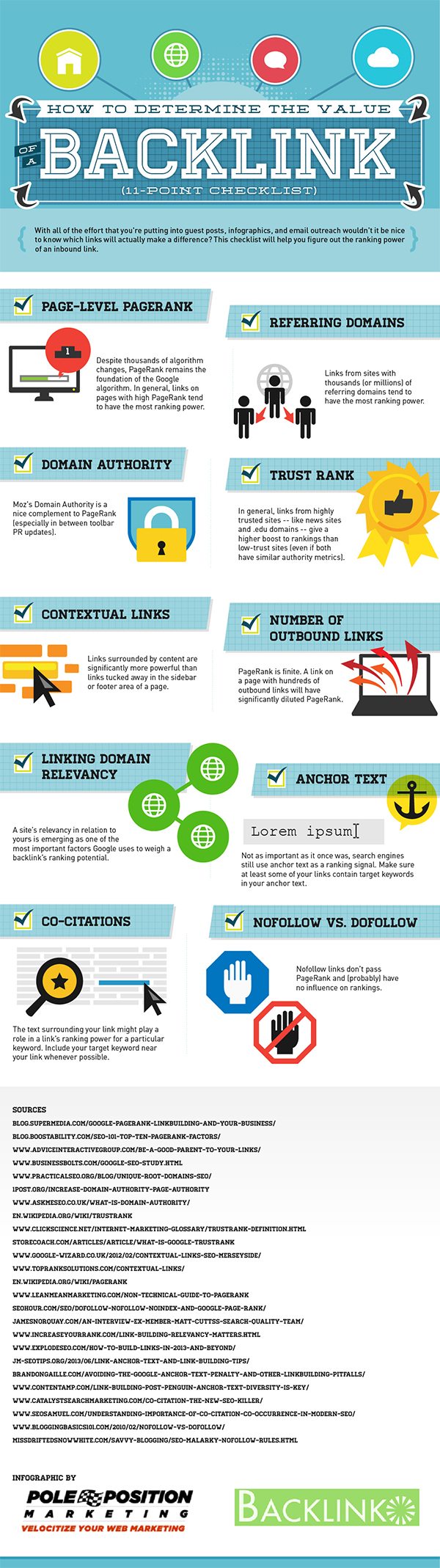
In this blog post, we’ll delve into the world of backlinks and explore 11 ways to measure the ranking power of a backlink. Understanding these metrics and factors will help you make informed decisions when it comes to link building and SEO.
Infographic from Pole Position Marketing.
1. Domain Authority (DA)
Domain Authority is a metric developed by Moz that quantifies the overall authority of a website on a scale from 0 to 100. Websites with higher DA scores are considered more authoritative and tend to rank better in search results. When assessing the ranking power of a backlink, it’s essential to consider the DA of the linking domain. A backlink from a high-DA website is generally more valuable than one from a low-DA site.
2. Page Authority (PA)
Page Authority, also developed by Moz, is similar to Domain Authority but focuses on the authority of a specific webpage rather than the entire domain. It measures the likelihood of a page ranking well in search results. A backlink from a high-PA page within a high-DA domain can significantly boost your SEO efforts.
3. Relevance
Relevance is a critical factor in backlink quality. Search engines value backlinks more when they come from websites and pages that are relevant to your content. For instance, if you run a blog about fitness and receive a backlink from a reputable fitness equipment manufacturer, it will likely carry more weight than a link from an unrelated site.
4. Anchor Text
Anchor text is the clickable text of a hyperlink. It’s essential to pay attention to the anchor text used in backlinks. Descriptive, keyword-rich anchor text that relates to your content can positively impact your SEO. However, over-optimized anchor text that appears spammy can lead to penalties. Strive for a natural and varied anchor text profile.
5. Follow vs. Nofollow
Links can be categorized as “follow” or “nofollow.” Follow links pass link equity from one site to another, helping with SEO. Nofollow links, on the other hand, do not pass link equity and are often used for user-generated content or to indicate that the linking site does not vouch for the linked content. While follow links are more valuable for SEO, a mix of both can appear more natural.
6. Link Placement
The placement of a backlink on a webpage matters. Links higher up on a page, within the main content area, tend to carry more weight than those in footers, sidebars, or less prominent areas. Contextual links within the body of a relevant article are highly valuable.
7. Link Diversity
Having a diverse backlink profile is essential for a healthy SEO strategy. This means that you should aim to acquire links from various sources, including different domains and types of websites. A natural link profile includes links from blogs, news sites, forums, and more.
8. Traffic and Click-Through Rate (CTR)
Backlinks can also contribute to your website’s traffic. A high-quality backlink from a popular website can drive direct traffic to your site. Additionally, a backlink’s CTR (the percentage of people who click on it) can indicate its value. A high CTR suggests that the link is not only relevant but also enticing to users.
9. Referral Traffic
Referral traffic refers to the visitors who come to your website through a backlink. Google considers this traffic source as a ranking factor. If a backlink generates a substantial amount of referral traffic, it signals to search engines that the linked content is valuable and authoritative.
10. Social Signals
While the direct impact of social signals (such as likes, shares, and comments) on SEO is still debated, there’s evidence to suggest that they can indirectly influence rankings. A backlink that is shared and engaged with on social media platforms may be seen as more valuable by search engines.
11. Competitor Analysis
Analyzing your competitors’ backlink profiles can provide valuable insights. Identify the websites linking to your competitors and assess their authority, relevance, and other factors. This can help you discover new link-building opportunities and potentially replicate their success.
Conclusion
Backlinks are a fundamental element of SEO, and understanding how to measure their ranking power is essential for optimizing your website’s search engine performance. By considering metrics like Domain Authority, Page Authority, relevance, anchor text, and link placement, you can make informed decisions about your link-building strategy. Additionally, monitoring traffic, CTR, and social signals can help you gauge the real-world impact of your backlinks. Remember that SEO is an ongoing process, and building a strong backlink profile takes time and effort, but the rewards in terms of improved search engine rankings are well worth it.

Author:
Mark Ford

The Most Common Local SEO Mistakes That Stop You Getting Found Online
Are you struggling to understand why your business isn’t showing up in local search results when customers are actively looking for your services? Want to uncover the common local SEO mistakes that could be quietly costing you enquiries and visibility? […]


