Do you believe that the process of SEO is as dead as a dodo? Do you think Google hates website owners that use SEO to improve their ranking?
In the fast-paced world of digital marketing, trends and strategies are constantly evolving. Search engine optimization (SEO) is no exception. Over the years, SEO has been the subject of countless debates, with some proclaiming its death and others championing its enduring relevance.
In 2017, SEO was still very much alive and kicking, but it was also plagued by a number of myths that needed to be dispelled.
In this blog post, we’ll delve into the 10 SEO myths that were circulating in 2017 and explore why they should be ignored. By shedding light on these misconceptions, we aim to help you navigate the ever-changing landscape of SEO and make informed decisions for your digital marketing strategy.
Think again! You’ll find a list of SEO myths you should ignore in this infographic.
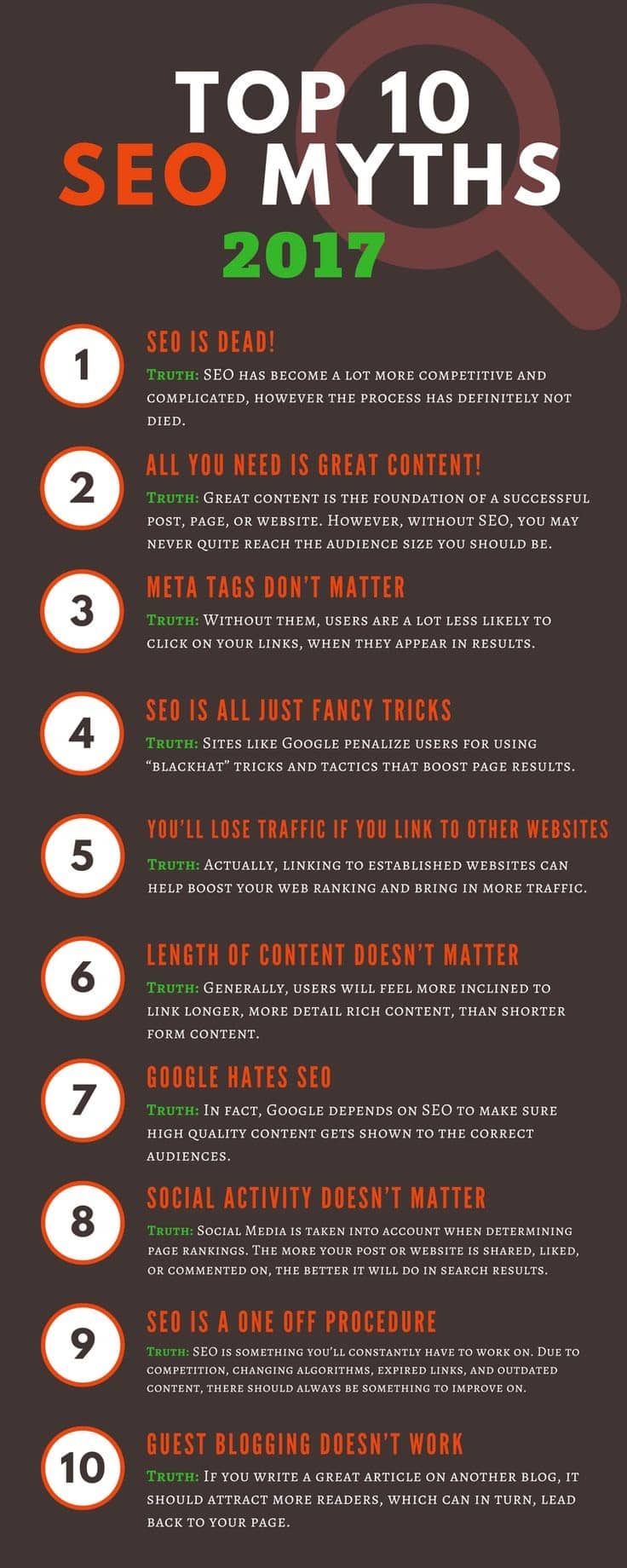
Myth 1: SEO is Dead
Let’s start by addressing the most common myth of all: the claim that SEO is dead. This assertion has been making the rounds for years, but it couldn’t be further from the truth. SEO is very much alive and continues to play a crucial role in digital marketing.
Search engines like Google are constantly updating their algorithms to provide users with the most relevant and high-quality search results. This means that SEO practices need to evolve to keep up with these changes. While some traditional SEO tactics may have become less effective, SEO as a whole is far from obsolete. In fact, it’s more important than ever.
In 2017, SEO was all about optimizing for user experience, mobile-friendliness, and content quality. As long as people continue to use search engines to find information, products, and services, SEO will remain relevant. So, don’t believe the hype—SEO is not dead.
Myth 2: Keyword Stuffing Still Works
Keyword stuffing is the practice of cramming as many keywords as possible into a piece of content in an attempt to manipulate search engine rankings. In the early days of SEO, this tactic might have worked to some extent. However, in 2017, keyword stuffing was not only ineffective but also harmful to your website’s search rankings.
Search engines have become much more sophisticated in their ability to understand the context and relevance of keywords within content. Keyword stuffing is a red flag that signals low-quality content to search engines, which can result in penalties and a drop in rankings.
Instead of stuffing keywords, focus on creating high-quality, informative, and engaging content that naturally incorporates relevant keywords. This will not only improve your search rankings but also provide a better user experience for your audience.
Myth 3: Backlinks Are No Longer Important
Backlinks, or links from other websites to yours, have long been a fundamental aspect of SEO. In 2017, the importance of backlinks had not diminished. In fact, they remained a crucial ranking factor.
However, what had changed was the quality of backlinks that search engines valued. In the past, the quantity of backlinks often took precedence over their quality. Websites would engage in link-building schemes that involved acquiring large numbers of low-quality or spammy links to artificially boost their rankings.
Search engines like Google became more adept at identifying and penalizing such manipulative practices. In 2017, it was more important than ever to focus on building high-quality, relevant, and natural backlinks. These links would not only improve your website’s authority but also help it rank higher in search results.
Myth 4: Content Quantity Trumps Quality
The idea that churning out a high volume of content is the key to SEO success was a prevalent myth in 2017. Some believed that flooding their websites with low-quality, thin, and repetitive content would help them rank higher in search results.
However, search engines had evolved to prioritize content quality over quantity. In 2017, it was clear that well-researched, informative, and valuable content was the way to go. Users and search engines alike preferred content that answered their questions, solved their problems, or provided relevant information.
Instead of focusing on quantity, invest your time and resources in creating in-depth, authoritative content that genuinely addresses the needs and interests of your target audience. Quality content not only attracts more organic traffic but also encourages visitors to stay longer on your site and engage with your brand.
Myth 5: SEO is All About On-Page Optimization
While on-page optimization is undeniably important, it’s a mistake to believe that it’s the only aspect of SEO that matters. In 2017, some SEO practitioners focused solely on optimizing meta tags, headings, and keyword placement within their content while neglecting other crucial factors.
Off-page SEO elements, such as backlinks, social signals, and brand mentions, played a significant role in search engine rankings. Additionally, technical SEO, which involves optimizing your website’s structure, speed, and mobile-friendliness, was critical for achieving and maintaining high rankings.
To succeed in SEO in 2017 and beyond, it was essential to adopt a holistic approach that encompassed both on-page and off-page optimization, as well as technical SEO.
Myth 6: SEO is a One-Time Effort
Another persistent myth that needed debunking in 2017 was the idea that SEO was a one-time effort. Some businesses believed that once they had optimized their website, they could sit back and watch the traffic roll in indefinitely.
In reality, SEO is an ongoing process. Search engines continually update their algorithms, competitors enter the market, and user behaviors change. To maintain and improve your search rankings, you must regularly update and refine your SEO strategy.
This involves monitoring your website’s performance, analyzing user data, adapting to algorithm updates, and staying up-to-date with industry trends. SEO is a long-term commitment, and those who treat it as such are more likely to see sustainable results.
Myth 7: Social Media Doesn’t Impact SEO
Social media and SEO have a complex relationship. While social signals (engagement and activity on social media platforms) may not be direct ranking factors, they can indirectly impact your SEO efforts in several ways.
In 2017, social media played a role in driving traffic to your website, increasing brand visibility, and amplifying your content’s reach. When your content is shared on social media, it can attract more backlinks and mentions, which can positively influence your search rankings.
Moreover, a strong social media presence can enhance your brand’s authority and credibility, which can indirectly contribute to better search rankings. So, don’t disregard the power of social media in your SEO strategy.
Myth 8: Mobile Optimization Doesn’t Matter
As mobile usage continued to rise, mobile optimization became increasingly crucial in 2017. However, some believed that their websites could perform well in search results without catering to mobile users.
Google, recognizing the significance of mobile-friendliness, introduced mobile-first indexing, which meant that it primarily used the mobile version of a website’s content to rank pages in search results. This shift underscored the importance of responsive web design, fast loading times, and a seamless mobile user experience.
Ignoring mobile optimization not only led to a poor user experience but also negatively impacted search rankings. In 2017 and beyond, prioritizing mobile-friendly design and performance was essential for SEO success.
Myth 9: Paid Advertising Trumps Organic Search
The debate between paid advertising and organic search has raged on for years. Some believed that paid ads were more effective than organic search results because they guaranteed visibility at the top of the search engine results pages (SERPs).
While paid advertising has its merits and can be a valuable part of your digital marketing strategy, it should not be viewed as a replacement for organic search. Organic search results still garnered the majority of clicks from users, and organic traffic often had a higher conversion rate.
In 2017, it was clear that a balanced approach that combined both paid advertising and SEO yielded the best results. Organic search provided long-term, sustainable traffic, while paid ads offered immediate visibility and the potential for quick wins.
Myth 10: SEO is All About Gaming the System
One of the most damaging myths about SEO was the belief that it was all about gaming the system and finding loopholes in search engine algorithms. This misconception led some businesses to engage in unethical and black-hat SEO practices, such as link spamming and keyword stuffing.
In reality, SEO was about providing value to users and meeting their needs. Search engines continually evolved to reward websites that offered high-quality content, a positive user experience, and genuine engagement.
In 2017, ethical and white-hat SEO practices were not only more sustainable but also less likely to result in penalties from search engines. Focusing on user-centric strategies and building a reputable online presence was the way to succeed in SEO.
Conclusion
In 2017, SEO remained a vital component of digital marketing, but it had to adapt to changing algorithms and user preferences. To succeed in the ever-evolving world of SEO, it was essential to dispel the myths that misled businesses and marketers.
SEO was not dead; it was very much alive and thriving. Keyword stuffing, low-quality content, and unethical practices were ineffective and could harm your rankings. Backlinks, content quality, and a holistic approach to SEO were crucial for success. Mobile optimization, social media, and a commitment to ongoing SEO efforts were also key factors in achieving and maintaining high search rankings.
As we move beyond 2017, the principles outlined in this article continue to be relevant. SEO is not a static discipline, and staying informed and adapting to changes is essential for long-term success in the digital landscape. By focusing on user value, quality content, and ethical practices, you can ensure that SEO remains a powerful tool in your digital marketing arsenal.

Author:
Mark Ford