
Are you looking for simple ways to improve your website’s search engine rankings? Want to follow a step-by-step SEO checklist to boost your site’s visibility and traffic?
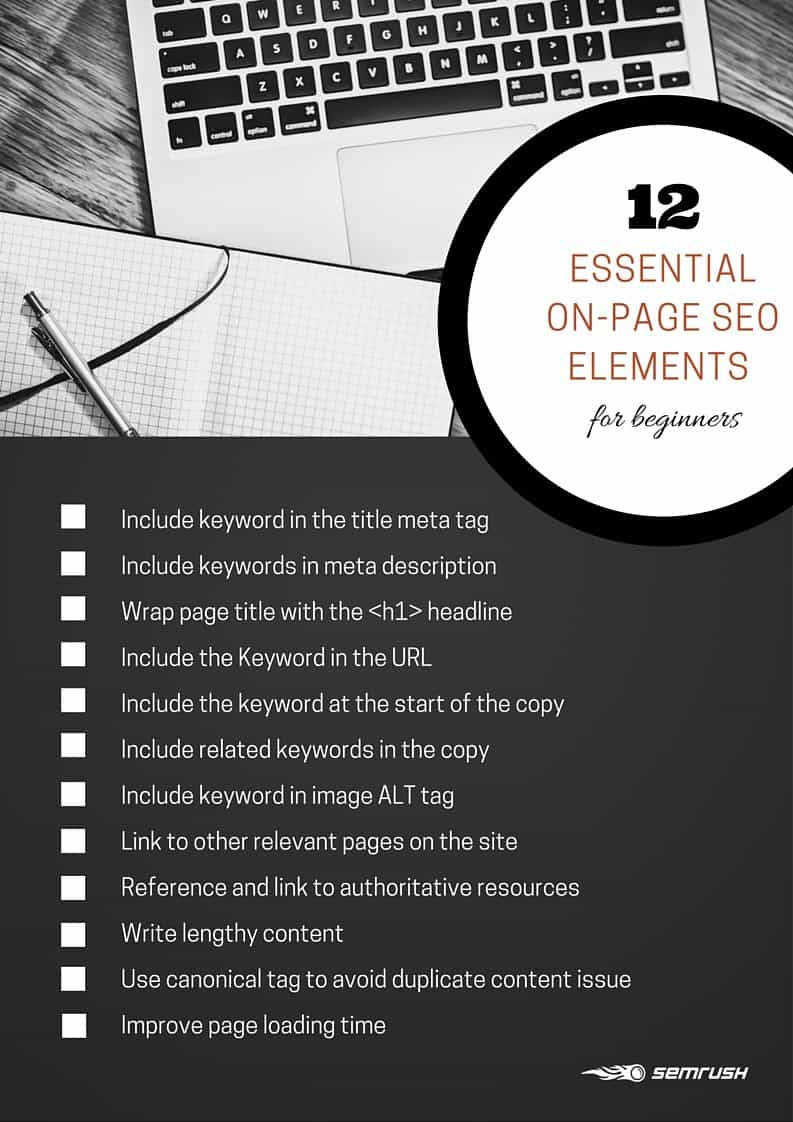
SEMrush share the best places to include your keywords (plus some additional on page optimisation techniques) in the infographic below.
Here’s what makes the list:
- Include the keyword in the title meta tag
- Use keywords in the meta description
- Wrap the page title in an <h1> tag
- Add the keyword in the URL
- Start the copy with the keyword
- Use related keywords in the content
- Include keywords in image ALT tags
- Link to relevant internal pages
- Reference and link to authoritative sources
- Write in-depth, high-quality content
- Use canonical tags to prevent duplicate content issues
- Improve page loading speed
Check out the post below for more.
Search Engine Optimization (SEO) is an essential part of making your website visible to search engines and users. For beginners, mastering on-page SEO can significantly improve rankings and drive more organic traffic.
This 12-step checklist provides practical, easy-to-follow guidance to optimize your website for success. Follow these steps to ensure your site is well-structured, user-friendly, and search engine-friendly.
Include the Keyword in the Title Meta Tag
The title meta tag is one of the most important on-page SEO factors. It tells search engines and users what your page is about. A well-optimized title can improve your click-through rate (CTR) and rankings. Make sure your title is concise, relevant, and includes your primary keyword.
- Keep your title under 60 characters for better readability.
- Place the main keyword as close to the beginning as possible.
- Avoid keyword stuffing; make the title natural and engaging.
- Use a unique title for each page to avoid duplication.
Use Keywords in the Meta Description
The meta description provides a brief summary of your webpage in search results. While it doesn’t directly impact rankings, it influences user clicks. A compelling, keyword-rich meta description can improve your site’s CTR. Make sure each page has a well-written, unique description.
- Keep the meta description between 150-160 characters.
- Naturally incorporate the target keyword within the description.
- Write a compelling call-to-action to encourage clicks.
- Avoid duplicate meta descriptions across different pages.
Wrap the Page Title in an <h1> Tag
Search engines prioritize content structure, and the <h1> tag signals the main heading. It helps both users and search engines understand the topic of the page. Proper use of <h1> tags improves readability and accessibility. Ensure that your page title is wrapped in an <h1> tag for optimal SEO impact.
- Use only one <h1> tag per page to maintain hierarchy.
- Make sure the <h1> includes the primary keyword naturally.
- Keep the heading clear, concise, and relevant.
- Avoid using <h1> tags for decorative or unnecessary text.
Add the Keyword in the URL
A well-structured URL improves SEO and user experience. Including keywords in the URL helps search engines understand the content of the page. Short, descriptive URLs rank better and are easier to share. Ensure your URL is readable and contains relevant keywords.
- Keep URLs short and avoid unnecessary words or numbers.
- Use hyphens to separate words instead of underscores.
- Avoid dynamic URLs with long strings of random characters.
- Ensure consistency by following a clear URL structure.
Start the Copy with the Keyword
Placing the keyword at the beginning of your content helps search engines quickly identify the topic. It also reassures users that they’ve found relevant information. However, keyword placement should be natural and not forced. Engaging introductions improve dwell time and reduce bounce rates.
- Include the primary keyword within the first 100 words.
- Write naturally and avoid keyword stuffing.
- Ensure the introduction is engaging and relevant to the reader.
- Keep sentences concise and informative for better readability.
Use Related Keywords in the Content
Search engines analyze related keywords to understand the context of your content. Using variations and synonyms improves topic relevance. This strategy helps pages rank for multiple search terms and provides a better user experience. Ensure keyword usage feels organic and valuable.
- Use long-tail variations of your primary keyword.
- Avoid repeating the same keyword excessively.
- Write naturally, keeping user experience in mind.
- Use tools like Google’s Keyword Planner for related terms.
Include Keywords in Image ALT Tags
Search engines can’t “see” images, so ALT tags help them understand the content. Image optimization is crucial for both SEO and accessibility. A properly written ALT tag improves rankings and ensures visually impaired users can interpret your content. Every image should have a meaningful ALT description.
- Use descriptive ALT text that accurately represents the image.
- Include relevant keywords without overstuffing.
- Keep ALT tags concise and relevant to the page’s topic.
- Avoid using generic text like “image123.jpg” as an ALT tag.
Link to Relevant Internal Pages
Internal linking strengthens website structure and improves navigation. It helps search engines understand the relationships between pages. Strategic internal linking increases dwell time and directs users to important pages. Every page should have contextual internal links.
- Link to high-value pages that provide additional insights.
- Use relevant anchor text that describes the linked content.
- Avoid excessive linking; keep it user-friendly.
- Update older pages with fresh internal links to boost relevance.
Reference and Link to Authoritative Sources
Outbound links to credible websites enhance content quality and SEO. Search engines consider external links as signals of credibility and reliability. Citing authoritative sources improves user trust and information accuracy. Ensure external links add value to your content.
- Link to trustworthy websites with high domain authority.
- Ensure outbound links open in a new tab for better UX.
- Regularly check and update broken links.
- Avoid linking to low-quality or spammy websites.
Write In-Depth, High-Quality Content
Long-form content generally performs better in search rankings. Comprehensive articles cover topics thoroughly, increasing engagement. Well-researched, structured content keeps users on your site longer. Aim to provide valuable, in-depth insights for your audience.
- Write at least 1,000 words for pillar content pages.
- Use subheadings, bullet points, and visuals for readability.
- Focus on user intent and provide solutions.
- Regularly update content to keep it relevant and fresh.
Use Canonical Tags to Prevent Duplicate Content Issues
Duplicate content can confuse search engines and hurt rankings. Canonical tags help consolidate similar pages, directing search engines to the preferred version. This strategy prevents dilution of SEO value. Implementing canonical tags ensures better indexing and ranking.
- Use the <link rel=”canonical”> tag on duplicate or similar pages.
- Choose the preferred URL version for search engines.
- Avoid publishing identical content across multiple pages.
- Regularly audit your site for duplicate content issues.
Improve Page Loading Speed
A fast-loading website improves user experience and SEO. Google considers page speed a ranking factor, so optimization is crucial. Slow pages lead to higher bounce rates and lower rankings. Ensuring fast load times enhances engagement and retention.
- Compress images to reduce file size.
- Enable browser caching and minify CSS/JavaScript files.
- Use a Content Delivery Network (CDN) to improve speed.
- Regularly test page speed using Google PageSpeed Insights.
Final Thoughts
SEO is an ongoing process that requires continuous optimization. Following this 12-step checklist will help you build a strong foundation for on-page SEO. Prioritizing search engine best practices enhances your site’s visibility, usability, and performance.
Stay updated with the latest SEO trends to maintain long-term success.

Author:
Mark Ford