Are you looking to understand what truly makes a web page rank well in search results? Want a clear breakdown of the on-page SEO elements that help your content perform, engage, and convert?
You’ll find the essential on-page SEO principles laid out clearly in this guide.
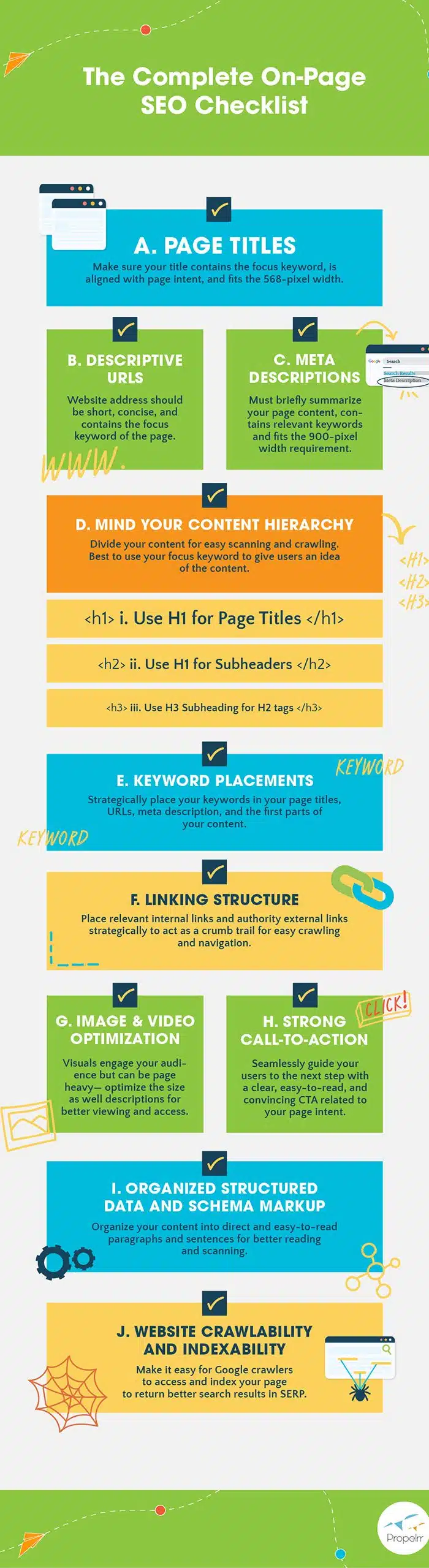
Here’s a summary of what’s covered:
- Page Titles
- Descriptive URLs
- Meta Descriptions
- Mind Your Content Hierarchy
- Keyword Placements
- Linking Structure
- Image & Video Optimisation
- Strong Call-to-Action
- Organised Structured Data and Schema Markup
- Website Crawlability and Indexability
Check out the post below for more.
Search engines are more sophisticated than ever, and winning visibility today is about far more than simply sprinkling a few keywords into your page. High-ranking pages are structured with intent, clarity, and user experience at the centre. On-page SEO is the backbone of any sustainable search strategy, providing the foundations that let your content shine.
In this deep dive, we explore the fundamental elements behind pages that perform strongly in search, attract clicks, and convert visitors into customers. By mastering each core building block, you create not only a search-friendly site but also a compelling and effortless user experience.
Whether you are fine-tuning an existing website or building new pages from scratch, this framework offers practical guidance to improve rankings, enhance usability, and future-proof your content for search success.
Page Titles
Page titles are one of the most important on-page SEO signals, because they tell search engines and users what your content is about. They act as the headline of your listing and play a key role in earning clicks from results pages. A well-crafted page title balances clarity, keyword relevance, and audience appeal to ensure your message resonates.
Your goal is to fit search intent while clearly communicating value, making it easier for both Google and readers to choose your page over competing results.
- Include your primary keyword naturally near the start of the title.
- Match the language and expectation of user search intent.
- Keep titles within recommended pixel and character limits to avoid truncation.
- Add compelling and descriptive wording to encourage clicks without clickbait.
Descriptive URLs
URLs serve as signals both to users and search engines, providing context and structure for your website. A descriptive and concise URL is easier to understand, simplifies crawling, and reinforces your keyword targeting efforts. Poorly structured URLs, on the other hand, can confuse visitors and dilute relevance.
By using clean, readable, and keyword-focused URLs, you improve user confidence and align your pages more closely with search engine expectations.
- Use short, simple URLs that clearly explain page content.
- Include the target keyword in the URL where appropriate.
- Avoid unnecessary parameters, numbers, or filler words.
- Use hyphens to separate words for readability and clarity.
Meta Descriptions
Meta descriptions are your chance to persuade users to click from the search results page. While they are not a direct ranking factor, they strongly influence click-through rate, which sends valuable behavioural signals to search engines. A strong description summarises your content, highlights value, and demonstrates relevance to the user’s search.
Think of this as your mini-pitch: clear, concise, and benefit-driven.
- Write a compelling summary that reflects page intent.
- Include relevant keywords naturally to reinforce context.
- Stay within recommended character limits to avoid truncation.
- Add a clear value or benefit to entice action and boost clicks.
Mind Your Content Hierarchy
Proper content structure ensures your pages are easy to read, navigate, and understand for both humans and search engines. Headings create logical flow and help organise information, guiding readers effortlessly from one idea to the next. When applied correctly, they also tell search engines what each section covers and signal relevance.
The aim is to build clarity and hierarchy using consistent formatting and meaningful sub-headings.
- Use one H1 for the main page title to signal the core topic.
- Use H2 tags for major content sections beneath the H1.
- Use H3 sub-headings to support and break down H2 sections.
- Keep paragraph structure clean and easy to scan for readers.
Keyword Placements
Strategic keyword use helps ensure your pages rank for the right terms without resorting to outdated stuffing tactics. Modern SEO prioritises natural language that aligns with user expectations and search behaviour. Effective placement signals relevance while protecting readability and flow.
Focus on clarity, user intent, and keyword alignment rather than repetition for its own sake.
- Include keywords in core positions like title, URL, and first paragraph.
- Use variations and supporting terms to build topical depth.
- Maintain natural sentence flow and avoid forced phrasing.
- Align keywords with user intent and search journey stage.
Linking Structure
Links act as pathways, guiding users and search crawlers through your website. Internal links help distribute authority, strengthen topical relevance, and improve user navigation. External links to reputable sources can also build context and credibility. A smart linking structure supports both usability and search performance.
By linking purposefully, you create an accessible and well-connected site that encourages exploration and trust.
- Add internal links to guide users to relevant content.
- Link to reputable external sources where useful to users.
- Use descriptive anchor text to clarify link relevance.
- Maintain a logical linking flow that supports user journey.
Image & Video Optimisation
Visual content is powerful, but it must be handled carefully to avoid slowing your site and harming user experience. Search engines rely on additional cues to understand images and video, so optimisation is essential. Proper labelling, sizing, and compression ensures fast loading, accessibility, and improved visibility.
Done right, visual optimisation enhances engagement and supports search performance.
- Compress media files to improve load times.
- Add alt text that describes imagery clearly and includes keywords where relevant.
- Use descriptive filenames rather than generic labels.
- Ensure responsive media that works across all devices.
Strong Call-to-Action
A high-ranking page is only valuable if it guides users to act. Calls-to-action (CTAs) give direction and purpose, helping visitors take the next step in their journey. Strong CTAs are clear, relevant, and aligned with the user’s intent and stage in the decision process.
Without CTAs, even the best content risks high exit rates and lost conversions.
- Place CTAs strategically where they naturally fit user flow.
- Use clear, action-focused language that reflects page intent.
- Keep CTAs simple, prominent, and easy to interact with.
- Match CTA tone and offer to user motivation and search context.
Organised Structured Data and Schema Markup
Schema markup helps search engines better understand your content and enhances visibility through rich results. Organised content and clear markup support better crawling, indexing, and presentation in search results. When paired with well-structured paragraphs and headings, this creates a page that is easy to interpret at scale.
Schema may not always be visible to users, but its impact can be significant.
- Use schema markup appropriate for page content type.
- Structure text into clear, readable paragraphs and sections.
- Validate markup to ensure accuracy and compatibility.
- Focus on clarity and consistency to enhance search understanding.
Website Crawlability and Indexability
Even the most well-optimised page cannot rank if search engines cannot access and index it. Technical accessibility ensures your site architecture, files, and settings allow seamless crawling. Prioritising crawlability also helps search engines understand your content faster and more efficiently.
The objective is to make your site effortless for bots to navigate and process.
- Ensure your robots.txt file does not block key pages.
- Check indexing settings and submit sitemaps where appropriate.
- Maintain a clean site architecture that supports navigation.
- Fix broken links and monitor crawl errors regularly.
Conclusion
On-page SEO is not a single tactic but a structured system that underpins every successful website. By focusing on clarity, relevance, and usability, you align your content with both user expectations and search engine standards. Each element, from your page title to your internal linking strategy, works together to build authority and deliver value.
As search evolves, the foundations explored here remain consistent: serve the user first, communicate clearly, and support your content with strong technical structure. Master these building blocks, and you lay the groundwork for higher visibility, stronger engagement, and long-term organic success.

Author:
Mark Ford