
Curious about the new SEO terms everyone’s talking about? Want to stay ahead of the curve by understanding the latest changes in search engine optimisation?
You’ll find some SEO basics in this infographic.
Here’s a summary of what’s covered:
- Entity-First Indexing
- Search Generated Experience (SGE)
- Attention SEO
- EEAT-Driven Structured Data
- Content Velocity
- AI Optimisation
- Sentiment-Driven SEO
- Neural Matching 2.0
- Topical Depth
- Programmatic SEO for AI Snippets
Check out the post below for more.
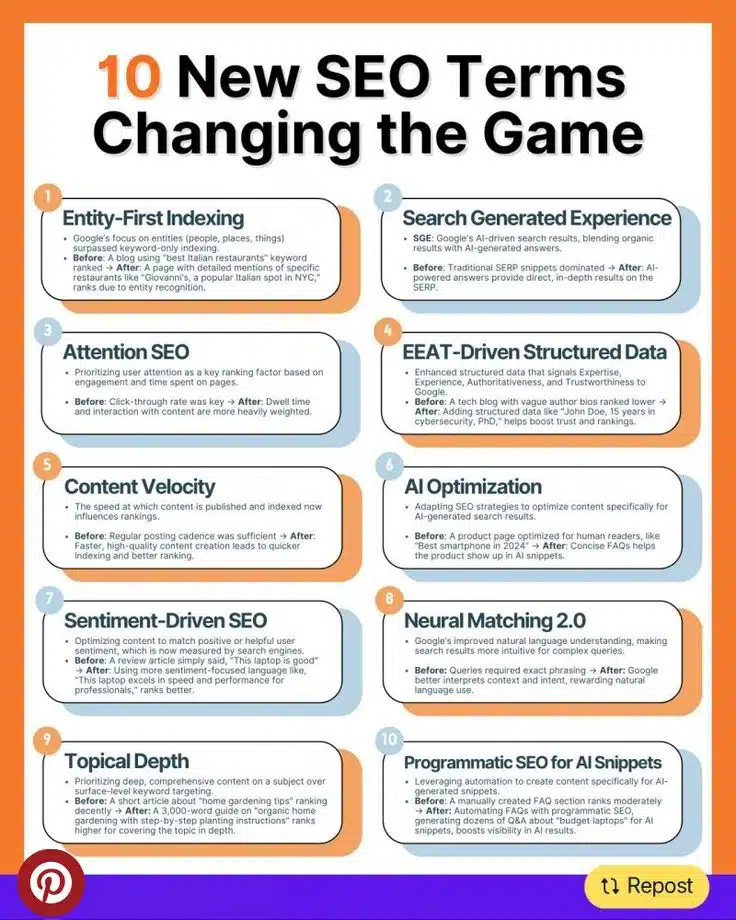
The world of SEO is evolving faster than ever, and staying ahead means keeping up with the latest terminology. From AI-generated answers to sentiment-driven strategies, today’s SEO landscape is rich with new concepts that go far beyond simple keyword optimisation.
These terms aren’t just jargon—they represent fundamental shifts in how search engines index, rank, and deliver content. If you’re serious about improving your online visibility, it’s time to learn the new language of search.
In this post, we’ll break down 10 of the most important new SEO terms. You’ll learn what they mean, why they matter, and how to apply them to your digital strategy.
Entity-First Indexing
Gone are the days when Google simply matched keywords to queries. Entity-first indexing means the algorithm now focuses on recognising specific entities—like people, places, and things—within your content. This shift helps search engines deliver more contextually relevant results based on deeper understanding.
- Optimise your content by including named entities like brands, people, and locations.
- Use schema markup to highlight entities clearly for search engines.
- Link to authoritative sources that reinforce the identity of the entities you mention.
- Write in a way that builds topical authority around the entities you want to rank for.
Search Generated Experience (SGE)
Search Generated Experience (SGE) is Google’s new AI-powered format that answers queries directly within search results. Instead of presenting just a list of links, Google now delivers AI-generated summaries, insights, and suggestions—changing how users interact with search.
- Focus on concise, fact-based content that AI can easily summarise.
- Include FAQs and short answers that are snippet-friendly.
- Optimise for conversational queries that mimic how users ask questions.
- Structure content with clear subheadings and logical flow to improve AI parsing.
Attention SEO
Attention SEO shifts the focus from click-through rates to user engagement. Search engines now prioritise content that keeps users engaged through longer dwell time, scroll depth, and interactions—making it crucial to focus on quality and usability.
- Improve readability with clear formatting, bullet points, and subheadings.
- Include interactive elements like videos, quizzes, or image galleries.
- Make your content mobile-friendly and easy to navigate.
- Use internal links to guide users deeper into your site and boost engagement.
EEAT-Driven Structured Data
Google increasingly uses structured data to assess your site’s Expertise, Authoritativeness, and Trustworthiness (EEAT). By marking up content with schema that supports credentials, qualifications, and proof of authority, you boost both rankings and credibility.
- Add schema for authors, reviews, and business credentials where relevant.
- Include bios and credentials for all content creators to build trust.
- Cite reputable sources and link to studies or industry organisations.
- Use clear, authoritative language that demonstrates subject matter expertise.
Content Velocity
Content velocity refers to the speed and consistency with which you publish new content. Algorithms now favour websites that produce high-quality, relevant content frequently and consistently, helping you stay visible and competitive.
- Create a publishing schedule and stick to it to build authority over time.
- Batch-create and schedule content in advance to maintain momentum.
- Focus on quality over quantity—but don’t let long gaps delay indexing.
- Monitor competitors’ publishing frequency and aim to match or exceed it.
AI Optimisation
AI optimisation is all about tailoring your content for AI-generated search responses. This means structuring your content in ways that AI models can easily interpret and display in featured snippets, FAQs, and summaries.
- Write concise answers to common questions near the top of your content.
- Use headings and bullet points that AI can extract with ease.
- Avoid overly complex language that may confuse natural language models.
- Refresh your content regularly to reflect current, factual information.
Sentiment-Driven SEO
Sentiment-driven SEO focuses on the emotional tone of your content. Search engines increasingly consider how positive, helpful, or reassuring your content feels—favouring pages that align with user sentiment and improve the overall search experience.
- Use emotionally intelligent language that matches user intent.
- Avoid overly negative or aggressive language unless justified.
- Highlight benefits and positive outcomes in product and service descriptions.
- Monitor reviews and feedback to align tone with what your audience values.
Neural Matching 2.0
Neural Matching 2.0 refers to Google’s advanced natural language processing capabilities. Rather than relying solely on keyword matching, it interprets user intent based on the full context of the query, rewarding naturally written, informative content.
- Write naturally, using full phrases instead of keyword stuffing.
- Focus on answering questions as users would actually ask them.
- Use semantically related terms to help algorithms understand context.
- Include examples, analogies, or real-world applications to clarify meaning.
Topical Depth
Topical depth prioritises thorough, in-depth coverage of a subject over shallow content. Google now favours pages that explore topics comprehensively, offering users everything they need to know in one place.
- Expand articles to cover FAQs, use cases, examples, and related subtopics.
- Use internal links to support deeper exploration of the subject.
- Include visuals like charts, diagrams, or infographics to enhance understanding.
- Group content into topical clusters to build authority in a niche area.
Programmatic SEO for AI Snippets
Programmatic SEO involves using automation to create or optimise content for AI-generated snippets. This method ensures that FAQs, how-to guides, and summaries are formatted in a way that maximises their chance of appearing in AI-enhanced search results.
- Generate dynamic content blocks that answer specific user queries.
- Use schema markup like FAQPage to structure content for AI snippets.
- Automate the creation of FAQs and glossaries from top-performing posts.
- Ensure consistent formatting so AI tools can easily interpret and reuse content.
Conclusion
SEO is no longer just about finding the right keywords—it’s about aligning with how search engines interpret and deliver information. From AI-generated snippets to structured data and entity-based indexing, the rules have changed. These new SEO terms reflect a more complex, intuitive, and user-focused approach to search that rewards clarity, relevance, and expertise.
By understanding and applying the concepts in this guide, you’re not just keeping up—you’re setting yourself up to lead in a rapidly evolving digital landscape. Whether you’re a marketer, business owner, or content creator, mastering this new lingo can give you a serious edge in today’s competitive search environment.

Author:
Mark Ford