Are you worried your business website is out of date? Do you think your website should be generating better results for your business?
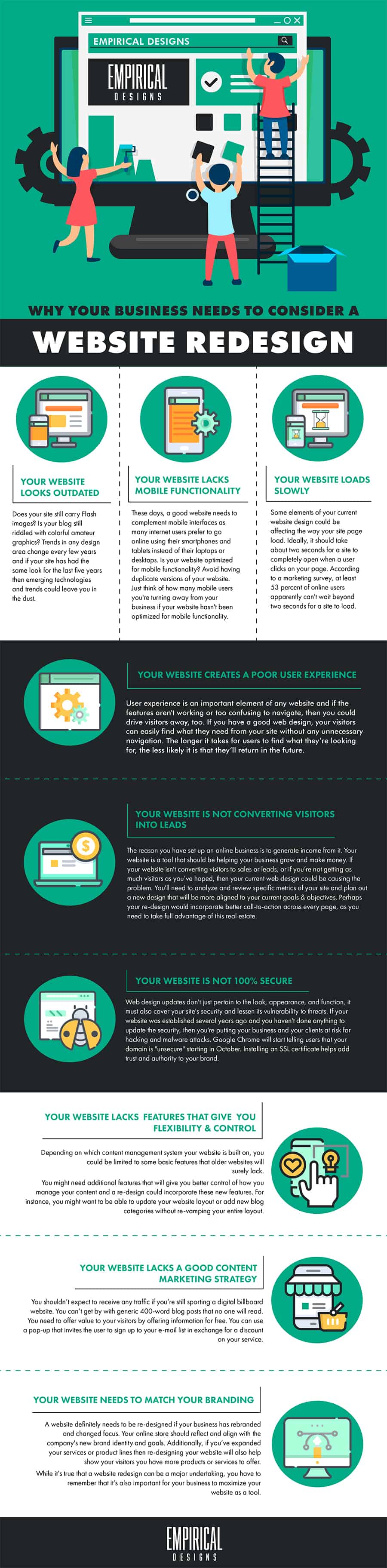
Empirical Designs share the tell-tale signs you’re due an upgrade in this infographic.
Here’s a quick summary:
- Your website looks outdated
- Your website lacks mobile functionality
- Your website loads slowly
- Your website creates a poor user experience
- Your website is not converting visitors into leads
- Your website is not secure
- Your website lacks features that give you flexibility and control
- Your website lacks a content marketing strategy
- Your website needs to match your branding
Check out the infographic for more detail.
Your website is the digital face of your business. It serves as your online storefront, marketing hub, and customer engagement platform.
But if your site isn’t performing as expected—whether it’s failing to generate leads, ranking poorly in search engines, or simply looking outdated—it may be time for an upgrade.
Here are nine key signs that indicate your website needs a refresh.
Your Website Looks Outdated
First impressions matter, and if your website design looks like it hasn’t been updated in years, visitors may assume your business is outdated too. Modern websites are sleek, clean, and easy to navigate.
- Clunky layouts, outdated fonts, and excessive clutter make your site look unprofessional.
- Competitors with more modern designs may appear more trustworthy and credible.
- Design trends change, and a dated site can make your business seem behind the times.
- A redesign can help align your site with modern web standards and user expectations.
It’s Not Mobile-Friendly
With over half of global web traffic coming from mobile devices, having a mobile-friendly website is essential. If your website isn’t responsive—meaning it doesn’t automatically adjust to different screen sizes—you’re likely losing potential customers.
- Google prioritizes mobile-friendly sites in search rankings.
- Users expect a seamless experience across all devices.
- A non-responsive site leads to high bounce rates and lost conversions.
- Mobile optimization improves accessibility and user satisfaction.
Slow Loading Speeds Are Driving Visitors Away
Speed is crucial in today’s fast-paced digital world. Studies show that users expect a website to load within two seconds, and a delay of even a few seconds can lead to high bounce rates.
- Large image files and excessive code slow down load times.
- Poor hosting or outdated CMS can impact site speed.
- Google considers page speed as a ranking factor.
- Faster websites lead to better user engagement and higher conversions.
Poor User Experience (UX)
A well-designed website should offer an intuitive and seamless user experience. If visitors struggle to navigate your site, find information, or complete desired actions, they will likely leave and look elsewhere.
- Difficult navigation frustrates users and reduces engagement.
- Excessive pop-ups or intrusive ads can drive visitors away.
- Poorly structured content makes information hard to find.
- A UX-focused redesign improves usability and customer satisfaction.
Your Website Isn’t Generating Leads or Conversions
One of the primary purposes of a business website is to generate leads and conversions. If your site isn’t driving sales, inquiries, or sign-ups, there may be an issue with its design, content, or functionality.
- Weak or missing call-to-action (CTA) elements reduce conversions.
- Outdated contact forms may be deterring potential customers.
- Poorly designed landing pages fail to capture leads effectively.
- A redesign can enhance lead generation strategies and sales funnels.
Search Engine Rankings Are Declining
If your website isn’t ranking well on search engines, it’s a major red flag. SEO best practices evolve constantly, and an outdated site might not be following current guidelines.
- Lack of proper meta tags, headings, and structured data affects rankings.
- Slow page speeds and poor mobile usability harm SEO performance.
- Outdated or irrelevant content reduces search visibility.
- Optimizing your site for SEO can boost traffic and online visibility.
Security Vulnerabilities Put Your Business at Risk
Cybersecurity threats are on the rise, and an outdated website is an easy target for hackers. If your site lacks an SSL certificate (HTTPS), has outdated plugins, or isn’t following modern security protocols, you could be at risk of data breaches.
- Websites without SSL are flagged as insecure by browsers.
- Outdated plugins and themes make your site vulnerable to attacks.
- A hacked site can damage your reputation and customer trust.
- Regular updates and security measures protect your business and users.
Your Content Strategy Is Outdated or Ineffective
Fresh, relevant content is key to keeping your audience engaged and improving your SEO. If your website still relies on outdated blog posts, generic copy, or poorly structured content, it may not be providing value to your audience.
- Old content reduces engagement and credibility.
- A lack of valuable information can drive visitors away.
- Poor content structure affects readability and retention.
- Updating content can improve search rankings and customer trust.
Your Website No Longer Aligns with Your Brand
As businesses grow and evolve, branding often changes. If your website doesn’t reflect your current brand identity, values, or offerings, it can create confusion for visitors.
- A mismatch between branding and website design weakens credibility.
- New services or products should be reflected in your online presence.
- Consistent messaging across platforms improves customer trust.
- A redesign ensures that your website accurately represents your business.
Conclusion: When to Take Action
If you’ve noticed one or more of these signs, it’s time to consider updating your website. A well-optimized, modern, and user-friendly site can boost your online presence, improve user experience, and ultimately drive more business.
- Aesthetic updates can enhance brand perception.
- Performance improvements lead to better search rankings.
- Optimized UX increases conversions and engagement.
- Investing in a website update positions your business for long-term success.
Whether you choose a full website redesign or incremental improvements, taking action now will ensure your site remains competitive in the digital landscape.

Author:
Mark Ford