
Are you struggling to get users to click on your search listings? Want to discover proven ways to boost your organic CTR and drive more traffic from Google?
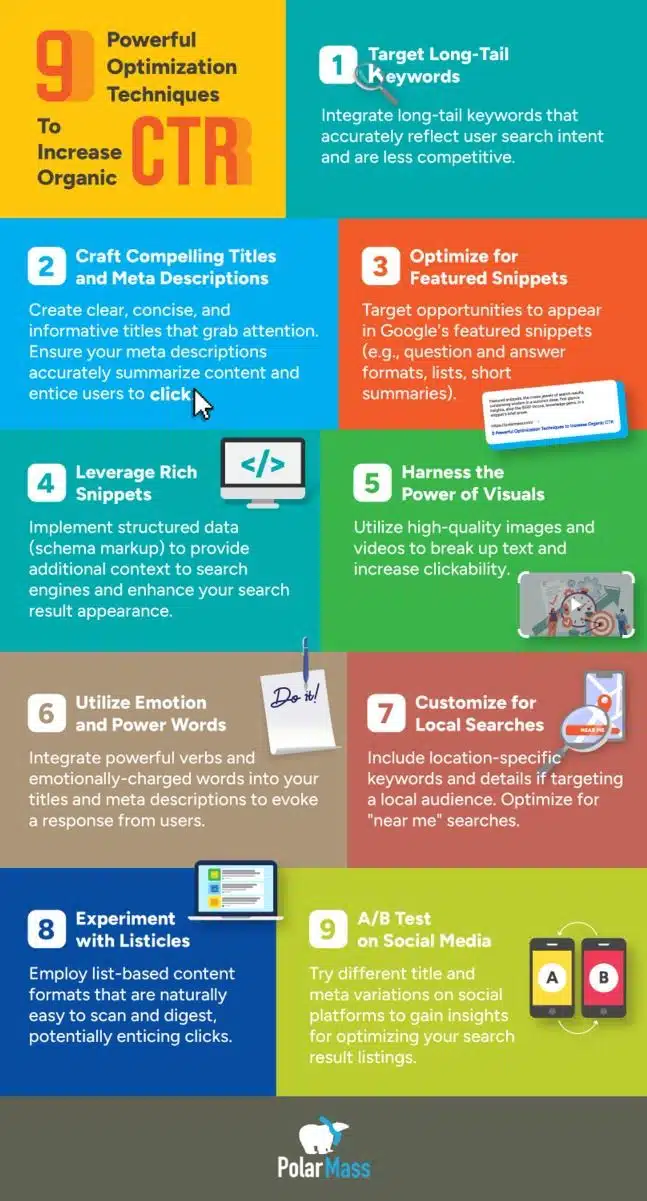
You’ll find some SEO basics in this infographic.
Here’s a summary of what’s covered:
- Use Long-Tail Keywords
- Write Compelling Titles & Meta Descriptions
- Optimise for Featured Snippets
- Leverage Rich Snippets
- Use Visual Content
- Add Emotional & Power Words
- Target Local Searches
- Create Listicles
- Run A/B Tests on Social Media
Check out the post below for more.
Getting your page to rank on Google is only half the battle. The real challenge is getting users to click your link instead of the others. That’s where optimising your organic click-through rate (CTR) comes in.
In this post, we’ll show you nine proven strategies that can significantly increase your CTR and make the most of your existing search rankings.
Use Long-Tail Keywords
Long-tail keywords are specific search phrases that reflect clear user intent. They’re typically less competitive than broader keywords and attract more qualified traffic. Because they mirror the language users type into Google, they can boost both visibility and engagement. Incorporating them into your content can give you a sharp edge in crowded search results.
- Focus on keyword phrases with 3–5 words that closely match user intent.
- Use long-tail keywords in your page titles, meta descriptions, and H1 headings.
- Target questions or specific needs like “best vegan recipes for beginners”.
- Use tools like Google Autocomplete, Answer the Public, or SEMrush for inspiration.
Write Compelling Titles & Meta Descriptions
Your title and meta description are your first impression in the search results. If they don’t catch the eye or speak to the user’s needs, they’ll scroll right past. The goal is to be clear, relevant, and enticing—while staying within character limits. The better your preview looks, the more likely it is to earn clicks.
- Write clear and engaging titles that highlight a benefit or solve a problem.
- Keep your title under 60 characters and your meta description under 160.
- Use action words and address the user directly (e.g., “Discover”, “Find out”, “You”).
- Accurately summarise your content so users aren’t misled after clicking.
Optimise for Featured Snippets
Featured snippets appear at the top of many search results, offering concise answers to user queries. Getting featured means gaining position zero—above even the #1 organic listing. To qualify, your content needs to be formatted and structured in a way Google can easily pull from. If done right, snippets can drastically improve your CTR.
- Use clear headings with direct answers underneath (ideal for Q&A formats).
- Structure your content with bullet points or numbered steps where relevant.
- Write short, well-structured summaries of 40–60 words to suit snippet length.
- Target “what is”, “how to”, and other snippet-friendly search queries.
Leverage Rich Snippets
Rich snippets enhance your organic listings with extra information like star ratings, product prices, and event details. These added elements draw attention and help users find what they’re looking for faster. By implementing schema markup on your site, you give search engines more context—and give users more reason to click.
- Use schema types relevant to your content (e.g., Article, Product, FAQ).
- Add structured data to highlight reviews, availability, or organisation details.
- Validate your markup using Google’s Rich Results Test before publishing.
- Use plugins like Rank Math or Schema Pro if you’re on WordPress.
Use Visual Content
High-quality visuals don’t just improve user experience—they can also increase your visibility in image-based search results. Images and videos encourage engagement, support your content, and break up long paragraphs. When users see that your page looks appealing, they’re more likely to click and stay.
- Include relevant, high-resolution images with descriptive ALT text.
- Add video content that complements or explains your written content.
- Use infographics to simplify complex information and boost shareability.
Add Emotional & Power Words
Certain words naturally evoke stronger emotions and engagement. These are known as power words, and they trigger curiosity, urgency, or excitement. Integrating them into your titles and descriptions can help your listings stand out. The right words, in the right places, can be the difference between a glance and a click.
- Use power words like “ultimate”, “essential”, “guaranteed”, or “secret”.
- Appeal to emotions—think relief, excitement, fear of missing out (FOMO).
- Avoid clickbait; match emotional tone with genuine content.
- Test different word variations to see what resonates with your audience.
Target Local Searches
If your business serves a specific area, local SEO can be a game-changer. Including local terms helps your content appear in geographically relevant searches. It also builds trust—users are more likely to click on listings that appear near them. Optimising for “near me” searches is essential for brick-and-mortar and service-based businesses.
- Add location-specific keywords in titles, headings, and metadata.
- Optimise your Google Business Profile and include consistent NAP info.
- Include customer reviews, local testimonials, and area-specific content.
- Use phrases like “in [City]” or “near [Landmark]” to capture regional intent.
Create Listicles
People love list-based content. It’s easy to scan, promises clear takeaways, and appeals to readers with limited time. From “10 Tips” to “5 Mistakes”, listicles set a clear expectation that feels manageable and valuable. In search results, list-based titles also tend to perform well in terms of CTR.
- Use odd numbers in your titles—studies show they attract more attention.
- Be specific about what the list covers (e.g., “7 Budgeting Tips for Freelancers”).
- Use list structure within the post to help with snippet eligibility.
- Keep your lists concise and focused, avoiding fluff or filler.
Run A/B Tests on Social Media
You don’t have to guess what title or description will work best. A/B testing on social platforms allows you to experiment in real time. By comparing different copy variations, you can gather data on which gets more clicks—then apply those learnings to your search listings. It’s a fast, low-risk way to refine your strategy.
- Post different versions of your title on platforms like Facebook or LinkedIn.
- Track engagement (clicks, likes, shares) to identify top performers.
- Use insights to improve your meta descriptions and headlines in search.
- Keep testing regularly as audience preferences evolve over time.
Conclusion
Getting more clicks from Google doesn’t require ranking #1—but it does require standing out. By improving your titles, embracing rich snippets, targeting specific user intent, and testing what works, you can significantly increase your organic CTR.
Each click is a chance to turn a visitor into a customer, so make every one count. Start optimising today, and make sure your search listings work as hard as your content does.

Author:
Mark Ford