
Are you frustrated that your marketing efforts aren’t delivering the results you expected? Wondering what successful brands are doing differently to stay ahead while others struggle to gain traction?
You’ll discover the core principles behind high-performing marketing strategies in this guide.
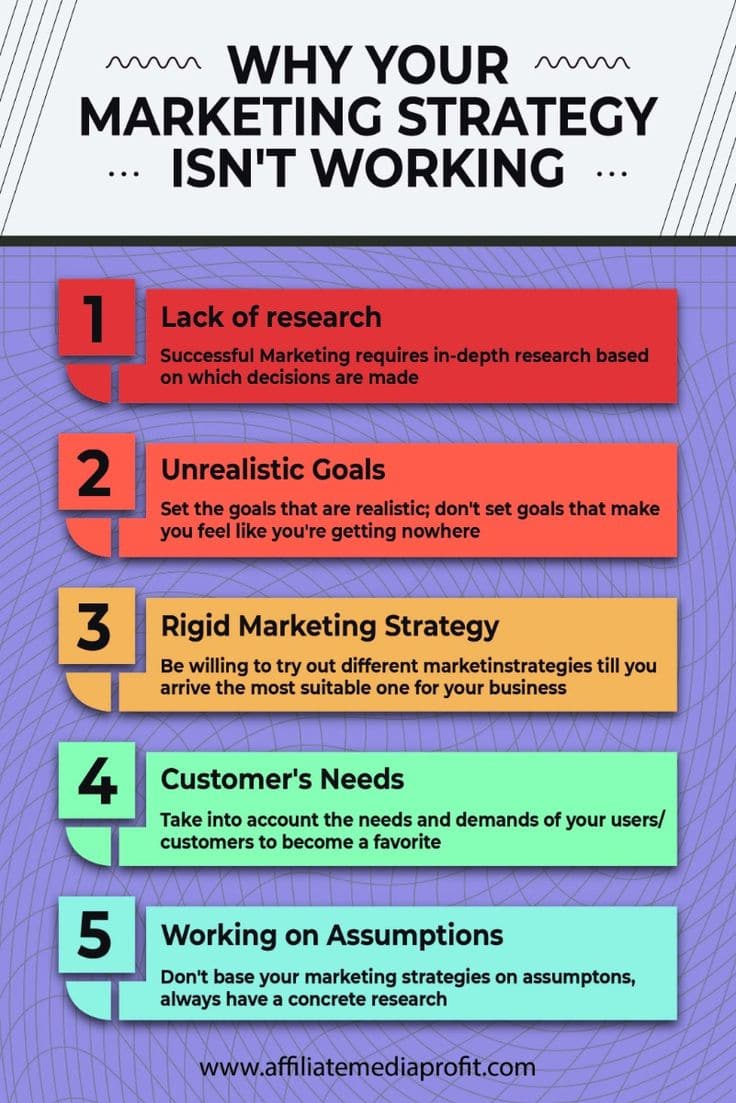
Here’s a summary of what’s covered:
- Lack of Research
- Unrealistic Goals
- Rigid Marketing Strategy
- Customer’s Needs
- Working on Assumptions
Check out the post below for more.
Marketing can feel like an endless puzzle. You try new tactics, test bold ideas, and invest time and money, yet the results sometimes fall flat. Many businesses get stuck in the cycle of trying harder instead of trying smarter, and that is where problems begin. The good news is that most marketing failures are not random; they come from predictable and avoidable mistakes.
In this guide, we will explore the core reasons marketing strategies fail and what successful brands do differently to consistently achieve growth. By understanding these common pitfalls and learning how to overcome them, you can build a more focused, resilient, and high-performing marketing strategy that delivers results you can measure and trust.
Lack of Research
A marketing strategy built on limited insight is like navigating a city without a map. Many businesses jump into campaigns without truly understanding their market, audience, or competition. When decisions are made on instinct rather than insight, even the most creative ideas struggle to land. Successful brands invest in research to create strategies based on reality rather than assumption.
Research doesn’t need to be complicated or expensive. It simply needs to be thoughtful, structured, and ongoing so you always remain aligned with your audience and industry trends.
- Conduct surveys and interviews to understand customer behaviours and motivations
- Review competitor strategies to spot gaps and inspiration
- Analyse data regularly instead of relying on one-off research
- Use audience insights to shape messaging, positioning, and channel choices
Unrealistic Goals
Ambition drives growth, but unrealistic expectations can do more harm than good. When businesses set targets that are disconnected from budget, resources, or timelines, marketing quickly becomes frustrating and directionless. Unattainable goals lead to rushed decisions, lack of clarity, and feelings of stagnation when results don’t immediately appear.
Successful brands set goals grounded in reality, backed by data, and aligned with business capacity. They measure progress progressively rather than expecting overnight success and view marketing as an investment in momentum, not a quick win.
- Set measurable goals using real data instead of wishful thinking
- Break larger objectives into achievable phases and milestones
- Align targets with budget, time, and team capacity
- Review and adjust goals regularly based on performance insights
Rigid Marketing Strategy
Sticking to a single marketing plan without flexibility is like driving with your eyes closed to traffic around you. Markets shift, platforms evolve, and customer behaviour changes constantly. When brands refuse to adapt, results stall. Rigidity doesn’t just slow growth; it prevents it altogether. Successful brands stay curious, agile, and experiment with new approaches.
Being adaptable doesn’t mean changing direction constantly. It means testing thoughtfully, tracking results, and refining what works. The most successful marketers see strategy as a living system rather than a fixed plan.
- Test new content formats, platforms, and approaches regularly
- Track performance data and optimise based on what works
- Stay aware of industry shifts and emerging trends
- Build a test-and-learn culture rather than relying on fixed assumptions
Customer’s Needs
Marketing fails when brands focus more on what they want to say than what customers need to hear. Many campaigns focus on product features, business priorities, or creative ideas without truly connecting to the real-world desires, frustrations, and motivations of customers. If your messaging doesn’t resonate with the audience, even the smartest plan will fall short.
Successful brands build strategies around customer insights. They listen, empathise, and respond to real needs rather than perceived ones. The result is messaging that feels personal, solutions-driven, and genuinely valuable.
- Conduct ongoing customer research to stay aligned with needs
- Tailor messaging to customer pain points, outcomes, and priorities
- Build content and offers that solve real problems
- Prioritise customer feedback to shape future marketing decisions
Working on Assumptions
Assumptions are one of the most dangerous elements in marketing. When decisions are based on gut feeling instead of data, campaigns become risky, unpredictable, and harder to measure. Many brands skip validation steps, assuming they already understand their audience or know what will work. That approach leads to wasted budget and missed opportunities.
Top-performing brands validate ideas before scaling them. They test small, learn fast, and refine what works instead of spending heavily on unproven strategies. They trade assumptions for insight and rely on evidence every step of the way.
- Validate ideas through small-scale tests before committing fully
- Use analytics and tracking to guide decisions, not guesswork
- Gather customer feedback to confirm direction and messaging
- Adjust campaigns based on what data reveals, not personal preference
Conclusion
Marketing success isn’t about luck. It is about clarity, research, and a willingness to adapt. Strategies fail when they are built on assumptions, unrealistic expectations, and rigid thinking rather than real insight and customer-led decisions. The brands that win are not necessarily the ones with the biggest budgets or boldest ideas, but the ones who stay curious, listen deeply, test thoughtfully, and refine constantly.
By grounding your marketing in research, setting realistic goals, remaining flexible, prioritising customer needs, and avoiding assumption-driven decisions, you build a strategy that is resilient, measurable, and primed for growth. Marketing is a journey rather than a sprint, and when you approach it with intention, patience, and intelligence, long-term success becomes not only possible but predictable.

Author:
Mark Ford