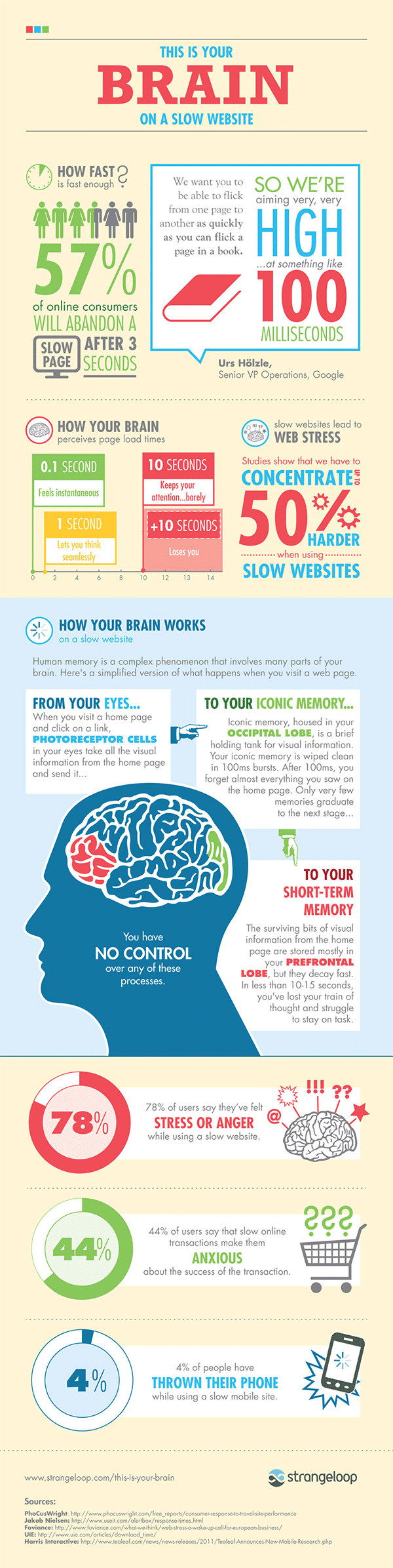
How slow is your business website? A recent study has found that 57% of online consumers abandon a website if a page takes longer than 3 seconds to load.
That same study has shown that 78% of people felt stressed or angry when using a slow website. Is your website causing internet rage?
The infographic below from Strangeloop shows you just how your brain works on a slow website.
In today’s digital age, a website serves as the virtual storefront for businesses of all sizes. It’s often the first point of contact between your brand and potential customers. However, despite investing time and resources in creating a visually appealing website, many businesses are unknowingly losing a significant portion of their website visitors within just a few seconds of their arrival. In this blog post, we’ll explore the reasons behind this alarming statistic and offer practical solutions to keep your visitors engaged and on your site.
Understanding the 3-Second Rule
The “3-Second Rule” refers to the idea that you have a mere three seconds to capture the attention and interest of your website visitors before they decide to click away. This concept has gained prominence due to the ever-decreasing attention spans of internet users. According to studies, the average human attention span has dwindled to around eight seconds, which is even shorter than that of a goldfish! This means that you have an incredibly brief window to make a lasting impression.
Now, let’s delve into the primary reasons behind this phenomenon and explore strategies to combat it.
Slow Loading Times
One of the most common culprits behind the rapid loss of website visitors is slow loading times. In today’s fast-paced world, users expect websites to load swiftly. If your site takes too long to load, visitors are likely to hit the back button and explore other options. Research indicates that 47% of users expect a web page to load in two seconds or less.
To combat this issue, consider the following steps:
- Optimize images and videos: Compressing and optimizing media files can significantly reduce loading times.
- Minimize HTTP requests: Fewer requests lead to quicker loading times. Reduce unnecessary scripts and plugins.
- Use a Content Delivery Network (CDN): CDNs distribute website content across multiple servers globally, ensuring faster loading times for users across different locations.
- Invest in reliable hosting: Choose a hosting provider that offers fast server speeds and uptime guarantees.
Poor Website Design
Your website’s design plays a pivotal role in retaining visitors. A cluttered, confusing, or outdated design can quickly turn users away. Some common design-related issues include:
- Unresponsive design: With the increasing use of mobile devices, having a responsive design that adapts to different screen sizes is essential.
- Overwhelming visuals: Excessive use of images, animations, or flashy elements can overwhelm visitors and distract them from your core message.
- Complex navigation: Make sure your website navigation is intuitive and easy to use. Visitors should find what they’re looking for without frustration.
To enhance your website’s design:
- Conduct user testing: Gather feedback from real users to identify design issues and make necessary improvements.
- Keep it simple: Embrace minimalism in your design, focusing on a clean and user-friendly interface.
- A/B testing: Experiment with different design elements and layouts to determine what resonates best with your audience.
Lack of Clear Value Proposition
A clear and compelling value proposition is critical for keeping visitors engaged. When users land on your website, they should immediately understand what you offer and why it’s valuable to them. Failing to convey this information within the first few seconds can result in high bounce rates.
To create an effective value proposition:
- Craft a concise headline: Use a succinct headline that communicates the main benefit of your product or service.
- Highlight key benefits: Use bullet points or short paragraphs to outline the advantages of choosing your brand.
- Include a strong call to action (CTA): Encourage visitors to take action by prominently featuring a CTA button or link.
Irrelevant or Poorly Written Content
Content is king, but it must be relevant and well-crafted to retain visitors. If your website content doesn’t resonate with your target audience or is riddled with errors, visitors are likely to lose interest quickly. Here’s how to address this issue:
- Know your audience: Understand your target audience’s pain points, preferences, and needs. Tailor your content to address these effectively.
- Invest in quality content: High-quality, informative, and engaging content is more likely to captivate visitors and keep them on your site.
- Proofread and edit: Eliminate grammatical errors and typos to ensure a professional and polished appearance.
Intrusive Pop-Ups and Advertisements
While pop-ups and advertisements can be effective for marketing and revenue generation, using them excessively or in an intrusive manner can drive visitors away. Pop-ups that appear immediately upon landing or obstruct content can be particularly frustrating for users.
To strike a balance between marketing and user experience:
- Use exit-intent pop-ups: Display pop-ups when users are about to leave your site rather than as soon as they arrive.
- Limit pop-up frequency: Avoid overwhelming visitors with too many pop-ups or ads on a single page.
- Provide value: If you use pop-ups, ensure that they offer something valuable to the user, such as a discount or useful content.
Lack of Trust Signals
Building trust with your website visitors is essential for keeping them engaged. If your site lacks trust signals, such as customer reviews, security certifications, or contact information, visitors may be hesitant to stay.
To establish trust:
- Display customer testimonials and reviews: Showcase positive feedback from previous customers to build credibility.
- Highlight security measures: Assure users that their data is safe by displaying trust badges and privacy policy links.
- Provide contact information: Make it easy for visitors to get in touch with your business through clear contact details.
Slow or Nonexistent Mobile Optimization
With the increasing use of smartphones, mobile optimization is no longer optional. If your website isn’t mobile-friendly, you risk losing a significant portion of your audience.
To optimize for mobile:
- Use responsive design: Ensure that your website adapts to various screen sizes and orientations.
- Test on multiple devices: Check how your site performs on different smartphones and tablets to identify and resolve issues.
- Optimize loading times: Mobile users are often on slower connections, so prioritize quick loading times for mobile devices.
Conclusion
Losing 57% of your website visitors within 3 seconds is a significant challenge that can impact your online success. However, by addressing the common issues discussed in this blog post, you can improve user retention, engagement, and conversion rates. Remember that capturing and maintaining your audience’s attention in today’s fast-paced digital landscape requires continuous effort and optimization. Invest in improving your website’s speed, design, content, and user experience to ensure that visitors not only stay longer but also become loyal customers.

Author:
Mark Ford

Mastering the Art of the Landing Page: Design, Copy, and Conversion in Harmony
Are you trying to design a landing page that not only looks great but actually converts visitors into customers? Want to learn how to balance design, copy, and strategy to create landing pages that work in perfect harmony? […]