Are you wondering whether your business really needs a website in today’s digital world? Want to discover the key reasons why having a website is essential for your success?
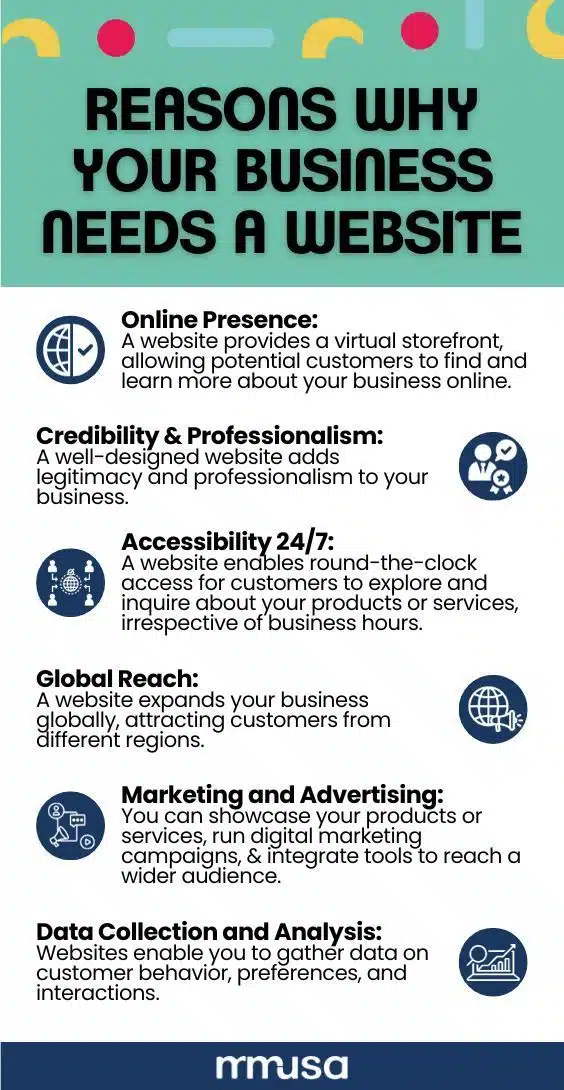
You’ll find 6 key reasons in this infographic from MMUSA.
Here’s what makes the list:
- Online Presence
- Credibility & Professionalism
- Accessibility 24/7
- Global Reach
- Marketing and Advertising
- Data Collection and Analysis
Check out the infographic for more information.
In today’s digital-first world, having a strong online presence is no longer optional—it’s essential. Whether you run a small local shop or a multinational corporation, a website is one of the most valuable assets your business can have. Yet, many business owners still underestimate its importance, relying solely on social media, word-of-mouth, or traditional marketing.
If you’re wondering whether a website is worth the investment, consider this: 81% of consumers research businesses online before making a purchase. If you don’t have a website, you’re missing out on a huge potential audience.
In this article, we’ll explore six compelling reasons why your business needs a website—and why you simply can’t afford to ignore them.
Establish a Strong Online Presence
The internet has become the go-to place for consumers searching for products, services, and recommendations. A website acts as your virtual storefront, making it easy for potential customers to find information about your business anytime, anywhere.
Imagine this scenario: Someone hears about your business from a friend and wants to learn more. What’s the first thing they do? They search for your business online. If they can’t find a website, they may assume you’re not legitimate or may turn to a competitor who does have an online presence.
Having a website means:
- Customers can find key details about your business, such as location, opening hours, and contact information.
- You can showcase your products or services with detailed descriptions, images, and pricing.
- You can provide valuable content, such as blog posts, FAQs, and testimonials, to engage potential customers.
Without a website, you’re essentially invisible to a large percentage of your audience.
Build Credibility and Professionalism
A well-designed website instantly adds legitimacy to your business. Today’s consumers expect reputable businesses to have a professional online presence. In fact, 75% of consumers judge a company’s credibility based on its website design.
Here’s how a website enhances your credibility:
- First impressions matter: A sleek, modern website gives customers confidence that your business is trustworthy.
- Showcase customer reviews and testimonials: A website allows you to highlight positive feedback, case studies, and success stories.
- Demonstrate expertise: By publishing blog posts, guides, or whitepapers, you position yourself as an authority in your industry.
Think of your website as your digital business card—a place where you control your brand’s image and message. Without one, you risk losing potential customers to competitors who appear more credible.
Provide 24/7 Accessibility to Customers
Unlike a physical store with set business hours, a website is always open. It provides round-the-clock access to your business, allowing customers to browse your products or services at their convenience.
Why is this important?
- Consumers shop outside of business hours. Many people research and make purchase decisions in the evenings or on weekends. If your business isn’t accessible, they may look elsewhere.
- You can automate customer support. Chatbots, contact forms, and FAQ sections allow visitors to get answers to common questions even when you’re not available.
- E-commerce integration enables instant sales. If you sell products online, a website allows customers to buy from you 24/7, increasing your revenue potential.
Even if you don’t sell online, simply providing detailed information about your business can help convert visitors into customers at any time of day.
Expand Your Reach Beyond Local Customers
If your business relies solely on foot traffic or local word-of-mouth, you’re limiting your potential customer base. A website breaks those barriers, allowing you to reach people beyond your immediate area.
Benefits of a global online presence:
- SEO (Search Engine Optimisation) helps attract customers from anywhere. By optimising your website with relevant keywords, you can appear in search results when people look for products or services like yours.
- You can tap into new markets. Even if you primarily serve a local audience, your website can attract people moving to the area or tourists looking for businesses like yours.
- You’re no longer restricted by geography. Whether you offer online services, ship products, or provide digital downloads, your customer base isn’t limited to your physical location.
Even small, locally owned businesses can benefit from having a website—it ensures that people searching online can find and connect with them.
Boost Your Marketing and Advertising Efforts
A website is a powerful marketing tool, giving you multiple ways to promote your business and attract new customers. While social media is useful, it shouldn’t be your only digital marketing strategy. Your website acts as the central hub where all your online marketing efforts come together.
Ways a website enhances your marketing:
- Search Engine Optimisation (SEO): By optimising your site for search engines, you increase your chances of ranking higher on Google and driving organic traffic.
- Content marketing: Blog posts, videos, and guides can attract potential customers while positioning you as an expert in your industry.
- Email marketing: A website allows you to collect email addresses and nurture leads through newsletters and promotional campaigns.
- Paid advertising: If you run Google Ads or social media ads, directing traffic to a professional website increases conversions compared to sending people to a social media page.
Without a website, your marketing efforts are far less effective because you have no central place to direct traffic or convert visitors into customers.
Gain Valuable Customer Insights with Data Collection
One of the biggest advantages of having a website is the ability to track and analyse customer behaviour. Unlike traditional marketing, where it’s difficult to measure results, a website provides valuable data on how people interact with your business online.
With tools like Google Analytics, you can track:
- Website traffic: See how many people visit your site, where they come from, and which pages they view.
- User behaviour: Learn how visitors navigate your website, what they’re interested in, and where they drop off.
- Conversion rates: Track how many visitors take desired actions, such as signing up for a newsletter, making a purchase, or contacting you.
- Customer demographics: Understand who your audience is—age, location, interests—so you can tailor your marketing strategies accordingly.
By leveraging this data, you can make data-driven decisions to improve your website, refine your marketing, and ultimately grow your business.
The Cost of NOT Having a Website
Still unsure if your business really needs a website? Consider what you’re losing by not having one:
- Lost customers: People who can’t find you online will likely go to competitors who have a website.
- Missed revenue opportunities: Without an online presence, you miss out on potential sales and leads.
- Weaker brand perception: Customers may perceive your business as outdated or untrustworthy.
- Limited marketing reach: Without a website, your digital marketing efforts are far less effective.
The cost of building and maintaining a website is far less than the long-term losses of not having one.
Final Thoughts
In today’s digital age, a website isn’t just a “nice-to-have”—it’s a necessity. Whether you’re a small business owner, an entrepreneur, or a large corporation, having a website is essential for reaching customers, establishing credibility, and growing your brand.
By investing in a professional website, you:
- Create a strong online presence
- Build trust and credibility
- Keep your business accessible 24/7
- Expand your customer reach
- Improve marketing effectiveness
- Gain valuable customer insights
If your business still doesn’t have a website, now is the time to act. Don’t let your competitors take all the online traffic—establish your digital presence today and start reaping the benefits!

Author:
Mark Ford