Are you just getting started with a marketing campaign for your business? Want to learn the key skills required for a successful marketing strategy?
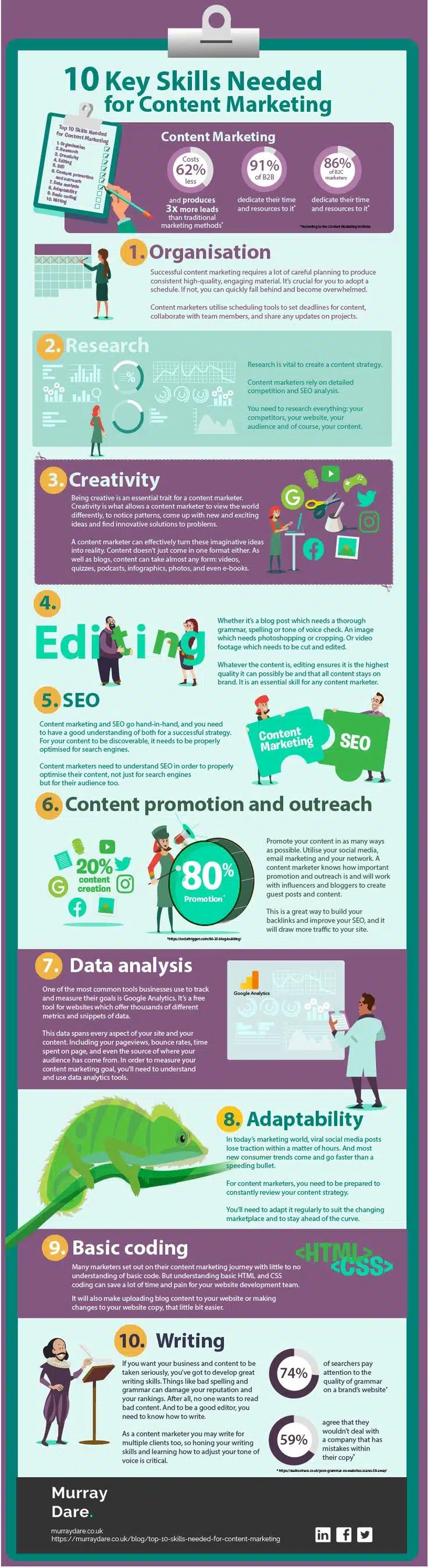
Murray Dare shares its essential marketing skills in this infographic.
Here’s what makes the list:
- Organisation
- Research
- Creativity
- Editing
- SEO
- Content Promotion and Outreach
- Data Analysis
- Adaptability
- Basic Coding
- Writing
Check out the infographic for more information.
A great marketing strategy doesn’t just happen—it’s built on a combination of skills that work together to create, distribute, and refine content that attracts the right audience.
Successful marketers know that it’s not just about having a good product or service; it’s about consistently reaching and engaging potential customers in a way that stands out from the competition.
To do that, you need a mix of creativity, technical knowledge, and strategic thinking. Here are ten essential skills that will help you build and execute a marketing strategy that delivers results.
Organisation: Keeping Everything on Track
Marketing is complex. Between content creation, social media, email campaigns, and paid ads, there are always multiple tasks running at once. Without strong organisational skills, deadlines get missed, campaigns become inconsistent, and opportunities slip through the cracks.
- Use project management tools like Trello, Asana, or ClickUp to stay on top of tasks.
- Create a content calendar to plan blog posts, social media updates, and promotions.
- Set clear priorities so you focus on high-impact tasks first.
Good organisation allows you to be more efficient, reduce stress, and maintain a consistent marketing presence without scrambling at the last minute.
Research: Understanding Your Market
The best marketing strategies are built on data, not assumptions. Without proper research, you risk targeting the wrong audience, missing trends, or failing to understand what drives customer decisions.
- Study your competitors to learn what’s working for them and identify gaps in the market.
- Use tools like Google Trends, BuzzSumo, and SEMrush to track what people are searching for.
- Conduct surveys, read customer reviews, and analyse past campaign performance to fine-tune your approach.
Marketing research helps you craft messages that resonate, choose the right platforms, and position your brand effectively in the marketplace.
Creativity: The Key to Standing Out
Consumers are bombarded with ads, emails, and content every day. If your marketing isn’t creative, it gets lost in the noise. Creativity isn’t just about making things look good—it’s about presenting ideas in unique and engaging ways that capture attention and make an impact.
- Develop a distinct brand voice that reflects your personality and values.
- Experiment with different formats, like videos, infographics, interactive content, and storytelling-based posts.
- Look outside your industry for inspiration to bring fresh ideas to your campaigns.
Creativity sets you apart, makes your content memorable, and encourages people to engage with your brand.
Editing: Refining Every Piece of Content
A small mistake in your marketing materials can make your brand look unprofessional. Whether it’s a blog post, social media ad, or video script, editing ensures that every piece of content is polished and communicates your message effectively.
- Double-check for grammar, spelling, and punctuation errors before publishing.
- Ensure consistency in tone, formatting, and branding across all platforms.
- Review visual content for image quality, readability, and proper alignment.
Well-edited content enhances your credibility and professionalism, making it easier for customers to trust your brand.
SEO: Making Your Content Discoverable
Even the best content won’t deliver results if no one sees it. Search engine optimisation (SEO) helps your website and content rank higher on Google, driving more organic traffic to your brand.
- Use keyword research tools like Ahrefs or Ubersuggest to find relevant search terms.
- Optimise website pages, blog posts, and images with proper titles, meta descriptions, and alt text.
- Build backlinks by guest posting on other websites and collaborating with industry leaders.
SEO isn’t a one-time task—it’s an ongoing process. When done right, it brings in consistent traffic without the need for paid advertising.
Content Promotion and Outreach: Expanding Your Reach
Creating great content is only half the battle—you also need a strong distribution strategy. If you’re not actively promoting your content, it won’t get the visibility it deserves.
- Share content across social media platforms and adapt it to suit each one.
- Partner with influencers, bloggers, or other businesses to increase reach.
- Use email marketing to send content directly to your audience.
A proactive approach to promotion ensures your content gets in front of the right people, increasing engagement and driving leads.
Data Analysis: Tracking What Works
Marketing isn’t about guesswork—it’s about results. Data analysis helps you understand what’s working, what’s not, and where to focus your efforts for the best return on investment.
- Monitor website traffic and user behaviour with Google Analytics.
- Track social media engagement, ad performance, and conversion rates.
- A/B test different marketing strategies to see what delivers the best results.
By making data-driven decisions, you avoid wasting time and money on ineffective campaigns and focus on what truly moves the needle.
Adaptability: Keeping Up with Change
Marketing trends, consumer behaviours, and platform algorithms are constantly evolving. What worked a year ago—or even a few months ago—might not work today. The ability to adapt quickly is a crucial skill for long-term success.
- Stay updated on industry news, emerging trends, and new technologies.
- Be willing to shift strategies when something isn’t working.
- Continuously test new approaches and refine based on feedback.
The most successful marketers are flexible, quick to learn, and ready to pivot when necessary.
Basic Coding: A Valuable Technical Skill
You don’t need to be a developer, but knowing a little about coding can give you an edge. Basic HTML, CSS, and even JavaScript can help you optimise websites, tweak email templates, and troubleshoot minor issues without relying on a developer for every small change.
- Learn simple HTML and CSS to edit blog posts and improve website formatting.
- Understand how to update meta tags, alt text, and structured data for SEO.
- Use basic coding knowledge to customise email campaigns and landing pages.
Even a small amount of technical skill can save time and give you greater control over your marketing assets.
Writing: The Foundation of All Marketing
Strong writing skills are the backbone of marketing. Whether it’s a social media post, a blog article, or an email campaign, the way you communicate your message directly impacts engagement and conversions.
- Write with clarity, conciseness, and a strong brand voice.
- Focus on storytelling to connect emotionally with your audience.
- Adapt writing style based on the platform, whether it’s a professional LinkedIn post or an informal Instagram caption.
Great writing builds trust, drives action, and ensures your marketing messages hit the right tone every time.
Conclusion
Marketing is a combination of strategy, creativity, and adaptability. Developing these ten key skills will help you craft compelling campaigns, reach the right audience, and make data-driven decisions that improve performance.
Whether you’re refining your SEO knowledge, improving your content promotion tactics, or learning basic coding, each new skill strengthens your overall marketing strategy. The more you invest in developing these abilities, the more effective your campaigns will be—and the better your results.

Author:
Mark Ford