
Are you finding it harder to make your content stand out in an increasingly crowded digital space? Want to learn how to overcome the biggest challenges modern content marketers face and stay ahead of the competition?
You’ll find some content basics in this infographic.
Here’s a summary of what’s covered:
- Content Strategists’ Challenges
- Content Writers’ Challenges
- PR/Marketing Managers’ Challenges
- Editors’ Challenges
- Project Managers’ Challenges
Check out the post below for more.
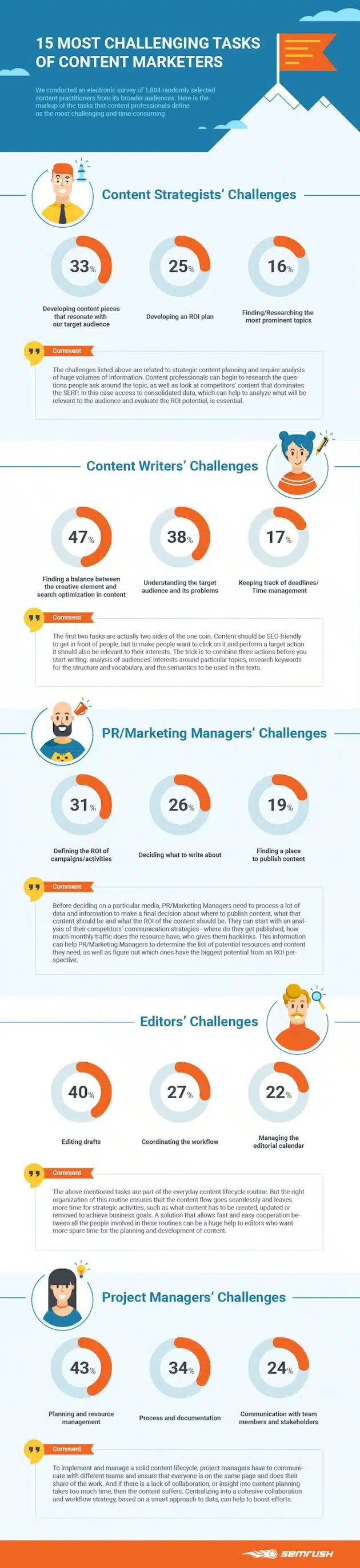
Content marketing has evolved far beyond simply publishing blogs or social posts. Today, it’s a complex ecosystem that demands strategy, creativity, analytics, and flawless execution. With changing algorithms, higher audience expectations, and tighter competition, content marketers face more challenges than ever before.
This post explores why it’s getting tougher—and how you can overcome the biggest obstacles to stay ahead.
Content Strategists’ Challenges
Content strategists are the architects behind every marketing plan. Their job is to identify what audiences care about, how to measure results, and which topics will drive long-term engagement. But as consumer behaviour and technology evolve, it’s becoming increasingly difficult to connect strategy with measurable outcomes.
- Focus on audience research through surveys, social listening, and data analytics to discover what truly resonates.
- Build flexible ROI models that go beyond traffic—include engagement, conversions, and customer retention metrics.
- Use content mapping to align every piece with the buyer’s journey, ensuring each stage has a clear purpose.
- Invest in data visualisation tools to simplify performance tracking and communicate results effectively to stakeholders.
Content Writers’ Challenges
Writers stand at the intersection of creativity and optimisation. Their challenge lies in crafting content that pleases both human readers and search algorithms—a balancing act that requires constant adaptation. With shrinking attention spans and endless competition, standing out is no easy task.
- Create audience personas that define tone, pain points, and preferred formats for better message alignment.
- Optimise naturally by using semantic keywords and structuring content for readability rather than keyword density.
- Batch similar writing tasks to maintain focus, reduce fatigue, and meet deadlines consistently.
- Repurpose high-performing content into multiple formats like social snippets, guides, and newsletters to maximise reach.
PR/Marketing Managers’ Challenges
PR and marketing managers must connect creativity with commercial value. They face the difficult task of choosing the right platforms, crafting campaigns that perform, and proving their worth through measurable ROI. As marketing budgets tighten, the demand for data-backed decisions grows stronger.
- Use campaign tracking tools to attribute leads, conversions, and engagement to specific content assets.
- Develop a clear content distribution plan that matches each channel’s audience behaviour and strengths.
- Set defined KPIs before launching campaigns to ensure every activity supports a measurable outcome.
- Conduct post-campaign reviews to evaluate ROI, refine messaging, and guide future marketing decisions.
Editors’ Challenges
Editors are the unsung heroes who ensure that ideas turn into polished, cohesive content. Their world revolves around deadlines, drafts, and managing teams of creators. As workloads increase, maintaining quality while staying organised is one of their toughest battles.
- Establish content guidelines covering tone, voice, formatting, and SEO to maintain consistency across writers.
- Use project management tools to assign, track, and approve tasks efficiently in collaborative environments.
- Build an editorial calendar that balances seasonal opportunities with evergreen content for ongoing visibility.
- Encourage constructive feedback loops that help writers grow while strengthening editorial quality.
Project Managers’ Challenges
Project managers bring structure and clarity to the content production process. They ensure resources are allocated, deadlines are met, and communication flows smoothly across teams. But with growing cross-department collaboration, managing time, tools, and people can feel like a juggling act.
- Hold regular progress meetings to identify bottlenecks early and adjust schedules accordingly.
- Document all processes—from ideation to publication—to reduce confusion and keep workflows consistent.
- Encourage open communication across departments to prevent misalignment and duplicated effort.
- Use analytics dashboards to track overall project health and identify where efficiency can be improved.
The Complexity of Measuring ROI
One of the biggest challenges across all roles is proving the value of content marketing. Success metrics vary widely—brand awareness, engagement, lead generation, conversions—and tying them all together is a major hurdle. Without clear attribution, even great campaigns can appear ineffective.
- Define success before creating content by setting SMART (Specific, Measurable, Achievable, Relevant, Time-bound) goals.
- Integrate analytics tools like Google Analytics, HubSpot, or SEMrush to connect marketing performance to revenue.
- Track micro-conversions, such as form fills or downloads, as early indicators of content effectiveness.
- Present ROI reports visually, using charts and insights that speak clearly to both creative and executive audiences.
The Battle Between Creativity and Data
Content marketing has shifted from purely creative storytelling to a data-driven discipline. Yet focusing too heavily on numbers can dilute originality and human connection. The key lies in blending creativity with analytics to produce content that performs without losing authenticity.
- Use data insights to guide creative ideas, not restrict them—let analytics spark inspiration rather than limit it.
- Test headlines, visuals, and formats through A/B experiments to see what resonates best with real audiences.
- Develop content pillars that serve as the foundation for creative freedom within strategic boundaries.
- Review audience engagement patterns regularly to adapt creative direction based on actual behaviour.
Workflow Coordination Across Teams
As content marketing grows more integrated, multiple departments now contribute to every campaign—design, social media, SEO, PR, and analytics. Managing this collaboration efficiently is crucial for maintaining speed and quality.
- Use shared project management platforms like Asana, Trello, or ClickUp to centralise communication.
- Assign clear ownership for each stage of production to prevent confusion or overlapping responsibilities.
- Implement version control systems to manage content revisions and reduce duplication.
- Create standardised review cycles so feedback is structured, consistent, and time-efficient.
Adapting to Constant Change
Algorithms, platforms, and audience preferences change faster than ever before. What works today might be obsolete tomorrow, leaving marketers in a continuous state of adaptation. Staying ahead means embracing change as part of the process, not an occasional disruption.
- Subscribe to industry newsletters and updates from key platforms to anticipate upcoming trends.
- Run quarterly audits to assess which channels, tactics, or content types are underperforming.
- Encourage a culture of experimentation, allowing teams to test new ideas without fear of failure.
- Invest in continuous learning through online courses and conferences to keep your team’s skills sharp.
Maintaining Consistency Without Losing Agility
While agility is key to adapting quickly, consistency ensures audiences recognise and trust your brand. Striking the right balance between flexibility and a strong brand identity is a common struggle for growing teams.
- Create a comprehensive brand style guide to unify tone, visuals, and messaging across all channels.
- Plan content in quarterly themes that align with broader business goals but leave room for timely updates.
- Automate repetitive tasks like scheduling and reporting to free time for creative work.
- Conduct regular content reviews to ensure tone and message remain consistent across platforms.
The Pressure to Perform
With increasing competition, marketers face immense pressure to produce content that not only ranks but converts. Expectations for performance are higher than ever, pushing teams to deliver results faster without sacrificing quality.
- Prioritise content that serves clear business objectives rather than creating for volume’s sake.
- Use past performance data to identify which content types and topics drive the highest ROI.
- Break large goals into smaller milestones to track progress and celebrate quick wins.
- Communicate realistic timelines and performance expectations with stakeholders to reduce unnecessary stress.
Technology Overload
The growing number of marketing tools can be both a blessing and a burden. While automation and analytics software promise efficiency, managing too many systems often leads to confusion, data silos, and wasted time.
- Audit your current tech stack to eliminate tools with overlapping features or low usage.
- Choose integrated platforms that allow seamless data sharing across teams and campaigns.
- Train staff thoroughly to ensure they’re getting the full value from each tool you keep.
- Regularly review new technologies, but only adopt those that directly solve an existing problem.
Remote and Hybrid Collaboration
The shift to remote and hybrid work environments has transformed team dynamics. While flexibility increases productivity for some, it can also cause communication breakdowns and misaligned priorities.
- Schedule consistent check-ins to maintain connection and ensure clarity on project goals.
- Use collaborative platforms for real-time feedback, version tracking, and document sharing.
- Encourage informal communication to strengthen team relationships despite physical distance.
- Set clear expectations for response times and deliverables to maintain accountability.
Evolving Audience Expectations
Audiences today expect relevance, authenticity, and personalisation. They quickly tune out generic or overly promotional content. Meeting these expectations requires brands to be deeply in tune with audience psychology and behaviour.
- Analyse audience data to identify interests, challenges, and preferred content formats.
- Leverage storytelling that connects emotionally, not just intellectually, with your readers.
- Segment content distribution by audience group to ensure relevance across all touchpoints.
- Encourage user interaction through polls, comments, and community engagement features.
Conclusion
Content marketing today is a balancing act between art and analytics, strategy and spontaneity, creativity and consistency. Every role—from strategist to editor—faces increasing complexity and pressure to perform. Yet those challenges also present opportunities: to innovate, refine, and build stronger connections with audiences.
By focusing on collaboration, adaptability, and continuous improvement, content marketers can not only survive but thrive in an ever-changing landscape. Staying ahead isn’t about working harder—it’s about working smarter, with purpose and precision.

Author:
Mark Ford