
Are you struggling to keep up with the constant demand for fresh, engaging website content? Want to learn how AI tools can help you write faster, smarter, and with greater impact?
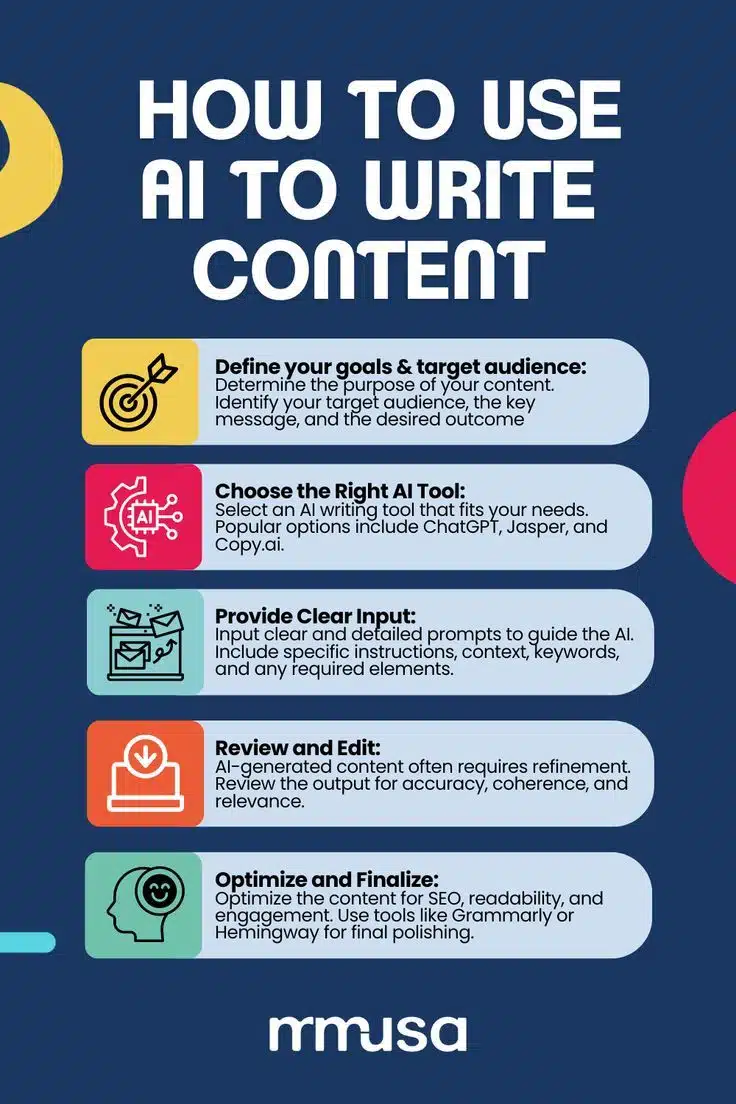
You’ll find some AI basics in this infographic.
Here’s a summary of what’s covered:
- Set Goals and Know Your Audience
- Select the Right AI Tool
- Give Clear Instructions
- Review and Refine
- Optimise and Finalise
Check out the post below for more.
Artificial intelligence has changed the way we create and consume content online. For businesses and marketers, it’s no longer about spending endless hours crafting every sentence manually.
With AI tools like ChatGPT, Jasper, and Copy.ai, producing high-quality, on-brand website content has become quicker, easier, and more efficient. But using AI effectively requires more than just typing in a prompt — it’s about understanding how to guide the process for the best results.
In this post, we’ll explore how AI can help you write better, faster, and more engaging website content. You’ll learn how to define your goals, choose the right tools, provide effective input, refine AI-generated drafts, and optimise your final output for SEO and readability.
Set Goals and Know Your Audience
Before using AI for content creation, you need clarity about what you want to achieve. AI can only produce relevant and effective copy when guided by specific goals and a clear understanding of who the content is for. Defining your audience and your message ensures the output aligns with your marketing strategy, tone, and conversion objectives.
- Define the purpose of each page or post — whether it’s to educate, inform, or convert visitors.
- Create detailed audience personas including demographics, challenges, and motivations.
- Identify your key message and ensure it connects with your business goals.
- Use this clarity to shape your prompts and tone, helping the AI stay focused and consistent.
Select the Right AI Tool
The right AI tool makes all the difference between average and outstanding results. Each platform offers unique strengths, such as creative writing, factual accuracy, or SEO optimisation. By choosing one that fits your specific requirements, you can streamline your workflow and produce content that feels polished and professional.
- Experiment with leading tools such as ChatGPT, Jasper, and Copy.ai to find the right fit.
- Consider your content type — blog posts, landing pages, or product descriptions — when selecting a tool.
- Evaluate the user interface and learning curve to ensure it integrates smoothly into your process.
- Look for tools that support SEO optimisation, tone control, and collaboration features.
Give Clear Instructions
AI performs best when given clarity, context, and direction. A vague or generic prompt will often lead to equally vague results. The more specific you are with your requirements — including tone, structure, and target keywords — the more accurate and useful the AI’s output will be.
- Start each prompt with clear objectives, stating what the content should achieve.
- Provide context and examples to help the AI understand your brand voice and style.
- Include relevant keywords and phrases to support SEO while maintaining natural flow.
- Request specific formats or structures, such as bullet points, headings, or meta descriptions.
Review and Refine
Even the best AI-generated content benefits from human review. While AI tools are excellent at generating ideas and structure, they can occasionally miss nuances, factual accuracy, or brand tone. Editing ensures the final version feels authentic, engaging, and aligned with your brand identity.
- Read through the content for accuracy and factual correctness, especially for data or statistics.
- Adjust for tone and voice, ensuring consistency with your website’s overall messaging.
- Simplify complex sections and remove repetition or filler language.
- Use editing tools or human input to polish grammar, punctuation, and flow.
Optimise and Finalise
Once the draft is refined, optimisation ensures it performs well across search engines and resonates with readers. This final stage focuses on improving readability, SEO, and engagement. By combining AI-generated ideas with human insight, you can craft content that’s not only efficient but impactful.
- Optimise for SEO by including meta titles, descriptions, and properly placed keywords.
- Use tools like Grammarly or Hemingway to assess readability and clarity.
- Ensure consistent formatting with clear headings, short paragraphs, and scannable layouts.
- End with a strong call to action that encourages readers to take the next step.
Why AI Makes Website Content Creation More Efficient
AI tools significantly reduce the time spent on drafting, research, and editing. They help you move from idea to finished copy in a fraction of the time it would take manually. This allows teams to focus more on strategy, creativity, and analysis rather than repetitive writing tasks.
- Use AI for first drafts to accelerate production and overcome writer’s block.
- Automate content ideation by generating topic lists, outlines, and subheadings.
- Speed up keyword research and SERP analysis with AI-powered SEO tools.
- Reallocate saved time to creative strategy and marketing campaigns.
Balancing AI with Human Creativity
While AI excels at efficiency and consistency, human creativity remains irreplaceable. AI lacks emotional intelligence, intuition, and deep contextual awareness — all vital for authentic storytelling. The most engaging website content blends AI’s technical power with a human touch that adds warmth and originality.
- Use AI to generate ideas and structure but rely on human editing for voice and nuance.
- Combine data-driven insights from AI with creative storytelling techniques.
- Ensure all AI-generated content aligns with brand personality and emotional tone.
- Treat AI as a collaborator, not a replacement, in your writing process.
Common Mistakes When Using AI for Content Writing
Despite its advantages, many marketers misuse AI tools and end up with generic or poorly optimised content. Avoiding these pitfalls ensures you get consistent, professional results that enhance your brand reputation rather than harm it.
- Don’t rely solely on AI — always proofread and fact-check the final draft.
- Avoid vague prompts, which produce irrelevant or unstructured results.
- Never publish AI output without customisation or human oversight.
- Ensure AI content is ethically used and compliant with copyright or originality standards.
The Role of SEO in AI-Generated Content
AI can simplify SEO by suggesting keywords, creating optimised headlines, and structuring content for search intent. However, the balance between keyword usage and natural language remains crucial. Over-optimisation can reduce readability and harm engagement.
- Use AI to identify primary and secondary keywords that match search intent.
- Let AI suggest meta tags and snippets for improved visibility.
- Maintain natural keyword placement to ensure organic flow.
- Continuously test and refine performance using analytics and AI-driven SEO tools.
How AI Enhances Content Personalisation
Modern AI tools analyse audience data to help you create content tailored to specific readers. Personalisation boosts engagement, reduces bounce rates, and increases conversion potential. By leveraging these insights, you can make every visitor feel understood and valued.
- Use AI to segment audiences by interests, behaviour, or demographics.
- Generate personalised headlines or calls to action that appeal to each segment.
- Adjust tone and messaging to match different stages of the buyer journey.
- Combine AI-driven personalisation with real human empathy for better results.
Future Trends: The Evolution of AI in Content Creation
As AI technology advances, content creation will continue to evolve. Expect greater integration between AI tools, analytics platforms, and marketing automation systems. The future will bring more intuitive systems that understand brand tone, emotion, and audience behaviour more deeply.
- Look out for AI-powered style training, allowing tools to mimic your unique voice.
- Expect voice and video content creation to merge seamlessly with text-based AI tools.
- Anticipate predictive AI systems that forecast content trends and performance.
- Embrace continuous learning, keeping up with AI innovations to stay competitive.
Conclusion
AI has revolutionised the way website content is written, edited, and optimised. When used correctly, it saves time, enhances quality, and drives engagement — all without sacrificing your brand’s unique voice. The secret lies in the partnership between human creativity and machine intelligence.
By defining your goals, choosing the right tools, giving clear instructions, and refining your results, you can produce professional-quality content at scale. The future of content creation isn’t about man versus machine — it’s about collaboration that brings out the best in both.

Author:
Mark Ford