Want to turn satisfied customers into powerful marketing assets? Looking for a proven framework to create case studies that actually drive sales?
You’ll find some marketing basics in this infographic.
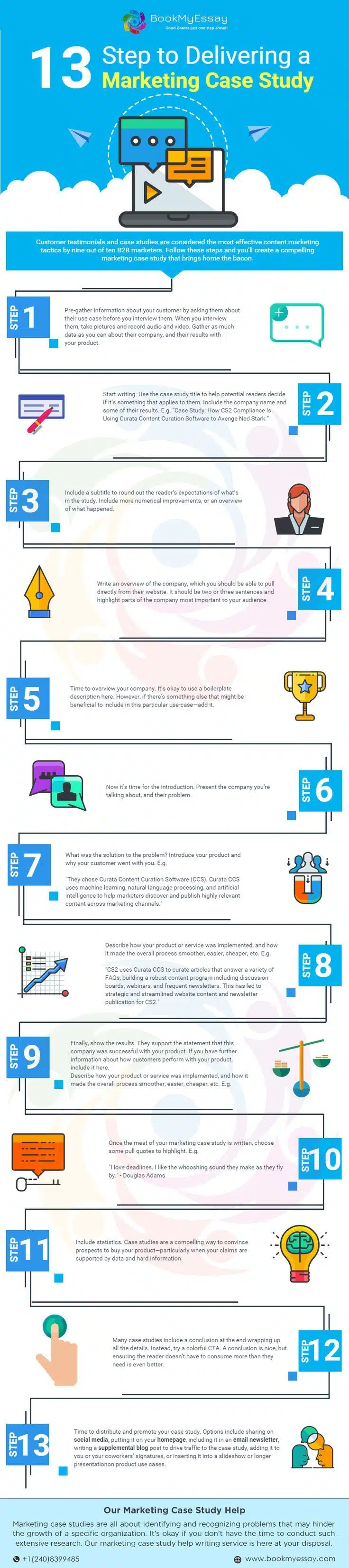
Here’s a summary of what’s covered:
- Gather Background Information
- Write a Strong Title
- Add a Subtitle
- Include a Company Overview
- Expand the Company Profile
- Set the Scene
- Present the Solution
- Explain the Implementation
- Show the Results
- Highlight a Memorable Quote
- Support with Statistics
- Finish with a CTA
- Distribute and Share
Check out the post below for more.
In the world of B2B and service-based marketing, nothing builds trust like a well-executed case study. It’s more than a glowing review—it’s a structured story that shows real-world results from real customers.
When done right, it can move prospects from awareness to decision with compelling evidence. If you want to turn satisfied customers into powerful sales tools, follow these 13 proven steps.
Gather Background Information
Before writing a single word, you need to know your customer’s story inside and out. The research stage lays the groundwork for an authentic and persuasive narrative. It also ensures you’re capturing meaningful insights that go beyond surface-level praise. The more you understand their journey, the more impactful your case study will be.
- Ask your customer to walk you through their challenge before using your product.
- Record conversations, take notes, and collect supporting documents or visuals.
- Clarify timelines, team involvement, and decision-making processes.
- Find out what success looks like to them in their own words.
Write a Strong Title
Your title is your first impression. It should hook the reader while clearly hinting at the value inside the case study. Avoid vague language—focus on specific results or the problem solved. A compelling title helps potential clients see themselves in the story.
- Focus on the result, e.g. “How [Company] Increased Conversions by 40%.”
- Mention the product or service if it adds clarity.
- Keep it short, punchy, and benefit-driven.
- Use keywords your audience is likely to search for.
Add a Subtitle
A subtitle is your chance to expand on the title with more detail. It helps orient the reader before they dive into the main content. This is the space to add context, highlight additional benefits, or reinforce credibility. It also sets the tone for the rest of the study.
- Summarise the transformation in one clear sentence.
- Include industry or niche details if relevant.
- Mention secondary outcomes not in the title.
- Use it to make the case study more relatable to your audience.
Include a Company Overview
It’s important to introduce the client, especially if your audience might not be familiar with them. The company overview should be short and focused on relevance, not fluff. You want readers to understand the type of business and why their story matters.
- Include the company’s size, sector, and location.
- Highlight what makes them a typical or ideal client.
- Mention how long they’ve been in business or working with you.
- Focus on facts that relate to the problem and solution in the case.
Expand the Company Profile
Now that you’ve briefly introduced the business, dig a little deeper. This section adds weight to their credibility and helps readers see the scale of the challenge. If there are unique factors that influenced the outcome, this is where to include them.
- Add context on team size, customer base, or operations.
- Mention any industry regulations or challenges they face.
- Include background on how they found or chose your company.
- Position them as a serious business with real goals and pain points.
Set the Scene
Every good story needs a conflict, and your case study is no different. This is where you explain the problem the customer was dealing with. Be clear and specific—what wasn’t working, and why did they decide to look for help?
- Describe the pain point in the customer’s own terms.
- Highlight the urgency or consequences of inaction.
- Show how the problem was affecting their business or workflow.
- Avoid jargon—keep the focus on the business challenge.
Present the Solution
Here’s where your product or service enters the picture. This section should explain what you provided, and how it was tailored to the client’s needs. Be clear about what the solution involved and why it was the right fit.
- Outline your product, service, or approach clearly.
- Include any customisation or consultation involved.
- Add a quote from the client about why they chose you.
- Link the features of your solution to their core problem.
Explain the Implementation
Solving the problem is great, but how you did it also matters. This section details the process—what you did, how you did it, and what it took to deliver results. This builds trust and shows that you can deliver on your promises.
- Break the implementation into clear stages or milestones.
- Note how long each phase took, if relevant.
- Mention any hurdles and how you overcame them.
- Include team roles, tools used, or support provided.
Show the Results
Results are the heart of your case study. This is where you prove your value with hard evidence. Whether it’s metrics, feedback, or visible change, the goal is to show transformation that your audience can aspire to.
- Use concrete numbers (e.g., “reduced response time by 55%”).
- Include direct quotes that reinforce the outcome.
- Highlight both quantitative and qualitative benefits.
- Compare before-and-after scenarios to show contrast.
Highlight a Memorable Quote
A single well-placed quote can capture the emotional tone of the story. It can underline satisfaction, reinforce a key benefit, or add a personal touch. Readers remember feelings more than facts—use this to your advantage.
- Choose a quote that expresses enthusiasm or relief.
- Let it emphasise the emotional value of your service.
- Use it as a pull-quote or graphic if publishing online.
- Avoid overly polished quotes—authenticity is more persuasive.
Support with Statistics
Data builds credibility. It backs up the success story with measurable impact, helping sceptical readers see that the results weren’t a fluke. Even small stats can help make a case feel grounded in reality.
- Include performance metrics (conversion rates, time savings, revenue growth).
- Use visual data like percentages or charts when possible.
- Compare baseline stats to post-implementation results.
- Cite any industry benchmarks for added context.
Finish with a CTA
Don’t let your case study just fade out. Instead of a dull summary, use a strong call to action that prompts the reader to take the next step. Whether that’s contacting you or reading another case study, guide the journey forward.
- Use a button or clear link to a contact page or form.
- Make the CTA relevant to the story (e.g., “Get similar results”).
- Encourage sharing or downloading the full study.
- Add a visual or colour contrast to help it stand out.
Distribute and Share
Creating a case study is only half the battle—it’s what you do with it that matters. Promote it strategically across multiple channels to reach your audience. The more exposure it gets, the more value you’ll get from it.
- Share it on social media with a strong visual and quote.
- Feature it in a newsletter to reach your email list.
- Add it to your website in a dedicated case study section.
- Include it in sales presentations or email signatures.
Conclusion
Case studies are powerful because they bridge the gap between marketing and proof. They demonstrate what you do, how you do it, and—most importantly—the results you deliver. By following these 13 proven steps, you’ll create compelling stories that not only inform but inspire.
Whether you’re closing deals or building credibility, a great case study is one of your most valuable sales tools—so take the time to do it right.

Author:
Mark Ford