
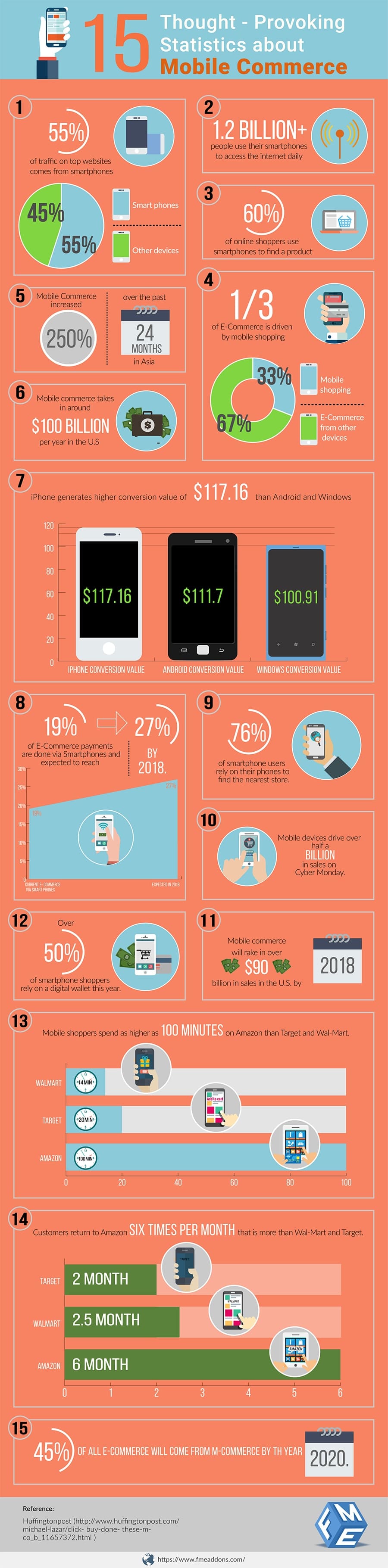
Did you know that 33% of Ecommerce sales originates from mobile users? And that figure is likely to rise to 45% over the next few years?
In today’s digital age, mobile devices have become an integral part of our lives. From communication and entertainment to shopping, mobile phones have revolutionized the way we interact with the online world.
This shift in consumer behavior has had a profound impact on the ecommerce industry. To succeed in the competitive landscape of online retail, businesses must adapt their strategies to meet the demands of mobile users.
In this blog post, we’ll explore 15 key mobile usage statistics that should guide your ecommerce website strategy. These stats will help you understand the importance of mobile optimization, user experience, and responsive design, ultimately leading to increased conversions and revenue for your online store.
To make sure your Ecommerce strategy stays up to date read through these key stats from FME Addons.
1. Mobile Internet Usage Is on the Rise
The first statistic underscores the overarching trend of mobile internet usage. According to Statista, as of 2021, approximately 53.3 percent of all global website traffic came from mobile devices. This figure has been steadily increasing year after year. With over half of internet users accessing websites through mobile devices, it’s crucial for ecommerce businesses to prioritize mobile-friendly design and functionality.
2. Mobile Commerce Is Growing Rapidly
Mobile commerce, or m-commerce, is experiencing exponential growth. As reported by eMarketer, m-commerce sales are projected to reach $3.56 trillion by 2021, accounting for 72.9 percent of total ecommerce sales. This highlights the immense opportunity for businesses to tap into the mobile market and leverage it to boost their revenue.
3. The Importance of Page Load Speed
Page load speed is critical for mobile users. Google’s research shows that as page load time increases from one second to three seconds, the probability of a visitor bouncing increases by 32 percent. By the time it reaches five seconds, the probability of bouncing jumps to 90 percent. Ensuring your mobile ecommerce website loads quickly is imperative for retaining visitors and reducing bounce rates.
4. Mobile Users Expect Seamless Experiences
Mobile users have high expectations when it comes to user experience. According to a survey by Google, 53 percent of mobile users will leave a website if it takes more than three seconds to load. Additionally, 50 percent of users expect a mobile site to load as fast as or faster than a desktop site. To retain and convert mobile visitors, your website must provide a seamless and fast experience.
5. Responsive Design Is a Must
A responsive design ensures that your website adapts to various screen sizes and devices. This is essential because, as of 2021, 53 percent of all internet traffic came from mobile devices. Not having a responsive design can result in a poor user experience and lost sales opportunities. Make sure your ecommerce website is optimized for mobile devices to capture a larger share of the market.
6. Mobile Shoppers Value Convenience
Convenience is a significant driver for mobile shoppers. According to a study by PayPal and IPSOS, 59 percent of mobile shoppers listed convenience as the primary reason for using their mobile devices to shop online. This emphasizes the importance of streamlining the checkout process, offering various payment options, and providing easy navigation on your mobile ecommerce site.
7. Mobile Apps Can Enhance Engagement
Mobile apps can provide a more immersive and personalized shopping experience. According to Statista, as of 2021, mobile apps accounted for 90 percent of time spent on mobile devices. Developing a mobile app for your ecommerce business can help you engage with your customers more effectively and provide them with a convenient shopping platform.
8. Mobile Shoppers Are Research-Oriented
Mobile users often use their devices for research before making a purchase decision. According to Google, 69 percent of smartphone users turned to their devices for ideas during their shopping journey. To capture these users, provide informative and engaging content that helps them make informed choices.
9. The Impact of Mobile SEO
Mobile SEO plays a crucial role in driving organic traffic to your ecommerce website. Google’s mobile-first indexing means that the search engine primarily uses the mobile version of your site to determine its ranking in search results. Ensuring that your mobile site is optimized for SEO is vital for maintaining visibility and attracting organic traffic.
10. Mobile Users Are More Likely to Convert
Mobile users often show a higher conversion rate than desktop users. A study by Monetate found that the conversion rate for mobile users was 2.03 percent, while for desktop users, it was only 1.55 percent. This suggests that, when properly optimized, mobile ecommerce websites have the potential to generate higher revenue per visitor.
11. The Influence of Mobile Video
Video content is a powerful tool for engaging mobile users. According to Cisco, by 2021, mobile video was projected to account for 78 percent of all mobile data traffic. Incorporating video product demonstrations, reviews, and tutorials into your ecommerce strategy can help you capture and retain the attention of mobile shoppers.
12. Mobile Payment Options Are Gaining Popularity
The adoption of mobile payment options is on the rise. Research from Statista indicates that mobile wallets like Apple Pay, Google Wallet, and Samsung Pay are becoming increasingly popular among consumers. Offering these payment options on your mobile ecommerce site can enhance the convenience and trustworthiness of your platform.
13. The Impact of Mobile Push Notifications
Mobile push notifications can be a valuable tool for re-engaging with your customers. According to Localytics, push notifications can increase user retention by 20 percent. Use them strategically to notify users about promotions, abandoned carts, and personalized product recommendations.
14. The Significance of Mobile Social Media
Mobile users frequently access social media platforms through their devices. A report from Statista revealed that in 2021, over 98 percent of Facebook users accessed the platform via mobile devices. This highlights the importance of having a strong social media presence and ensuring that your ecommerce website is easily shareable on these platforms.
15. Mobile Users Appreciate Personalization
Personalization is a key factor in improving the mobile shopping experience. According to Epsilon, 80 percent of consumers are more likely to make a purchase when brands offer a personalized experience. Utilize data and analytics to tailor product recommendations and content to individual user preferences.
Conclusion
The mobile revolution has transformed the ecommerce landscape. As the statistics show, mobile usage is on the rise, and mobile commerce presents significant growth opportunities. To succeed in this evolving digital landscape, ecommerce businesses must prioritize mobile optimization, responsive design, and a seamless user experience.
By understanding the preferences and behaviors of mobile users, you can tailor your ecommerce website strategy to meet their needs. Whether it’s improving page load speed, adopting mobile-friendly payment options, or investing in mobile apps, taking the right steps to cater to mobile shoppers can lead to increased conversions and revenue for your online store.
In conclusion, the mobile-first approach isn’t just a trend; it’s a fundamental shift in consumer behavior. Embrace it, optimize your ecommerce strategy for mobile users, and watch your online business thrive in the mobile-driven era of ecommerce.

Author:
Mark Ford