Are you looking for ways to measure the success of your marketing strategy? Need some guidance on the metrics you need to monitor?
Understanding what works and what doesn’t is an essential part of any marketing strategy. It gives you the valuable information you need to spend more time on the techniques that are working, and highlights areas where you need to improve.
For some guidance the guys at Curata have included 29 metrics in the infographic below.
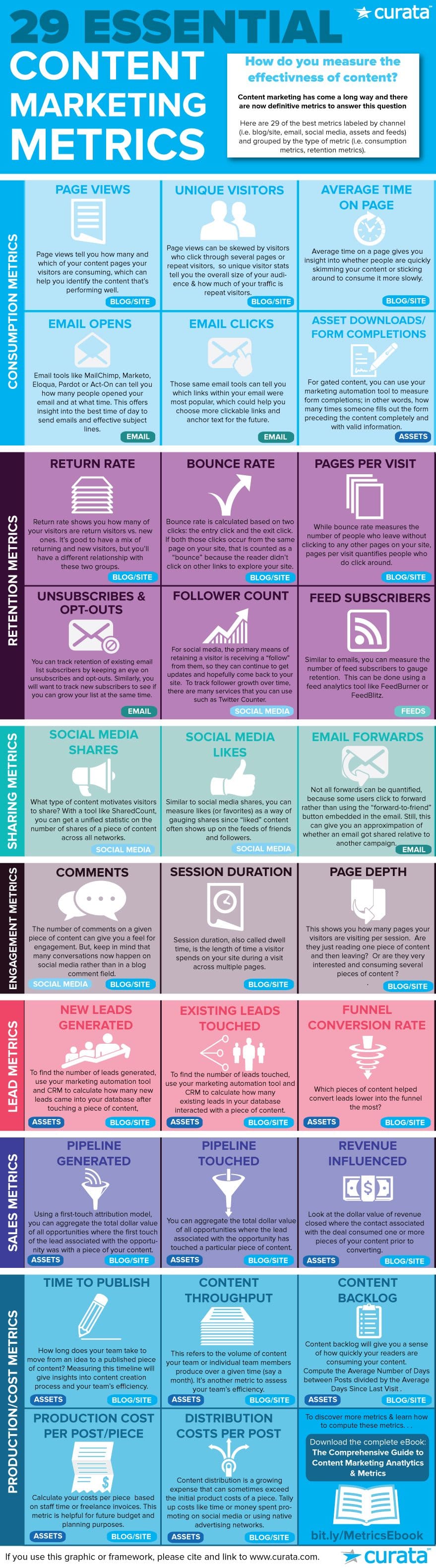
In today’s digital age, marketing has become more data-driven than ever before. Businesses rely on a multitude of marketing channels and strategies to reach their target audiences. To determine the effectiveness of these strategies, marketers need to track and analyze various metrics. These marketing metrics provide valuable insights into the performance of your campaigns, allowing you to make data-driven decisions and optimize your marketing efforts.
In this comprehensive guide, we’ll explore 29 essential marketing metrics that will help you gauge the success of your marketing strategy. These metrics cover different aspects of your marketing efforts, from website traffic and social media engagement to email marketing and sales conversions. By regularly monitoring and interpreting these metrics, you can refine your marketing approach, allocate resources more efficiently, and ultimately drive better results for your business.
Website Traffic Metrics
- Pageviews: Pageviews indicate how many times visitors have viewed your website’s pages. Tracking pageviews can help you understand which content is the most popular and engaging for your audience.
- Unique Visitors: This metric shows the number of distinct individuals who have visited your website within a specific time frame, providing insight into your reach and potential audience size.
- Bounce Rate: Bounce rate measures the percentage of visitors who leave your site after viewing only one page. A high bounce rate may indicate issues with your website’s content or user experience.
- Average Session Duration: This metric reveals how much time visitors spend on your website on average. Longer session durations often signify higher engagement and interest in your content.
- Conversion Rate: The conversion rate tracks the percentage of visitors who take a desired action, such as making a purchase, signing up for a newsletter, or filling out a contact form. It’s a crucial metric for measuring the effectiveness of your website in driving user actions.
- Click-Through Rate (CTR): CTR measures the ratio of clicks to impressions for specific elements on your website, such as links or buttons. It’s commonly used in email marketing and online advertising to assess the effectiveness of call-to-action (CTA) elements.
SEO Metrics
- Organic Traffic: Organic traffic refers to visitors who arrive at your website through unpaid search engine results. Tracking organic traffic can help you evaluate the success of your SEO efforts.
- Keyword Rankings: Monitor the ranking positions of your target keywords in search engine results pages (SERPs). Improvements in keyword rankings indicate the effectiveness of your SEO strategy.
- Backlink Profile: Assess the quality and quantity of backlinks pointing to your website. A healthy backlink profile can boost your website’s authority and search engine rankings.
- Click-Through Rate (CTR) in SERPs: Analyze the CTR of your pages in search engine results. A high CTR suggests that your meta titles and descriptions are effectively attracting clicks.
- Organic Conversion Rate: Measure the conversion rate of visitors who come to your site through organic search. This metric helps determine the quality of organic traffic and the relevance of your content.
Content Engagement Metrics
- Time on Page: Similar to average session duration, time on page focuses on individual pages, providing insights into how engaging your content is.
- Social Shares: Track the number of times your content is shared on social media platforms. Social shares indicate the reach and virality of your content.
- Comments and Discussions: Engagement metrics like comments and discussions on your blog or social media posts demonstrate audience interaction and interest in your content.
- Scroll Depth: Measure how far down the page users scroll. Deeper scroll depths suggest that your content is compelling enough to hold their attention.
- Video Views and Watch Time: If you produce video content, track views and watch time to gauge its popularity and effectiveness in conveying your message.
Email Marketing Metrics
- Open Rate: The open rate reveals the percentage of email recipients who open your email. A higher open rate indicates the effectiveness of your subject lines and sender reputation.
- Click-Through Rate (CTR): In email marketing, CTR measures the ratio of clicks to email opens. It helps determine how engaging your email content and CTA buttons are.
- Conversion Rate: Measure the percentage of email recipients who take the desired action, such as making a purchase or signing up for a webinar, after clicking on your email links.
- Bounce Rate: Track the bounce rate to identify issues with your email list hygiene. High bounce rates can negatively impact your sender reputation.
Social Media Metrics
- Followers/Fans Growth: Monitor the growth of your social media followers or fans across platforms. A steady increase indicates a growing audience.
- Engagement Rate: Calculate the engagement rate by dividing the total engagement (likes, comments, shares) by the number of followers or fans. It shows the level of interaction with your content.
- Click-Through Rate (CTR): In social media, CTR measures the percentage of clicks on your posts or ads relative to impressions. It’s crucial for assessing the effectiveness of your social media content.
- Social Media Reach: Track the total number of users who have seen your content. Increasing reach can expand your brand’s visibility.
- Conversion Rate: Measure the percentage of social media users who take a desired action, such as filling out a form or making a purchase after clicking on your social media links.
Paid Advertising Metrics
- Cost Per Click (CPC): Calculate the average cost you pay for each click on your paid advertising campaigns. Lower CPC indicates efficient ad spending.
- Click-Through Rate (CTR): CTR in paid advertising measures the ratio of clicks to impressions. A higher CTR suggests that your ad copy and design are compelling.
- Return on Ad Spend (ROAS): ROAS quantifies the revenue generated for every dollar spent on advertising. A positive ROAS indicates a profitable campaign.
- Ad Conversion Rate: Measure the percentage of users who complete a desired action after clicking on your ads, such as making a purchase or subscribing to a service.
Conclusion
In the ever-evolving landscape of marketing, data-driven decision-making is paramount to success. The 29 marketing metrics outlined in this guide provide valuable insights into different aspects of your marketing strategy, from website performance to social media engagement and paid advertising effectiveness. By consistently monitoring and analyzing these metrics, you can adapt and refine your marketing approach to achieve better results, allocate resources efficiently, and ultimately drive the success of your business. Remember that the choice of which metrics to focus on should align with your specific goals and objectives, ensuring that your marketing efforts are tailored to meet your unique business needs.

Author:
Mark Ford

10 New Year’s Marketing Resolutions to Grow a Small Business Sustainably
Are you struggling to make your marketing efforts deliver steady growth instead of short bursts of activity? Wondering how to build a marketing approach that supports your small business over the long term without constant trial and error? […]
10 Marketing Trends for 2026: What Smart Businesses Will Focus On Next
Are you looking to understand how marketing is shifting in 2026 and what today’s smartest brands are prioritising? Want to know which strategic trends will shape how businesses attract, convert, and retain customers over the next year? […]
How to Build a Marketing Technology Stack That Actually Works Together
Are you trying to figure out how to connect your marketing tools so they actually support each other instead of working in isolation? Want to understand the key steps to building a marketing technology stack that runs smoothly across your entire customer journey? […]