Twitter vs Facebook – which do you prefer? Want to know why Twitter would be the better choice?
Facebook may seem the obvious choice when it comes to marketing a new business, everyone uses it after all and just by looking at other pages you can see how many likes, comments and shares they’re getting. This doesn’t mean that it’s the most effective option for you though.
To explain why The DIY Musician has created the infographic below.
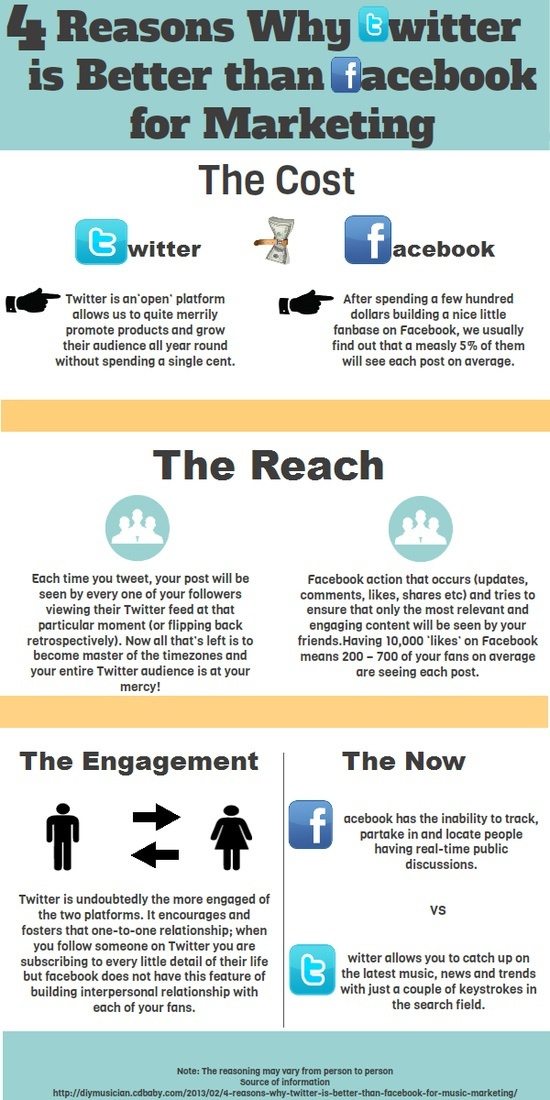
In the ever-evolving landscape of social media marketing, businesses are constantly seeking the most effective platforms to promote their products and services. Among the many choices available, Twitter and Facebook are two of the most prominent players. While both platforms have their merits, Twitter offers several distinct advantages that make it a superior choice for businesses looking to maximize their marketing efforts. In this blog post, we’ll explore four compelling reasons why Twitter trumps Facebook when it comes to marketing your business.
1. Real-Time Engagement
One of the primary strengths of Twitter is its real-time nature. The platform is designed for instant communication, allowing businesses to engage with their audience in the here and now. This real-time engagement is especially beneficial for marketing because it enables brands to respond promptly to customer inquiries, address issues, and ride the wave of trending topics.
Instant Feedback
On Twitter, you can post a tweet and receive immediate feedback from your audience through likes, retweets, and comments. This instant feedback loop is invaluable for businesses as it allows them to gauge the effectiveness of their content and adjust their strategies accordingly. You can quickly determine which tweets resonate with your audience and which ones fall flat, making it easier to refine your marketing approach.
Capitalizing on Trends
Twitter is the go-to platform for real-time discussions and trending topics. By monitoring trending hashtags and joining relevant conversations, businesses can tap into the collective consciousness of the platform’s users. This provides a unique opportunity to increase brand visibility and engage with a broader audience. Facebook, on the other hand, is less dynamic in this regard, with content often having a longer shelf life and less emphasis on trending topics.
Timely Promotions and Offers
If your business has time-sensitive promotions or offers, Twitter is the ideal platform to get the word out quickly. Whether you’re running a flash sale or announcing a limited-time discount, you can share the information instantly and reach a wide audience. This immediacy can drive immediate action from your followers, helping you capitalize on time-bound opportunities.
2. Larger Reach through Hashtags
Hashtags are a fundamental element of Twitter’s culture, and they play a significant role in extending the reach of your marketing efforts. When used strategically, hashtags can help your tweets reach a much broader audience than your followers alone. This is where Twitter outshines Facebook.
Viral Potential
The viral nature of Twitter is closely tied to hashtags. When you use popular and relevant hashtags in your tweets, your content becomes discoverable by users searching for or following those hashtags. This means that even if you have a relatively small following, your tweet can gain traction if it resonates with the right hashtag communities. On Facebook, hashtags are less commonly used for discovery, limiting your content’s potential reach.
Trending Hashtags
Twitter prominently displays trending hashtags on its platform, making it easy for users to explore and engage with trending topics. Businesses can leverage these trending hashtags to join conversations that align with their brand and products. This can result in increased visibility and engagement, which is harder to achieve on Facebook, where trending topics are less emphasized.
Niche-Specific Targeting
Twitter allows for highly specific and niche-specific targeting using hashtags. Businesses can identify and engage with communities that are directly relevant to their products or services. This level of granularity is challenging to achieve on Facebook, where targeting options are more limited and not as hashtag-driven.
3. Enhanced Visibility and Discoverability
Twitter excels in making it easier for businesses to enhance their visibility and discoverability, which are essential for successful marketing campaigns.
Profile Discovery
On Twitter, users are more likely to discover new profiles and businesses organically. The platform’s recommendation algorithms suggest accounts to follow based on user interests and engagement patterns. This means that even without extensive advertising, your business can gain followers and visibility through organic discovery. In contrast, Facebook’s organic reach has declined significantly in recent years, making it harder for new businesses to gain traction without paid promotion.
Retweet Culture
The retweet feature on Twitter allows users to share interesting content with their followers quickly. When your followers retweet your tweets, they expose your content to their networks, increasing your reach exponentially. Facebook shares have a similar function, but they often don’t have the same viral effect as retweets. Twitter’s retweet culture fosters a sense of community and amplifies your brand’s message.
Search Engine Visibility
Twitter profiles and tweets often rank well in search engine results pages (SERPs). This means that when people search for topics related to your business, your Twitter profile and relevant tweets can appear in the results, increasing your online visibility. Facebook profiles and posts are not as consistently indexed by search engines, limiting your potential for organic search engine traffic.
4. Direct and Authentic Engagement
Twitter’s format encourages direct and authentic engagement between businesses and their audience. This authenticity can be a game-changer in building brand loyalty and trust.
Personalized Interactions
Twitter’s character limit forces concise communication, making interactions feel more personal and direct. Businesses can respond to tweets and engage with customers in a way that feels like a one-on-one conversation. This personal touch can help foster stronger customer relationships and brand loyalty.
Transparency and Responsiveness
Twitter’s real-time nature also promotes transparency and responsiveness. Businesses that address customer concerns or inquiries promptly and publicly demonstrate their commitment to customer satisfaction. This can enhance your brand’s reputation and showcase your dedication to quality customer service.
Humanizing Your Brand
Twitter allows businesses to showcase their personality and values. By sharing behind-the-scenes glimpses, company culture, and employee stories, you can humanize your brand and connect with your audience on a more emotional level. Facebook can achieve this to some extent, but the more casual and direct nature of Twitter makes it easier to establish a personal brand identity.
Conclusion
While both Twitter and Facebook have their merits for marketing, Twitter offers distinct advantages that make it a superior choice for businesses looking to enhance their online presence and engage with their audience. Its real-time engagement, hashtag-driven reach, enhanced visibility and discoverability, and direct and authentic interactions set it apart as a platform that fosters meaningful connections with customers. By harnessing the power of Twitter, businesses can tap into a dynamic and responsive audience, ultimately driving better results in their marketing efforts.

Author:
Mark Ford