Is your blogging strategy failing to hit the mark? Are you making mistakes that are costing your business money?
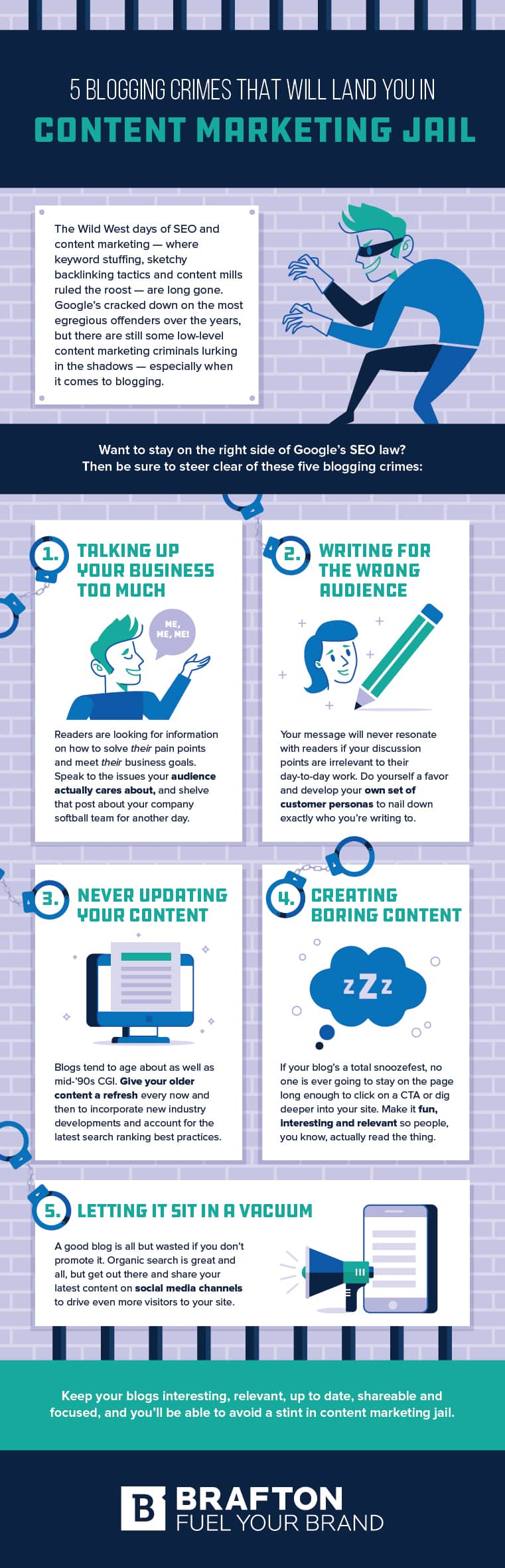
Brafton share their blogging mistakes to avoid in this infographic.
Here’s a quick summary:
- Focusing too much on your business
- Writing for the wrong audience
- Never updating your content
- Creating boring content
- Letting it sit in a vacuum
Check out the infographic for more detail.
Blogging can be an incredibly powerful tool for businesses, driving traffic, building brand authority, and engaging with customers. However, many businesses fall into common traps that can turn their blogs from potential goldmines into content wastelands.
Here are five blogging crimes that can sabotage your content marketing efforts and how to avoid them.
Focusing Too Much on Your Business
One of the most common mistakes businesses make with their blogs is focusing too much on themselves. While it might seem logical to use your blog to talk about your products, services, and company news, this approach often backfires.
Readers visit your blog to find value, solutions to their problems, and insights that can help them. Constantly talking about your business can quickly turn them away.
The Pitfall of Self-Centric Content
When your blog is filled with self-promotion, it becomes less about the reader and more about you. This can make your content feel like a never-ending sales pitch, which is a major turn-off.
Readers are looking for content that addresses their needs and interests, not an infomercial about your latest product.
The Importance of Value-Driven Content
Value-driven content prioritizes the reader’s needs and interests. It’s about providing helpful, relevant, and engaging information that solves problems, answers questions, or entertains.
When readers find value in your content, they are more likely to return, share your posts, and eventually become loyal customers.
Strategies for Shifting the Focus
- Understand Your Audience’s Pain Points: To create value-driven content, start by understanding your audience’s pain points. Conduct surveys, engage with customers directly, and use analytics tools to gain insights into what your audience is looking for. What challenges do they face? What questions do they have? What information are they seeking? By answering these questions, you can tailor your content to address the specific needs and interests of your audience.
- Create Educational Content: Educational content is one of the most effective ways to provide value to your audience. This can include how-to guides, tutorials, explainer videos, and informative articles. For example, if you run a small business selling gardening supplies, you could create content on topics like “How to Start a Home Garden,” “Tips for Growing Organic Vegetables,” or “The Best Tools for Beginner Gardeners.” By sharing your expertise, you help your readers while also subtly showcasing your products.
- Leverage Industry Insights and Trends: Sharing industry insights and trends positions your business as a thought leader in your field. Write about the latest developments in your industry, offer your perspective on emerging trends, and analyze how these changes might impact your audience. This type of content not only educates your readers but also demonstrates that your business is knowledgeable and forward-thinking.
- Tell Stories: Storytelling is a powerful way to engage your audience. Share stories about your customers’ experiences, success stories, and case studies that highlight how your products or services have made a difference. For instance, a small business offering marketing services could write a case study about a client who saw significant growth after implementing their strategies. These stories make your content more relatable and help potential customers see the real-world benefits of your offerings.
- Provide Actionable Tips and Advice: Readers love content that offers practical, actionable tips they can apply immediately. Whether it’s a list of quick hacks, step-by-step instructions, or expert advice, actionable content empowers your readers to take action and see results. For example, a financial consulting firm could write a blog post titled “5 Simple Ways to Improve Your Personal Budget Today,” providing readers with easy-to-follow steps that add value and build trust.
- Use Data and Research: Backing up your content with data and research adds credibility and authority. Share statistics, study findings, and research-backed insights to support your points. This not only enhances the value of your content but also helps establish your business as a credible source of information. For instance, if you’re in the health and wellness industry, you could write about “The Latest Research on the Benefits of a Plant-Based Diet,” citing studies and expert opinions to provide a well-rounded and informative post.
Balancing Self-Promotion and Value
While the focus should primarily be on providing value, it’s still important to promote your business subtly and strategically. Here’s how you can strike the right balance:
- Soft Sell Through Content: Instead of hard selling, use a soft sell approach by integrating mentions of your products or services naturally within your content. For example, in a blog post about “Effective Home Workout Routines,” a fitness equipment company could mention, “Using a high-quality resistance band, like the ones we offer, can enhance your workout by providing additional resistance.”
- Include Calls to Action (CTAs): Include relevant and non-intrusive CTAs within your content. These can be in the form of a subtle suggestion at the end of a blog post, encouraging readers to “Learn more about our solutions” or “Get a free consultation.” The key is to make sure the CTA aligns with the content and feels like a natural next step for the reader.
- Offer Free Resources: Create and offer free resources such as eBooks, checklists, templates, or webinars that provide additional value to your readers. In exchange for these resources, you can collect email addresses and nurture these leads through email marketing. For example, a software company could offer a free eBook on “Top 10 Tips for Efficient Project Management” while subtly promoting their project management tool.
- Highlight Customer Success Stories: Showcase customer success stories and testimonials within your content. This not only provides social proof but also demonstrates the value of your products or services through real-life examples. For instance, a CRM software company could write a blog post on “How Our CRM Helped a Small Business Increase Sales by 30%,” detailing the customer’s journey and success.
- Use Visual Content: Visual content such as infographics, videos, and images can help convey your message more effectively and keep readers engaged. Create visual content that educates or entertains while subtly incorporating your brand. For example, an infographic on “The Benefits of Digital Marketing” by a digital marketing agency can include their logo and a CTA at the end.
Monitoring and Adjusting Your Strategy
Continuously monitor the performance of your content to understand what resonates with your audience. Use analytics tools to track metrics such as page views, time on page, social shares, and conversion rates. Pay attention to reader feedback and comments to gain insights into their preferences and needs.
Based on this data, adjust your content strategy as needed. If certain topics or formats perform better, consider creating more of that type of content. Conversely, if you notice that self-promotional content consistently underperforms, scale back and refocus on value-driven content.
Summary
Shifting the focus from your business to your audience is crucial for successful blogging. By providing valuable, relevant, and engaging content, you can build trust, establish authority, and create a loyal readership. Remember, the goal of your blog is not just to promote your business but to serve your audience.
When you prioritize their needs and interests, your content marketing efforts will be far more effective, ultimately driving growth and success for your business.
Writing for the Wrong Audience
Understanding your audience is crucial for any content marketing strategy. Yet, many businesses make the mistake of writing for the wrong audience or not having a clear target audience at all.
This can lead to content that misses the mark and fails to engage the readers you want to attract.
Misidentifying Your Audience
Writing for the wrong audience often stems from a lack of understanding of who your ideal readers are. You might have a general idea, but without a detailed audience persona, your content can become too generic or irrelevant.
If you’re targeting small business owners but writing in a tone and style suited for corporate executives, your message will likely fall flat.
Creating Audience Personas
To write effective content, start by developing detailed audience personas. These are fictional representations of your ideal readers based on real data and research. Consider factors like demographics, interests, pain points, and behaviors.
Once you have a clear picture of who you’re writing for, tailor your content to meet their specific needs and preferences. Use the language they use, address their challenges, and provide solutions that are relevant to them.
Steps to Identifying Your Target Audience
- Conduct Market Research: Market research is the foundation of identifying your target audience. Use surveys, interviews, and focus groups to gather data about your existing and potential customers. Analyze this data to identify common characteristics and trends among your audience. Look for patterns in demographics, interests, and behaviors that can help you understand who your audience is and what they need.
- Analyze Your Current Audience: Look at your current customer base and blog analytics to gain insights into who is already engaging with your content. Tools like Google Analytics can provide valuable data on your audience’s demographics, interests, and behavior on your site. Identify your most engaged users and examine what type of content they interact with the most. This can give you clues about what resonates with your audience and who they are.
- Create Detailed Audience Personas: Once you have gathered enough data, create detailed audience personas. These should include:
-
- Demographic Information: Age, gender, location, education level, occupation, income level, etc.
- Psychographic Information: Interests, values, lifestyle, personality traits, etc.
- Behavioral Information: Buying habits, brand loyalty, product usage, online behavior, etc.
- Pain Points and Challenges: The specific problems and challenges your audience faces that your content can help solve.
- Goals and Aspirations: What your audience hopes to achieve, both personally and professionally.
Give each persona a name and backstory to make them more relatable. For example, “Marketing Mary is a 35-year-old marketing manager at a mid-sized company. She is looking for ways to improve her team’s efficiency and stay updated on the latest marketing trends.”
Tailoring Content to Your Audience
Once you have your audience personas, use them to guide your content creation. Here’s how:
- Address Their Pain Points: Focus on creating content that addresses the specific pain points and challenges identified in your audience personas. For example, if your audience is small business owners struggling with social media marketing, create blog posts like “10 Social Media Tips for Small Businesses” or “How to Create a Social Media Strategy on a Budget.”
- Use the Right Tone and Language: The tone and language of your content should resonate with your audience. If you’re targeting young entrepreneurs, use a casual, conversational tone. For a more professional audience, such as corporate executives, a formal and authoritative tone might be more appropriate. Use the language and terminology that your audience is familiar with to make your content more relatable and engaging.
- Provide Relevant Solutions: Offer solutions that are relevant and actionable for your audience. If your persona is “Startup Sam,” a new entrepreneur looking for funding, write about topics like “How to Pitch Your Startup to Investors” or “Top Funding Options for New Businesses.” Ensure your content provides practical advice and steps that your audience can implement.
- Incorporate Visuals and Examples: Visuals and examples can make your content more engaging and easier to understand. Use images, infographics, charts, and videos that appeal to your audience. Include real-life examples and case studies that your audience can relate to. For instance, if your audience is teachers, use examples from the classroom to illustrate your points.
- Segment Your Content: Not all content will be relevant to all segments of your audience. Consider segmenting your content to cater to different audience personas. Create specific blog categories or series that target different segments. For example, a business blog could have sections for “Small Business Tips,” “Marketing Strategies,” and “Entrepreneurial Advice,” each tailored to different audience personas.
Monitoring and Adjusting Your Strategy
Creating audience personas and tailoring your content is an ongoing process. Continuously monitor the performance of your content to see how well it resonates with your audience.
Use analytics tools to track metrics such as page views, time on page, bounce rate, and social shares. Pay attention to reader feedback and comments to understand what they like and what they don’t.
Collecting Feedback
Encourage your audience to provide feedback through comments, surveys, and social media interactions. Ask questions like:
- What type of content do you find most valuable?
- Are there any topics you’d like us to cover?
- How can we improve our content to better meet your needs?
Use this feedback to refine your audience personas and adjust your content strategy accordingly. If you find that a certain type of content consistently underperforms, re-evaluate whether it aligns with your audience’s needs and interests.
Adapting to Changes
The needs and preferences of your audience can change over time. Stay updated on industry trends and shifts in your audience’s behavior. Regularly revisit and update your audience personas to ensure they remain accurate and relevant.
Adapt your content strategy to address new challenges and opportunities that arise in your industry.
Summary
Writing for the wrong audience is a common but avoidable mistake in content marketing. By conducting thorough market research, creating detailed audience personas, and tailoring your content to address the specific needs and interests of your audience, you can create more effective and engaging blog posts.
Continuously monitor and adjust your strategy to ensure you are meeting your audience’s evolving needs. When you write for the right audience, your content is more likely to resonate, engage, and drive results for your business.
Never Updating Your Content
Content creation doesn’t end once you hit publish. One of the biggest mistakes you can make is to never revisit and update your old content.
Over time, information can become outdated, links can break, and what was once a high-performing post can start to lose its relevance and effectiveness.
The Consequences of Neglect
Neglecting your old content can hurt your blog in several ways. Outdated information can damage your credibility and trust with readers. Search engines favor fresh, updated content, so failing to keep your posts current can negatively impact your SEO rankings.
Additionally, as your business and industry evolve, your older content may no longer align with your current messaging and goals.
The Benefits of Updating Content
Regularly updating your content offers numerous benefits. It can improve your search engine rankings, increase your site traffic, enhance your credibility, and extend the lifespan of your blog posts.
Updated content also provides an opportunity to re-engage with your audience and show that your blog is a reliable source of current information.
Strategies for Regular Content Updates
- Conduct Regular Content Audits: A content audit involves reviewing all the content on your blog to assess its performance, relevance, and accuracy. Schedule regular audits—quarterly or biannually—to identify which posts need updating. During the audit, look for outdated information, broken links, and posts that are no longer relevant or aligned with your brand’s current message.
- Identify High-Performing Content: Focus on updating your high-performing content first. Use analytics tools to identify blog posts that consistently drive traffic, engagement, and conversions. These posts are valuable assets, and keeping them updated can help maintain their performance and extend their lifespan. Prioritize these posts for updates to ensure they continue to deliver value to your audience.
- Update Outdated Information: Information can quickly become outdated, especially in fast-moving industries. Review your posts for any outdated statistics, facts, or references. Replace them with the latest data and insights. For example, if you have a blog post about social media trends from two years ago, update it with the latest trends and examples to keep it relevant.
- Fix Broken Links and Add New Ones: Broken links can frustrate readers and hurt your SEO. Use tools like Google Search Console or third-party link checkers to identify and fix broken links in your content. Additionally, add new internal and external links where relevant. Internal links can help guide readers to other relevant content on your site, while external links to authoritative sources can enhance your content’s credibility.
- Enhance with New Media: Visual content is highly engaging and can enhance the readability and appeal of your blog posts. Add new images, infographics, videos, or charts to your updated posts. For instance, if you have a blog post on “How to Start a Garden,” consider adding a step-by-step video tutorial or a new infographic that visually summarizes the key points.
- Optimize for SEO: Updating your content is an excellent opportunity to improve its SEO performance. Review your keywords and incorporate any new relevant keywords that have emerged since the post was first published. Optimize meta titles, descriptions, and headers. Ensure your content follows current SEO best practices, such as using alt text for images and optimizing for mobile devices.
- Refresh the Content Structure: The structure of your content can significantly impact its readability and engagement. Break up long paragraphs, use subheadings to organize the content, and include bullet points or numbered lists to make the information more digestible. This can make your content more reader-friendly and improve its overall user experience.
- Add New Insights and Examples: As your industry evolves, new insights and examples emerge. Incorporate these into your updated posts to provide additional value to your readers. For example, if you originally wrote about digital marketing strategies, you could update the post with recent case studies, new tools, or emerging trends that have become relevant since the original publication.
Developing a Content Update Schedule
Creating a content update schedule can help you stay organized and ensure your content remains fresh and relevant. Here’s how to develop one:
- Categorize Your Content: Group your content into categories based on topics, performance, and the last update date. This will help you prioritize which posts need attention first. High-traffic and evergreen posts should be at the top of your list, followed by posts that are highly relevant to your current business goals.
- Set a Regular Review Cycle: Establish a regular review cycle for each category. For example, review high-performing and evergreen content every six months, while less critical posts can be reviewed annually. Creating a calendar or using project management tools can help you keep track of your update schedule.
- Allocate Resources: Updating content can be time-consuming, so allocate resources accordingly. Assign team members or hire freelancers to help with content updates. Make sure they have the necessary skills and knowledge to update the content effectively.
- Track Your Progress: Use a tracking system to monitor which posts have been updated and when. This can help you stay on top of your content updates and ensure that no posts are overlooked. Keeping detailed records also allows you to measure the impact of your updates on traffic and engagement metrics.
Tools to Assist with Content Updates
Several tools can assist with content updates and make the process more efficient:
- Google Analytics: Google Analytics provides valuable insights into your content’s performance. Use it to identify high-traffic posts, understand user behavior, and track the effectiveness of your updates.
- Google Search Console: Google Search Console helps you identify broken links, track keyword performance, and understand how your content is performing in search results. It’s a valuable tool for identifying areas where your content needs improvement.
- Content Management Systems (CMS): Most CMS platforms, like WordPress, have built-in tools for managing and updating content. Use these tools to schedule updates, optimize for SEO, and track revisions.
- SEO Tools: SEO tools like Ahrefs, SEMrush, and Moz can help you identify new keywords, analyze competitors, and optimize your content for search engines. They also provide insights into backlink profiles and technical SEO issues.
- Editorial Calendars: Tools like Trello, Asana, or CoSchedule can help you plan and manage your content update schedule. Use these tools to assign tasks, set deadlines, and track progress.
Promoting Updated Content
Once you’ve updated your content, don’t forget to promote it. Share your updated posts on social media, include them in your email newsletters, and reach out to influencers or industry partners who might find the new information valuable.
Promoting updated content can drive new traffic to your site and re-engage your audience.
Summary
Regularly updating your content is essential for maintaining its relevance, improving SEO, and keeping your audience engaged.
By conducting regular content audits, prioritizing high-performing posts, fixing broken links, adding new media, optimizing for SEO, and promoting your updates, you can ensure your blog remains a valuable resource for your readers.
Developing a content update schedule and using the right tools can make the process more manageable and effective. Remember, a well-maintained blog not only attracts more visitors but also builds trust and credibility with your audience, ultimately contributing to the growth and success of your business.
Creating Boring Content
Creating content that captures and retains your audience’s attention is crucial for small businesses looking to build their brand and grow their customer base.
Here are in-depth tips and guidance on how to avoid creating boring content and ensure your marketing efforts stand out:
- Understand Your Audience: Conduct thorough research to understand your target audience’s preferences, interests, and pain points. Use tools like surveys, social media analytics, and customer feedback to gather insights. Create detailed buyer personas that include demographic information, interests, and online behavior. This will help you tailor your content to address their specific needs and interests, making it more engaging and relevant.
- Tell a Story: Incorporate storytelling elements into your content. Stories are powerful tools for capturing attention and making your content memorable. Share stories about your brand’s journey, customer success stories, or behind-the-scenes looks at your business. Ensure your stories have a clear structure: a beginning that sets the scene, a middle that introduces a challenge or conflict, and an end that resolves the issue and provides a takeaway.
- Use Visual Content: Integrate high-quality visuals to complement your text. Visual content, such as images, videos, infographics, and GIFs, can make your content more engaging. Ensure your visuals are relevant and add value to your message. For example, use infographics to simplify complex information, videos for product demonstrations, and images to highlight key points. Tools like Canva and Adobe Spark can help you create professional-looking visuals without a significant budget.
- Keep It Concise: Avoid unnecessary fluff and get to the point quickly. In today’s fast-paced digital world, attention spans are short. Make sure your content is clear, concise, and easy to read. Use headings, bullet points, and short paragraphs to break up the text. Get to the main point early in your content and use the rest to provide supporting information.
- Be Authentic: Show authenticity and personality in your content. Authenticity resonates with audiences and builds trust. Write in a conversational tone and let your brand’s personality shine through. Share your values, mission, and what makes your business unique. Avoid overly corporate or generic language. Authentic content can help humanize your brand and make it more relatable.
- Offer Value: Provide valuable and actionable insights. Ensure your content offers real value to your audience. This could be in the form of tips, tutorials, how-to guides, or industry insights. Content that solves a problem or answers a question is more likely to engage your audience and keep them coming back for more. Always aim to educate, inform, or entertain your readers.
- Engage with Your Audience: Encourage interaction and engagement. Invite your audience to participate in the conversation. Ask questions, encourage comments, and respond to feedback. Use polls and quizzes to make your content interactive. Engaging with your audience shows that you value their input and helps build a community around your brand.
- Leverage User-Generated Content: Incorporate content created by your customers and followers. User-generated content (UGC) is a powerful way to build trust and authenticity. Encourage your customers to share their experiences with your products or services on social media and feature their content on your channels. UGC not only provides fresh content but also demonstrates social proof, showing potential customers that others are enjoying your offerings.
- Experiment with Different Formats: Use a variety of content formats to keep your audience engaged. Different formats can appeal to different segments of your audience. Mix up your content with blog posts, videos, podcasts, infographics, and social media posts. Experiment to see which formats resonate most with your audience. For example, you might find that your audience prefers video tutorials over written guides or that infographics perform better on social media.
- Optimize for SEO: Ensure your content is optimized for search engines. SEO helps your content get discovered by people searching for topics related to your business. Use keyword research tools to identify relevant keywords and incorporate them naturally into your content. Optimize your titles, meta descriptions, and headers. Additionally, focus on creating high-quality, valuable content, as search engines prioritize content that provides a good user experience.
- Stay Current: Keep your content up-to-date and relevant. Regularly update your content to reflect the latest industry trends, news, and best practices. Create content calendars to plan and schedule timely content around holidays, seasons, and significant industry events. Staying current ensures your content remains relevant and engaging for your audience.
- Measure and Adjust: Monitor the performance of your content and make adjustments as needed. Use analytics tools to track how your content is performing. Look at metrics like engagement, shares, comments, and conversion rates. Identify what works and what doesn’t, and adjust your strategy accordingly. Continuously testing and refining your content approach helps ensure you’re always meeting your audience’s needs and preferences.
Summary
Creating engaging content is essential for small businesses looking to connect with their audience and build their brand. By understanding your audience, telling compelling stories, using visuals, and offering real value, you can avoid the trap of boring content.
Engage with your audience, leverage user-generated content, and experiment with different formats to keep your content fresh and interesting. Stay current, optimize for SEO, and continually measure and adjust your strategy to ensure your content remains effective.
By following these tips and guidance, you can create content that captivates and converts, helping your small business thrive in a competitive market.
Letting It Sit in a Vacuum
Creating high-quality content is only half the battle. For small businesses, ensuring that this content reaches and engages the target audience is crucial. Letting content sit in a vacuum—unseen and unengaged—negates its potential impact.
Here are in-depth tips and guidance on how to prevent your content from languishing in obscurity and maximize its reach and effectiveness.
Leverage Social Media Platforms
Use social media to distribute and promote your content.
Social media platforms are powerful tools for amplifying your content. Identify the platforms where your target audience is most active—whether it’s Facebook, Instagram, LinkedIn, Twitter, or TikTok—and share your content there. Use platform-specific strategies to enhance engagement, such as:
- Facebook: Share blog posts, videos, and infographics. Use Facebook Groups to engage with niche communities.
- Instagram: Utilize visually appealing images, short videos, and Stories. Use relevant hashtags to reach a broader audience.
- LinkedIn: Post industry-specific articles, whitepapers, and case studies. Engage in professional groups and discussions.
- Twitter: Share quick updates, blog post links, and industry news. Use trending hashtags to increase visibility.
Encourage your followers to share your content to further expand your reach.
Optimize for Search Engines (SEO)
Ensure your content is optimized for search engines to increase organic traffic.
SEO is essential for making your content discoverable. Here’s how to optimize your content:
- Keyword Research: Use tools like Google Keyword Planner, Ahrefs, or SEMrush to identify relevant keywords. Integrate these keywords naturally into your content.
- On-Page SEO: Optimize your titles, meta descriptions, headers, and images. Use internal and external links to enhance your content’s credibility and structure.
- Content Quality: Focus on producing high-quality, informative, and engaging content. Search engines prioritize content that offers value to users.
- Technical SEO: Ensure your website is mobile-friendly, has fast load times, and uses secure HTTPS protocols.
Regularly update your content to keep it relevant and improve its search engine ranking.
Build an Email List
Use email marketing to distribute content directly to your audience.
Email marketing is a direct and effective way to reach your audience. Here’s how to make the most of it:
- Sign-Up Incentives: Offer incentives such as eBooks, discounts, or exclusive content to encourage sign-ups.
- Segmentation: Segment your email list based on demographics, interests, and behavior to send targeted content.
- Personalization: Personalize your emails with the recipient’s name and tailor content to their preferences.
- Automation: Use automated email campaigns to nurture leads and keep your audience engaged with regular updates.
Track email performance metrics such as open rates, click-through rates, and conversions to refine your strategy.
Engage with Online Communities
Participate in online forums and communities related to your industry.
Engaging in online communities can help you reach a targeted audience. Here’s how:
- Identify Relevant Communities: Find forums, groups, and social media communities where your target audience hangs out (e.g., Reddit, Quora, industry-specific forums).
- Provide Value: Share your expertise by answering questions, participating in discussions, and providing valuable insights.
- Share Content: Post links to your content when relevant to the discussion. Ensure it adds value and isn’t perceived as spam.
Building a reputation as a helpful and knowledgeable participant can drive traffic to your content and enhance your brand’s credibility.
Collaborate with Influencers
Partner with influencers to amplify your content’s reach.
Influencer marketing can help you tap into new audiences. Here’s how to approach it:
- Identify Influencers: Look for influencers who align with your brand values and have an engaged following within your target demographic.
- Build Relationships: Engage with influencers by commenting on their posts and sharing their content. Build a relationship before pitching collaboration ideas.
- Create Win-Win Collaborations: Offer something of value in return for their promotion, such as free products, services, or affiliate commissions.
- Co-Create Content: Collaborate on content creation to leverage their expertise and audience. This could include guest blog posts, social media takeovers, or joint webinars.
Influencer endorsements can significantly boost your content’s visibility and credibility.
Repurpose Content
Repurpose existing content into different formats to reach a broader audience.
Repurposing content allows you to maximize its value and reach different segments of your audience. Here are some ideas:
- Blog to Video: Turn popular blog posts into engaging videos or webinars.
- Infographics: Convert data-heavy articles into visually appealing infographics.
- Podcasts: Discuss your written content in podcast episodes to reach auditory learners.
- Social Media Posts: Break down long-form content into bite-sized social media updates.
Repurposing content not only extends its lifespan but also caters to different consumption preferences.
Use Paid Advertising
Invest in paid advertising to boost your content’s reach.
Paid advertising can give your content the initial push it needs to gain traction. Consider these options:
- Social Media Ads: Use platforms like Facebook Ads, Instagram Ads, and LinkedIn Ads to target specific demographics and interests.
- Google Ads: Promote your content through search ads and display ads to reach users actively searching for related topics.
- Sponsored Content: Partner with industry websites and blogs to feature your content as sponsored posts.
Track and analyze your ad performance to ensure a good return on investment and optimize your campaigns.
Engage with Your Audience
Actively engage with your audience to foster a community around your content.
Engagement is key to building a loyal audience. Here’s how to do it:
- Respond to Comments: Reply to comments on your blog posts, social media updates, and other content platforms.
- Ask Questions: Encourage interaction by asking questions and prompting discussions.
- User-Generated Content: Feature content created by your audience, such as testimonials, reviews, and social media posts.
- Live Interactions: Host live sessions such as Q&As, webinars, and live streams to engage with your audience in real-time.
Building a community around your content encourages repeat visits and word-of-mouth promotion.
Monitor and Analyze Performance
Regularly monitor and analyze your content’s performance to refine your strategy.
Use analytics tools to track key performance indicators (KPIs) such as:
- Traffic: Monitor the number of visitors to your content.
- Engagement: Track metrics like likes, shares, comments, and time spent on page.
- Conversions: Measure how well your content drives desired actions, such as sign-ups, downloads, or purchases.
- Bounce Rate: Analyze how quickly visitors leave your content to identify areas for improvement.
Use this data to identify what’s working and what isn’t, and adjust your content strategy accordingly.
Summary
For small businesses, creating content is only part of the equation. Ensuring that content reaches and engages your audience is crucial for maximizing its impact.
By leveraging social media, optimizing for search engines, building an email list, engaging with online communities, collaborating with influencers, repurposing content, using paid advertising, actively engaging with your audience, and continuously monitoring performance, you can prevent your content from sitting in a vacuum and ensure it reaches its full potential.
By implementing these strategies, your small business can enhance its online presence, attract and retain customers, and ultimately achieve its growth objectives.
Conclusion
Avoiding these five blogging crimes is essential for a successful content marketing strategy.
By focusing on providing value to your audience, understanding who your readers are, keeping your content updated, creating engaging posts, and actively promoting your work, you can turn your blog into a powerful tool for your business.
Remember, the goal of your blog is not just to generate traffic, but to build relationships, establish authority, and ultimately drive growth for your brand.

Author:
Mark Ford