Does your company website suffer from a high bounce rate? Is your website copy not inspiring visitors to convert?
Driving traffic to your site is just one part of a successful digital marketing strategy, but equally important is what your visitors see when they get there. Are you answering their questions and providing enough social proof to ease their fears?
For some guidance creating website copy that converts take a look at this infographic from Lead Pages.
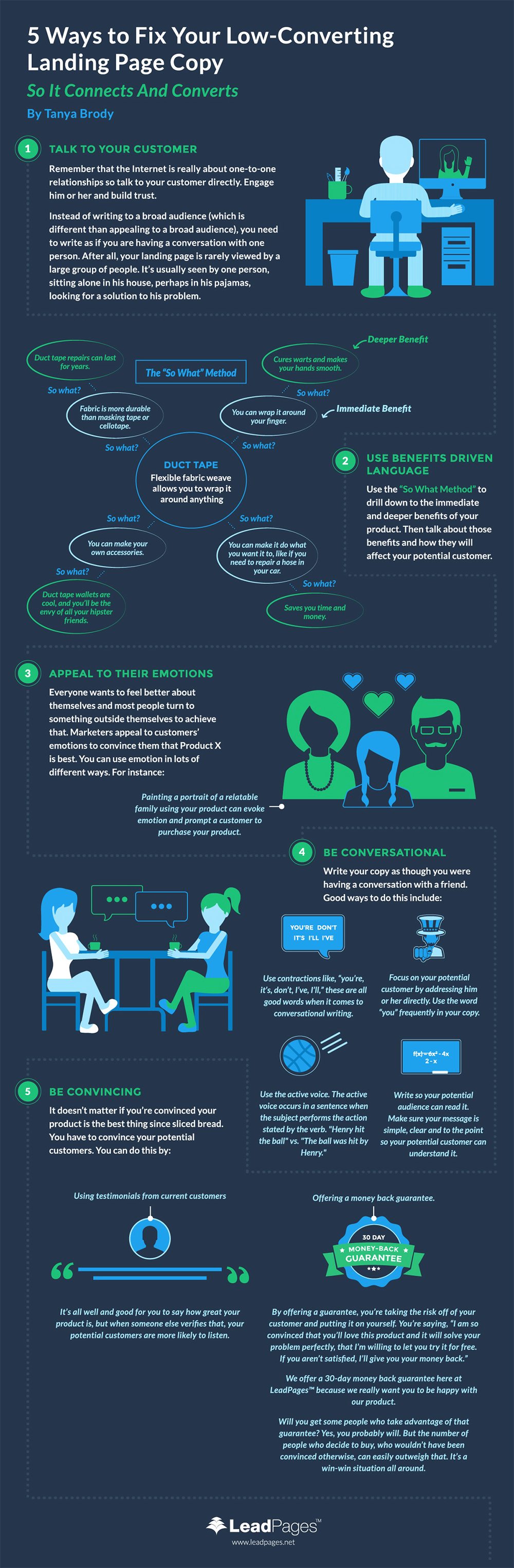
In today’s digital age, a well-crafted website is a fundamental component of a successful business. However, a beautifully designed website alone won’t guarantee success; you need persuasive and effective website copy to convert visitors into customers. If your website is struggling to convert, your copy might be the culprit. But fear not! In this blog post, we’ll explore five proven strategies to fix your low-converting website copy and turn it into a powerful sales tool.
1. Understand Your Audience
The first step in crafting compelling website copy is to understand your target audience. To convert visitors into customers, you must speak directly to their needs, desires, and pain points. Start by creating detailed customer personas that outline the characteristics, preferences, and problems of your ideal customers.
Here are some questions to help you get started:
- What are your customers’ demographics? (Age, gender, location, etc.)
- What are their interests and hobbies?
- What challenges or pain points do they face that your product or service can solve?
- What objections might they have about your product or service?
Once you have a clear understanding of your audience, tailor your website copy to resonate with them. Use language and messaging that addresses their specific needs and concerns. By doing so, you’ll create a more personal and engaging experience for your visitors.
2. Focus on Benefits, Not Features
One common mistake in website copywriting is focusing too much on product features and not enough on the benefits to the customer. While it’s essential to highlight what your product or service offers, it’s equally important to explain how it will improve your customers’ lives.
For example, instead of simply listing the technical specifications of your product, emphasize how it can solve a problem or make life easier for your customers. Use persuasive language to describe the outcomes and benefits they can expect.
Here’s a before-and-after example:
Before: Our new smartphone has a 6-inch HD display, 128GB of storage, and a 20MP camera.
After: Experience stunning visuals, store all your memories without worry, and capture breathtaking photos with our new smartphone.
By focusing on benefits, you make your product or service more relatable and appealing to your audience, increasing the chances of conversion.
3. Craft Compelling Headlines and Subheadings
In the fast-paced world of the internet, you have only a few seconds to capture your visitors’ attention. That’s where compelling headlines and subheadings come into play. Your website’s headlines should be attention-grabbing and communicate the most critical aspects of your offering.
Here are some tips for crafting effective headlines and subheadings:
- Keep them concise and to the point.
- Use action verbs to inspire action.
- Highlight the most significant benefits or solutions.
- Create a sense of urgency or curiosity.
Consider A/B testing different headlines to see which ones resonate best with your audience. A strong headline can make the difference between a visitor bouncing from your site and a visitor becoming a customer.
4. Build Trust with Social Proof
One of the most powerful tools in your conversion toolkit is social proof. Social proof includes reviews, testimonials, case studies, and trust badges that demonstrate the positive experiences of past customers. When visitors see that others have had a positive experience with your product or service, it instills confidence and trust in your brand.
Here are some ways to incorporate social proof into your website:
- Display customer testimonials prominently on your homepage and product pages.
- Showcase ratings and reviews from trusted review platforms.
- Share case studies that highlight real-world success stories.
- Include trust badges or certifications to reassure visitors about security and credibility.
Make sure the social proof you display is genuine and up-to-date. Encourage happy customers to leave reviews, and regularly update your website with new testimonials and success stories.
5. Use Clear Calls to Action (CTAs)
The final piece of the conversion puzzle is your call to action (CTA). A CTA is a clear and compelling directive that tells visitors what action you want them to take next. Whether it’s making a purchase, signing up for a newsletter, or contacting your sales team, a well-crafted CTA guides visitors towards conversion.
Here are some best practices for creating effective CTAs:
- Use action-oriented language, such as “Buy Now,” “Sign Up Today,” or “Get Started.”
- Make your CTA buttons stand out with contrasting colors.
- Keep it concise and to the point.
- Create a sense of urgency or offer an incentive, such as “Limited Time Offer” or “Get 20% Off Today.”
Place CTAs strategically throughout your website, including on product pages, blog posts, and landing pages. Test different CTA variations to see which ones drive the most conversions, and make adjustments accordingly.
Conclusion
Your website copy plays a pivotal role in converting visitors into customers. To fix your low-converting website copy, start by understanding your audience and tailoring your messaging to their needs. Focus on the benefits of your product or service, craft compelling headlines and subheadings, build trust with social proof, and use clear calls to action.
Remember that effective copywriting is an ongoing process. Continuously monitor your website’s performance, gather feedback from customers, and make improvements as needed. With these strategies in place, you’ll be well on your way to turning your website into a high-converting sales machine that drives business growth and success.

Author:
Mark Ford