Are you struggling to make your B2B homepage capture attention and win over potential clients? Want to learn the essential features that turn a homepage into a powerful client-converting tool?
You’ll find some web design basics in this infographic.
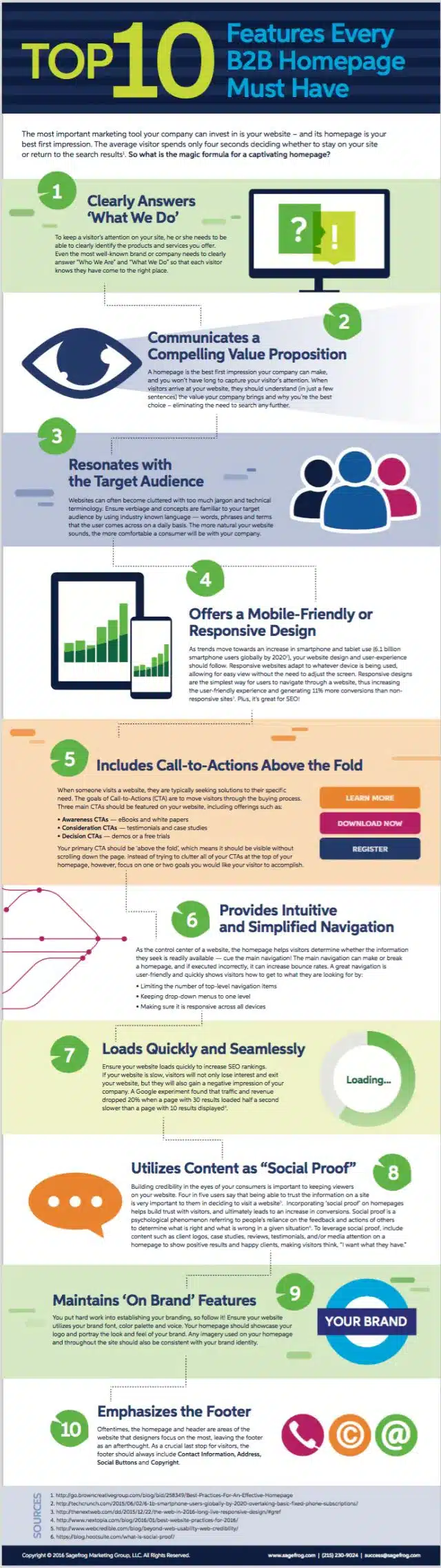
Here’s a summary of what’s covered:
- Clearly Answers “What We Do”
- Communicates a Compelling Value Proposition
- Resonates with the Target Audience
- Offers a Mobile-Friendly or Responsive Design
- Includes Call-to-Actions Above the Fold
- Provides Intuitive and Simplified Navigation
- Loads Quickly and Seamlessly
- Utilises Content as “Social Proof”
- Maintains “On Brand” Features
- Emphasises the Footer
Check out the post below for more.
A homepage is the most important digital asset for any B2B business. It serves as the first impression, the entry point, and often the deciding factor for whether a visitor stays or leaves. With only a few seconds to capture attention, your homepage needs to be clear, persuasive, and easy to use. The key is combining strategy with simplicity, ensuring every element drives visitors toward trust and action.
In this guide, we’ll explore the essential features that make a B2B homepage effective. By following these principles, you can build a website that not only looks professional but also converts visitors into paying clients. Each section will cover one critical feature, explain why it matters, and provide actionable tips you can implement right away.
Clearly Answers “What We Do”
When visitors land on your homepage, they need to know instantly what your business offers. Ambiguity or vague messaging often causes people to click away in search of clarity elsewhere. Even well-known brands cannot assume that visitors already understand what they do. A concise, prominent statement about your services helps anchor the user experience and prevents confusion.
- Place a short tagline or headline that summarises your core offering.
- Use plain language instead of technical jargon to explain your work.
- Ensure the “What We Do” section appears above the fold.
- Support the headline with a brief subtext or graphic for clarity.
Communicates a Compelling Value Proposition
A strong value proposition communicates why clients should choose your company over competitors. Visitors need to understand, in just a few sentences, the unique benefits you deliver. This goes beyond stating your services—it highlights the specific results and advantages your business brings to the table. A clear value proposition eliminates hesitation and reduces the urge to continue searching.
- Write a short, benefit-driven statement that explains your value.
- Focus on outcomes your clients achieve by working with you.
- Avoid overcomplicating the message—keep it short and persuasive.
- Place it near your headline to reinforce your main offering.
Resonates with the Target Audience
Your homepage should feel familiar, relatable, and easy to understand for your target market. If visitors are met with dense jargon, they are less likely to engage with your content. Instead, craft your messaging using words and phrases your audience uses every day. The more natural and conversational the tone, the more trust you will build.
- Research your audience’s pain points and tailor language to them.
- Replace technical terms with everyday expressions where possible.
- Use customer-centric phrasing that addresses their needs directly.
- Test messaging to see which resonates most with your audience.
Offers a Mobile-Friendly or Responsive Design
With mobile usage continuing to rise, responsive design is no longer optional. Your homepage should look and function seamlessly on desktops, tablets, and smartphones. A poor mobile experience creates frustration and causes users to abandon your site. Responsive design not only improves usability but also boosts conversion rates and SEO performance.
- Ensure your site automatically adapts to different screen sizes.
- Test interactive elements like menus and forms on mobile devices.
- Optimise images and graphics to load quickly across platforms.
- Prioritise readability with scalable fonts and clear layouts.
Includes Call-to-Actions Above the Fold
Calls-to-action (CTAs) are the drivers of conversions on your homepage. Placing them above the fold ensures visitors see them before scrolling further. Whether you want users to download a guide, request a demo, or get in touch, the CTA should be obvious and compelling. Multiple types of CTAs can guide users through awareness, consideration, and decision stages.
- Use action-oriented text like “Get Started” or “Download Now.”
- Keep CTAs visually distinct with bold buttons or colours.
- Offer different CTAs for awareness, consideration, and decision.
- Avoid clutter—focus on one or two key actions above the fold.
Provides Intuitive and Simplified Navigation
Navigation can make or break a website experience. If users struggle to find what they need, they are more likely to abandon the site altogether. An intuitive structure ensures visitors locate information quickly without unnecessary clicks. Streamlining navigation reduces bounce rates and helps users move through the buying journey more effectively.
- Limit the number of top-level menu items for clarity.
- Avoid overloading menus with excessive drop-down options.
- Keep navigation consistent across all pages.
- Ensure the menu is responsive and easy to use on mobile devices.
Loads Quickly and Seamlessly
Speed is a critical factor in user experience and search engine ranking. A slow-loading homepage can cause visitors to leave before engaging with your content. People expect websites to load in seconds, and any delay creates frustration. Optimising performance ensures your site is both user-friendly and competitive in search results.
- Compress images and files to reduce loading times.
- Use reliable hosting and content delivery networks (CDNs).
- Minimise the use of heavy scripts that slow performance.
- Test your site regularly with speed-check tools like Google PageSpeed.
Utilises Content as “Social Proof”
Social proof reassures visitors that others have trusted your business and had positive outcomes. This validation builds credibility and encourages new clients to engage with your services. Testimonials, reviews, and case studies are powerful ways to showcase success. The goal is to make visitors think, “If it worked for them, it can work for me.”
- Display testimonials with names, photos, or company logos.
- Showcase case studies that highlight measurable client results.
- Feature recognisable brand logos of past or current clients.
- Use reviews or media mentions to reinforce credibility.
Maintains “On Brand” Features
Consistency in branding creates a professional and trustworthy image. Your homepage should reflect your established brand identity, from colours and fonts to tone of voice. This alignment reinforces recognition and helps build long-term trust. Every design choice and piece of content should feel like it belongs to your brand.
- Use your brand’s official colour palette consistently.
- Include your logo prominently but not overpoweringly.
- Apply fonts and typography that match your identity.
- Align tone of voice with your wider brand communication.
Emphasises the Footer
While often overlooked, the footer is a valuable area of your homepage. It serves as a hub for essential information, giving visitors easy access without cluttering the main design. A well-designed footer helps with navigation, reinforces credibility, and ensures users can find key details. It should be functional, informative, and professional.
- Include company contact details and office addresses.
- Add social media links to encourage further engagement.
- Provide quick links to important internal pages.
- Display copyright and legal information clearly.
Conclusion
Your homepage is more than just the front page of your website—it is the digital face of your business. In just seconds, visitors decide whether to stay, explore, or move on. By implementing these ten essential features, you create a homepage that is not only visually appealing but also strategically designed to win clients.
From clarity in messaging and compelling value propositions to responsive design and social proof, every element contributes to building trust and driving conversions. When your homepage combines speed, simplicity, and brand consistency, it becomes a powerful tool that turns first impressions into lasting client relationships.

Author:
Mark Ford